Edexcel Jan 2014 (IAL) Paper 5 Q24

Answers available below

SECTION C Answer ALL the questions. Write your answers in the spaces provided. 24 Phthalates The benzene dicarboxylic acids and their esters are important industrial compounds. The structures of two of these acids are shown below. HO C C OH O O HO OH benzene-1,2-dicarboxylic acid benzene-1,4-dicarboxylic acid Benzene-1,2-dicarboxylic acid is manufactured by the catalytic oxidation of naphthalene to phthalic anhydride which is then hydrolysed. This reaction sequence is summarised below. OH OH naphthalene phthalic anhydride benzene-1,2- dicarboxylic acid The use of naphthalene as a source of these compounds gave rise to the common names, phthalic acid for benzene-1,2-dicarboxylic acid and terephthalic acid for benzene-1,4-dicarboxylic acid. The alkyl esters derived from benzene-1,2-dicarboxylic acid are known as phthalates. Phthalates are used as plasticisers to increase the flexibility of many common plastics. However, some phthalates are known to be endocrine disruptors and recent studies have raised concerns about their role in the fall in human fertility rates. Because phthalates are used in making plastic drinks bottles and leach readily out of the structure, they are easily ingested. The polyester Terylene is derived from benzene-1,4-dicarboxylic acid and ethane-1,2-diol. 20 *P42993A02028*<br />
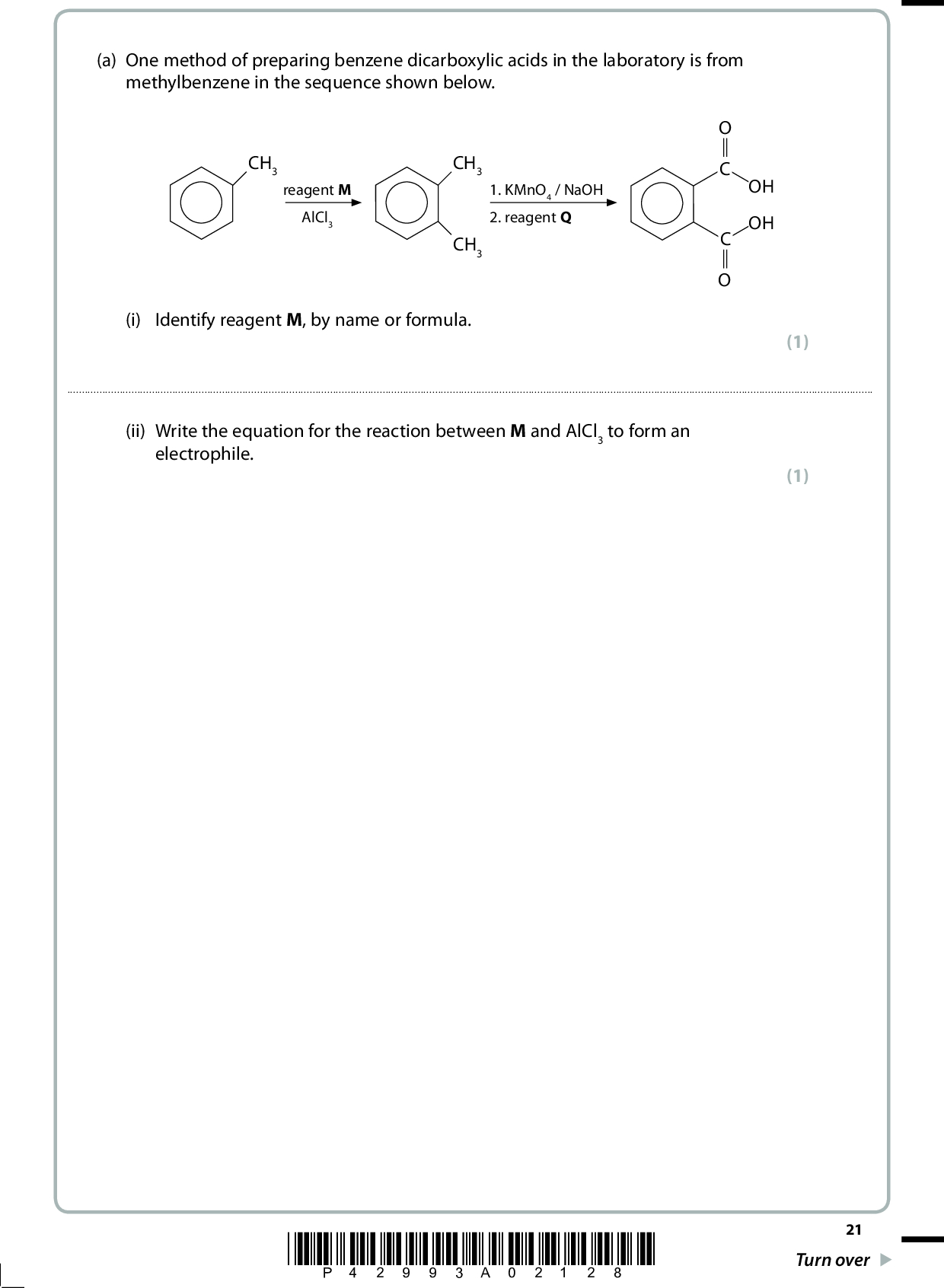
 (a) One method of preparing benzene dicarboxylic acids in the laboratory is from methylbenzene in the sequence shown below. CH3 reagent M AlCl3 CH3 CH3 1. KMnO4 / NaOH 2. reagent Q (i) Identify reagent M, by name or formula. OH OH (1)(ii) Write the equation for the reaction between M and AlCl3 to form an electrophile. (1) *P42993A02128* 21 Turn over<br />
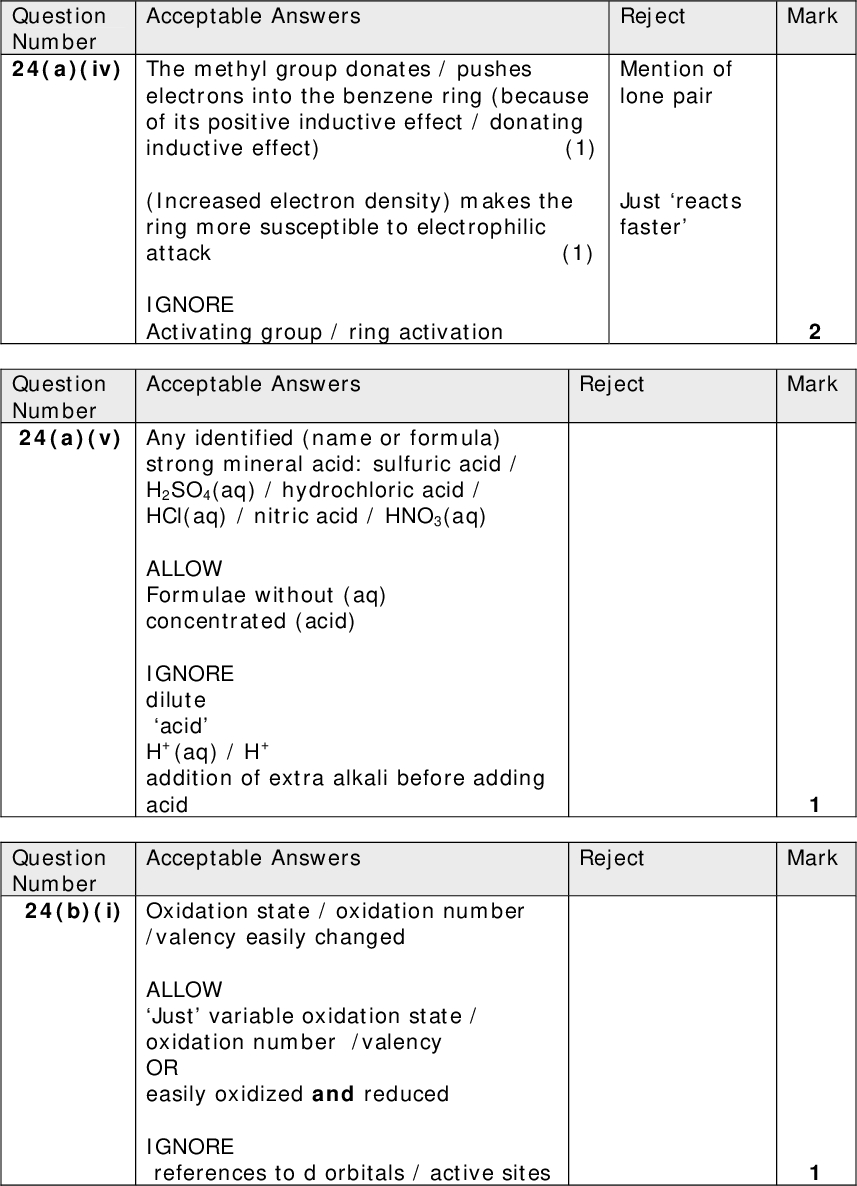
 (iii) Give the mechanism for the reaction of methylbenzene with your electrophile in (a)(ii). (iv) Suggest why methylbenzene reacts faster than benzene in this type of reaction. (3) (2)(v) In the second step of the synthesis, the potassium manganate(VII) is an oxidizing agent. Suggest the identity of reagent Q, which is added when oxidation is complete. (1)22 *P42993A02228*<br />
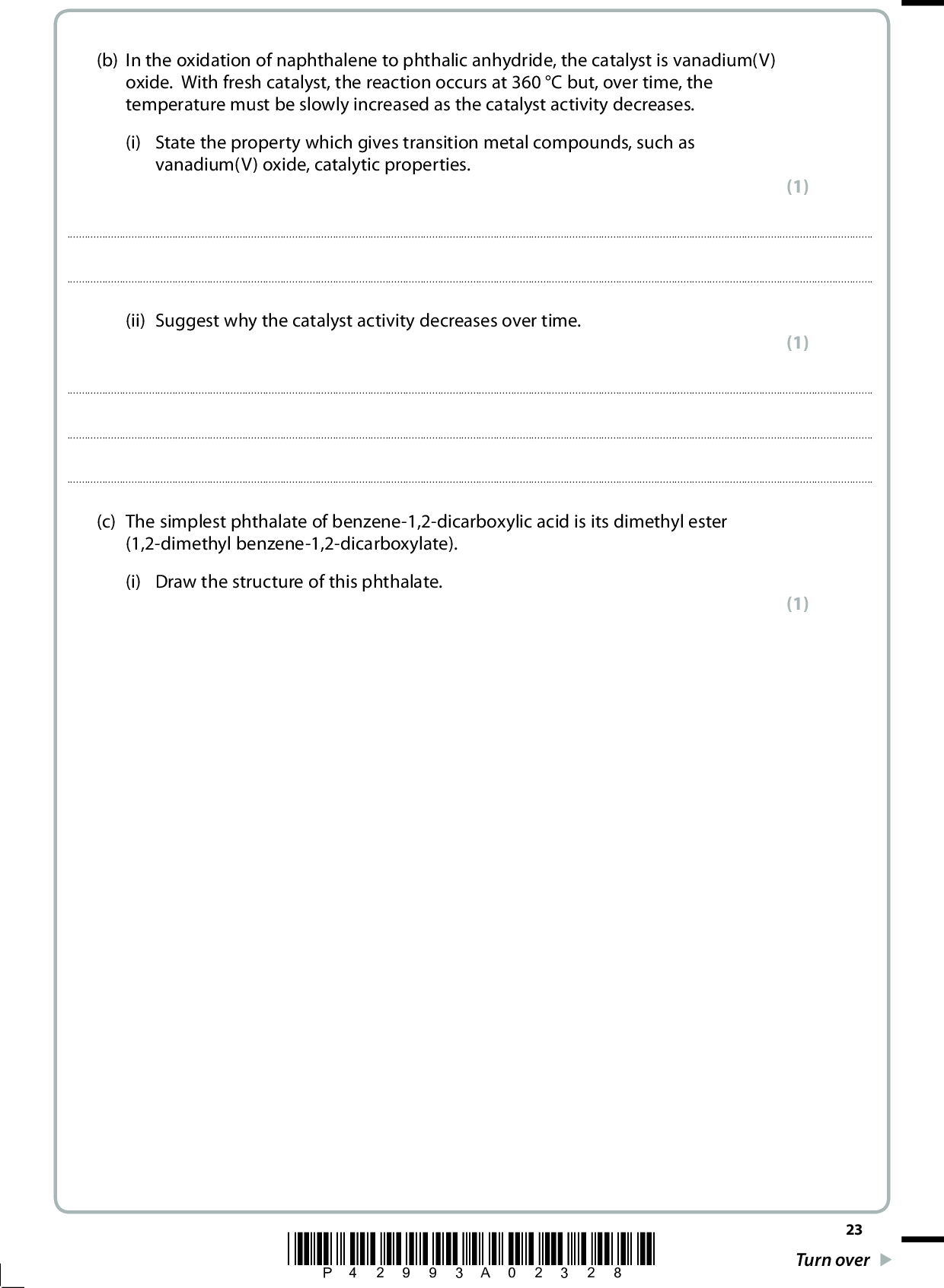
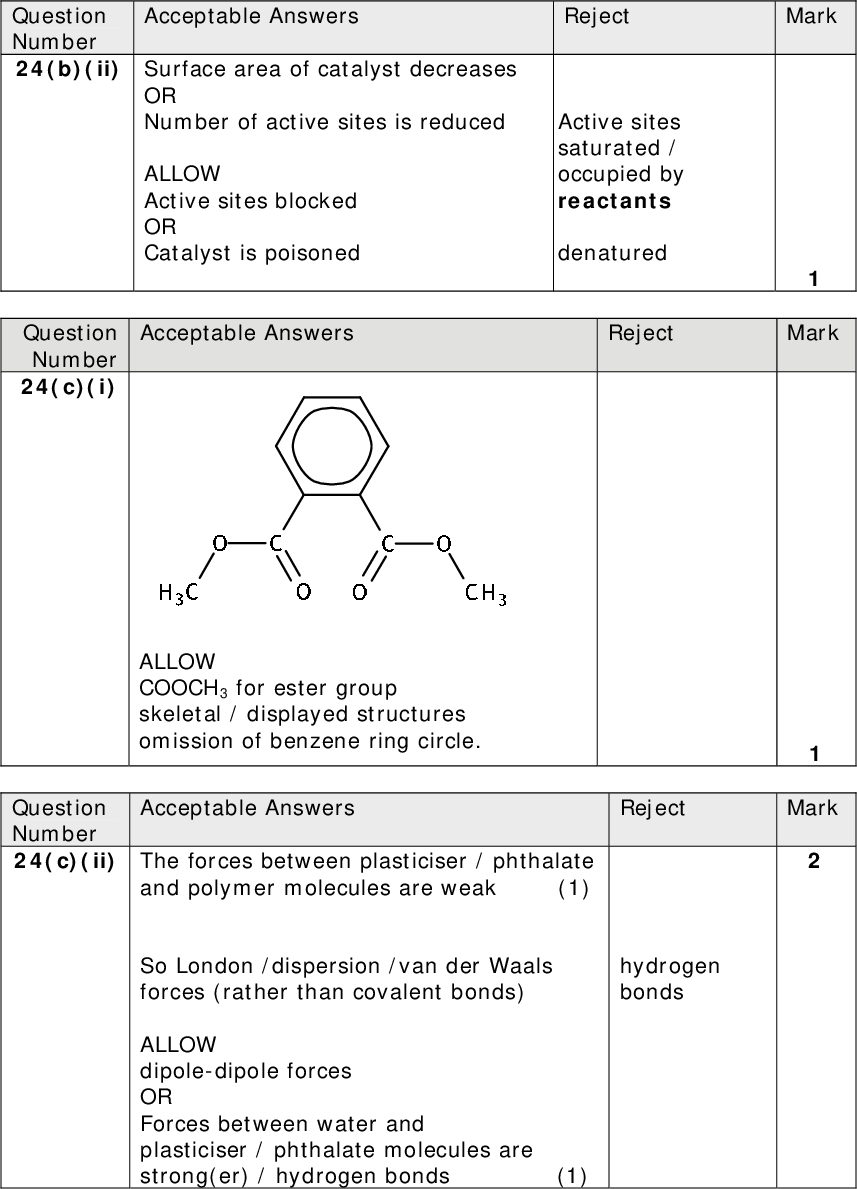
 (b) In the oxidation of naphthalene to phthalic anhydride, the catalyst is vanadium(V) oxide. With fresh catalyst, the reaction occurs at 360 C but, over time, the temperature must be slowly increased as the catalyst activity decreases. (i) State the property which gives transition metal compounds, such as vanadium(V) oxide, catalytic properties. (1)(ii) Suggest why the catalyst activity decreases over time. (1)(c) The simplest phthalate of benzene-1,2-dicarboxylic acid is its dimethyl ester (1,2-dimethyl benzene-1,2-dicarboxylate). (i) Draw the structure of this phthalate. (1) *P42993A02328* 23 Turn over<br />
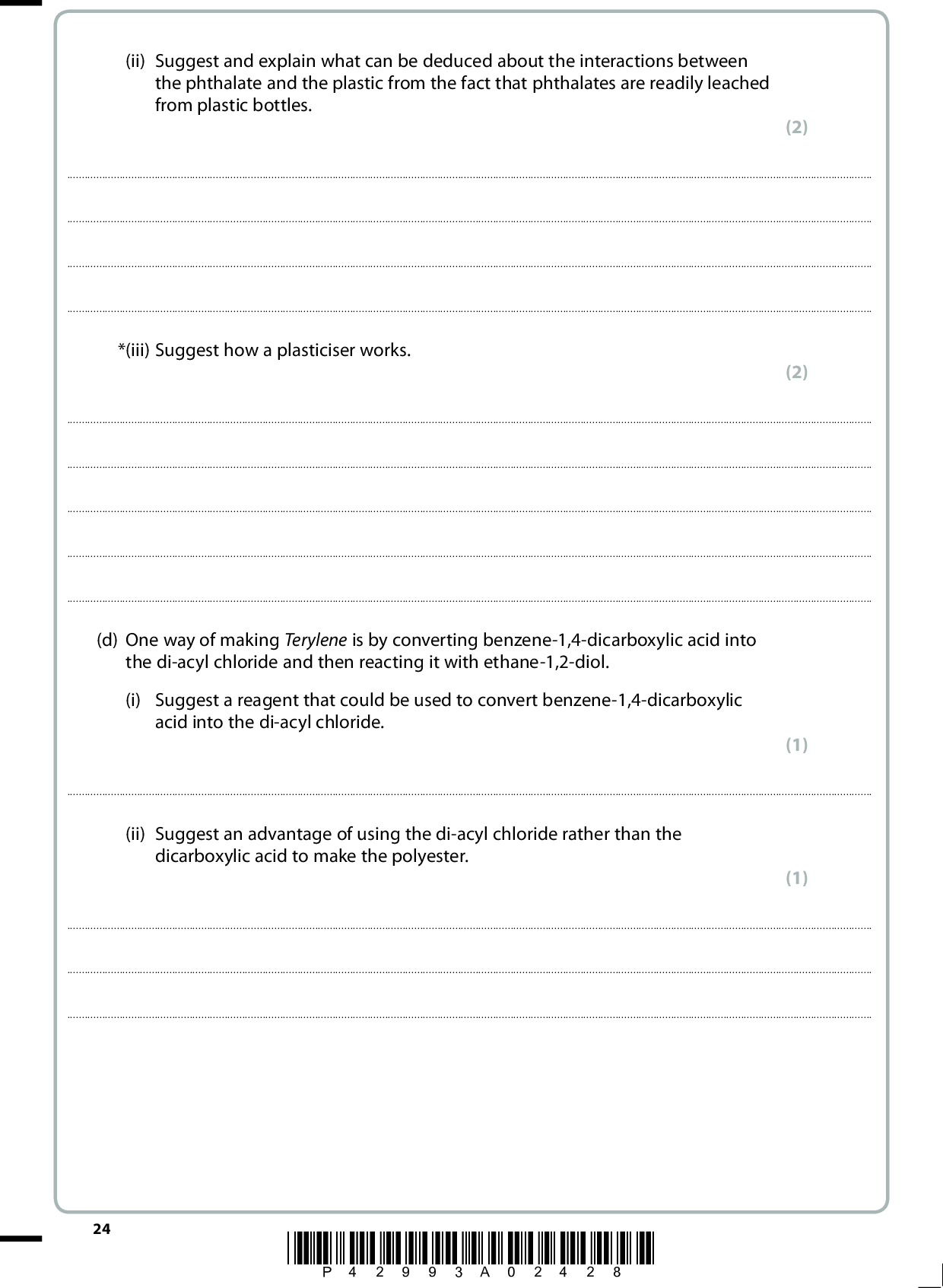
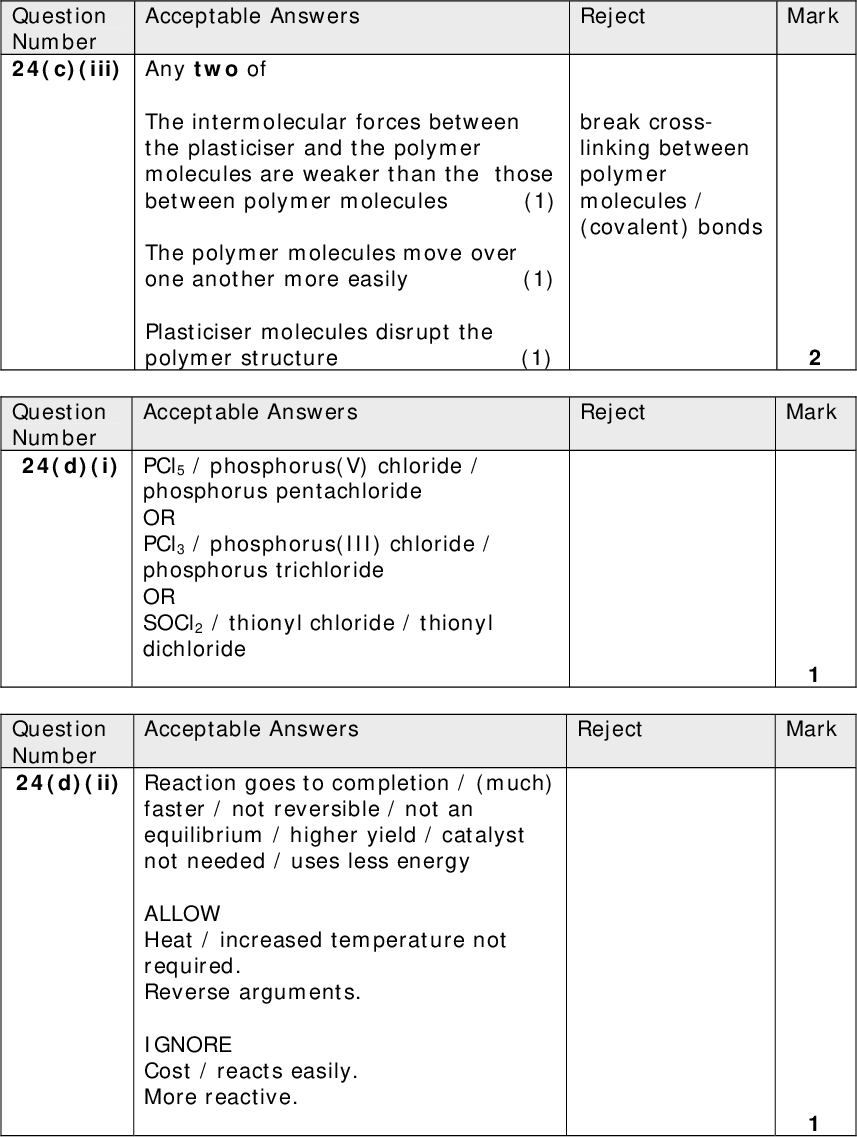
 (ii) Suggest and explain what can be deduced about the interactions between the phthalate and the plastic from the fact that phthalates are readily leached from plastic bottles. (2)*(iii) Suggest how a plasticiser works. (2)(d) One way of making Terylene is by converting benzene-1,4-dicarboxylic acid into the di-acyl chloride and then reacting it with ethane-1,2-diol. (i) Suggest a reagent that could be used to convert benzene-1,4-dicarboxylic acid into the di-acyl chloride. (1)(ii) Suggest an advantage of using the di-acyl chloride rather than the dicarboxylic acid to make the polyester. (1)24 *P42993A02428*<br />
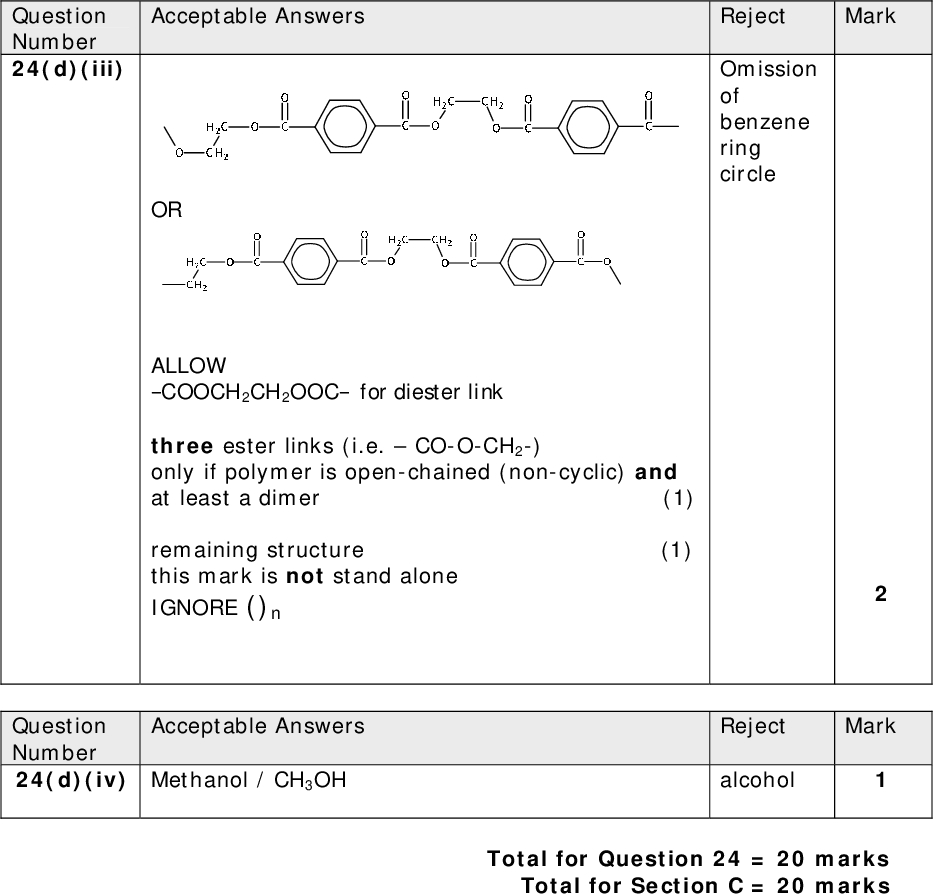
 (iii) Draw the structure of the polyester, Terylene, showing two repeat units. (iv) In practice, the manufacture of Terylene involves a process called ester exchange in which ethane-1,2-diol reacts with the dimethyl ester of benzene-1,4-dicarboxylic acid. What would be the by-product of this reaction? (2) (1)(Total for Question 24 = 20 marks) TOTAL FOR SECTION C = 20 MARKS TOTAL FOR PAPER = 90 MARKS *P42993A02528* 25<br />

Show answer