Edexcel Jun 2017 (IAL) Paper 1 Q23

Answers available below

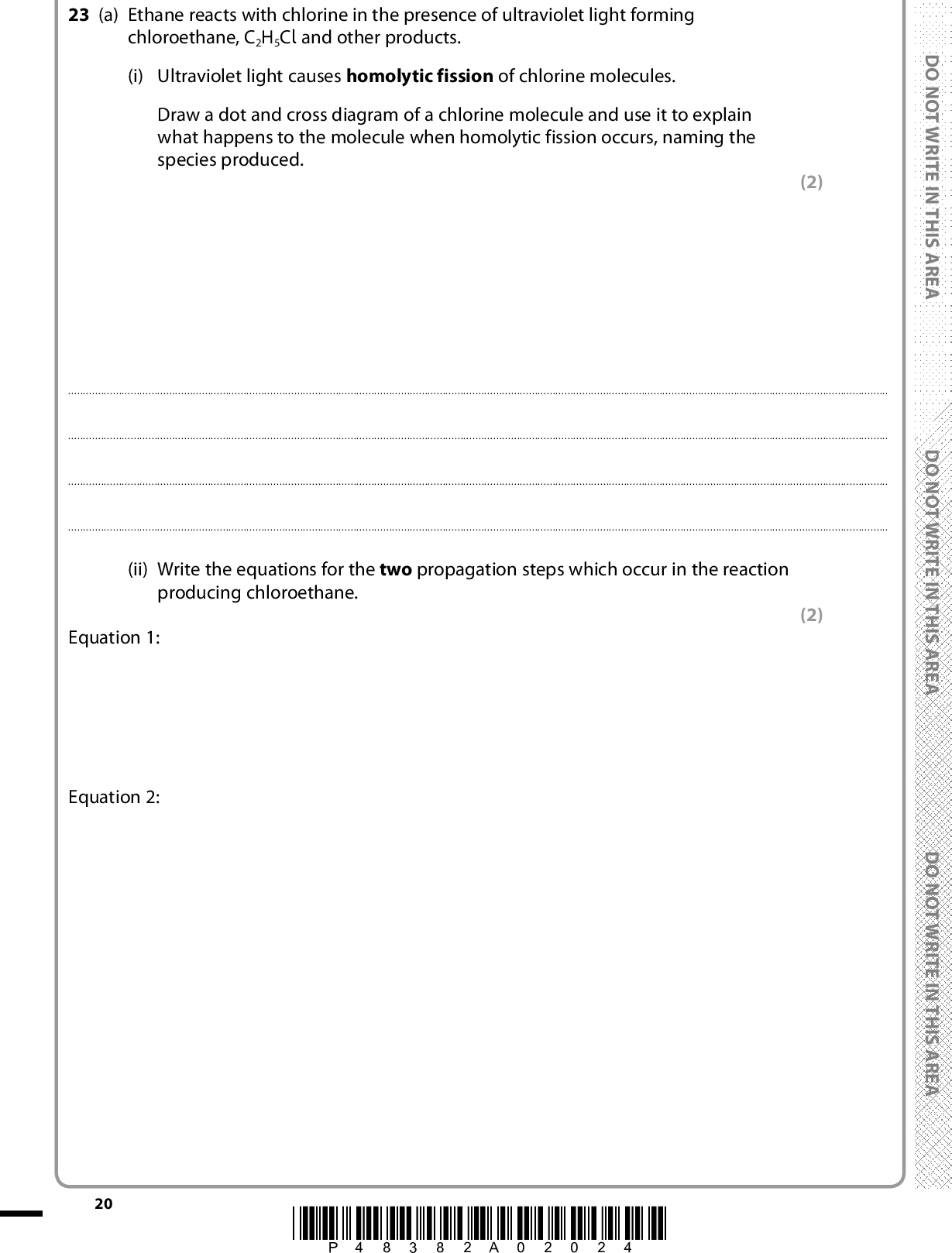
23 (a) Ethane reacts with chlorine in the presence of ultraviolet light forming chloroethane, C2H5Cl and other products. (i) Ultraviolet light causes homolytic fission of chlorine molecules. Draw a dot and cross diagram of a chlorine molecule and use it to explain what happens to the molecule when homolytic fission occurs, naming the species produced. (2)(ii) Write the equations for the two propagation steps which occur in the reaction producing chloroethane. Equation 1: Equation 2: (2) 20 *P48382A02024* D O N O T W R I T E I N T H I S A R E A D O N O T W R I T E I N T H I S A R E A D O N O T W R I T E I N T H I S A R E A<br />
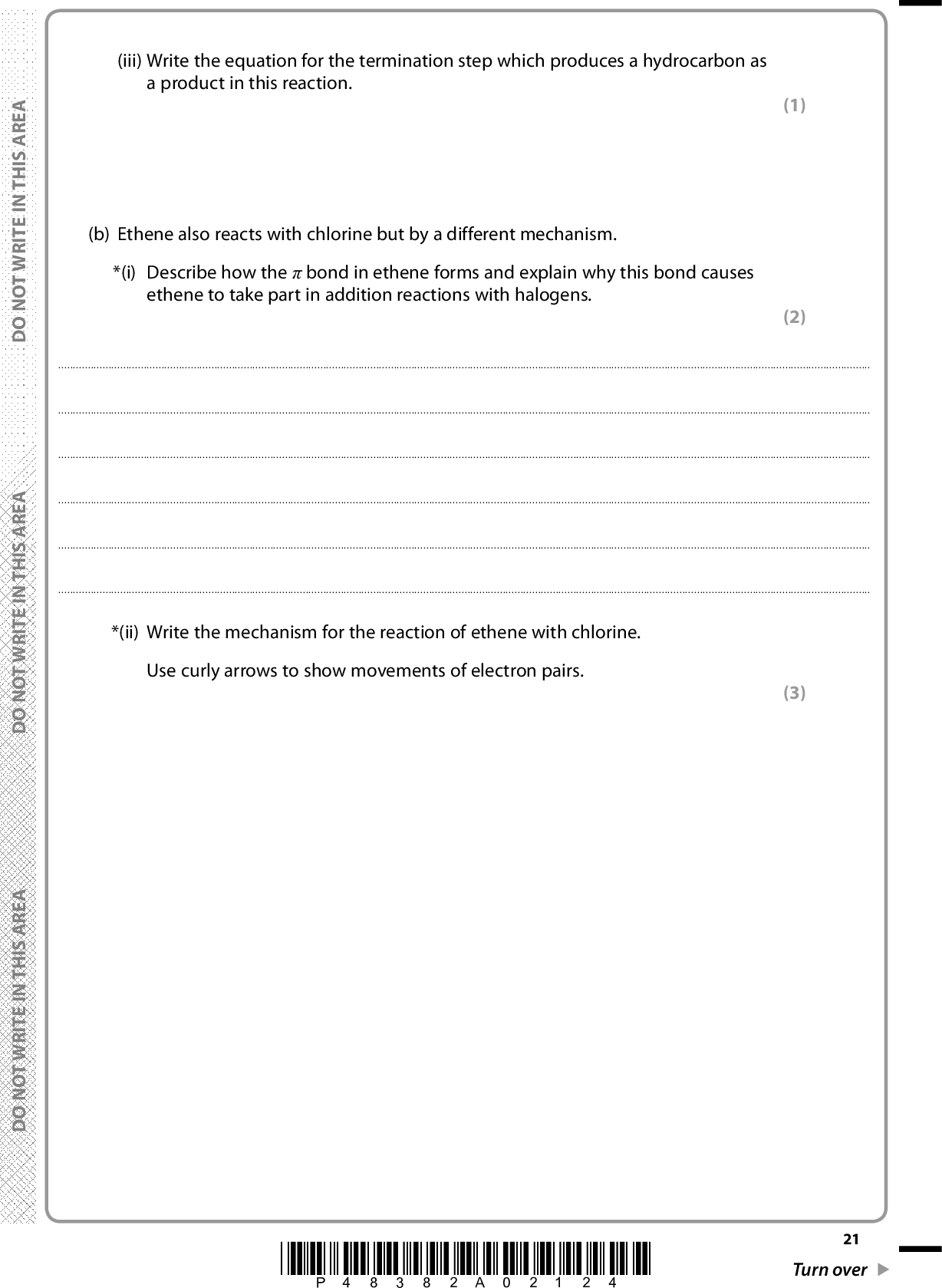
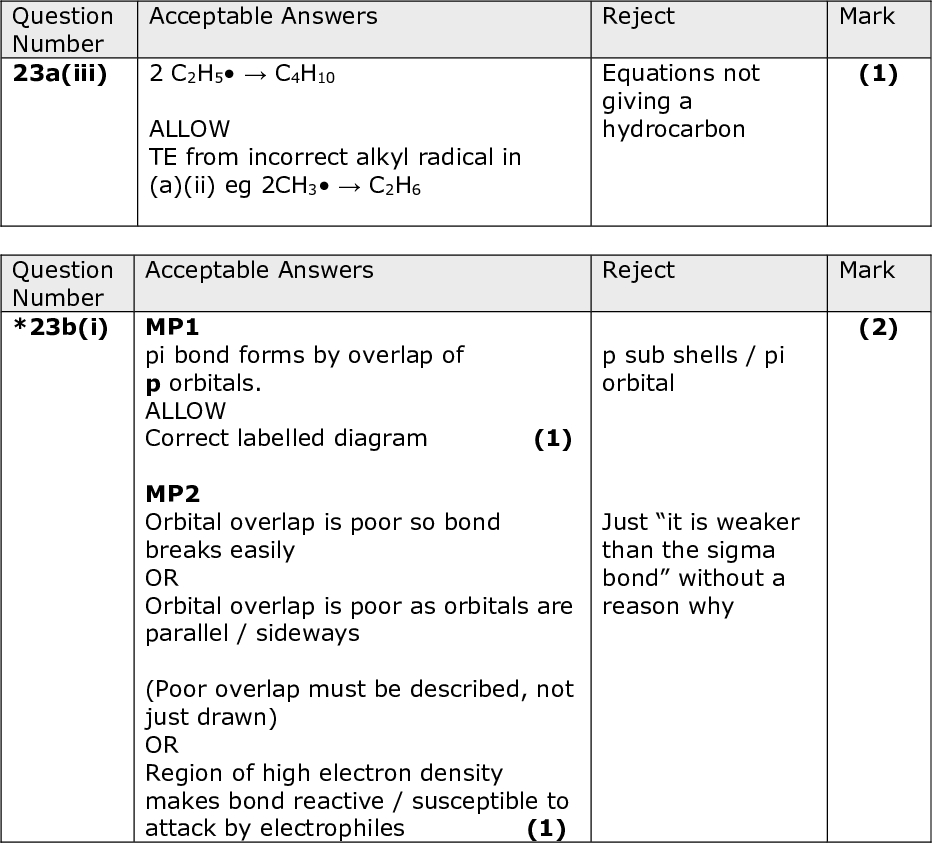
 (iii) Write the equation for the termination step which produces a hydrocarbon as a product in this reaction. (b) Ethene also reacts with chlorine but by a different mechanism. *(i) Describe how the (cid:652) bond in ethene forms and explain why this bond causes ethene to take part in addition reactions with halogens. (1) (2)*(ii) Write the mechanism for the reaction of ethene with chlorine. Use curly arrows to show movements of electron pairs. (3) A E R A S I H T N I E T I R W T O N O D A E R A S I H T N I E T I R W T O N O D A E R A S I H T N I E T I R W T O N O D *P48382A02124* 21 Turn over<br />
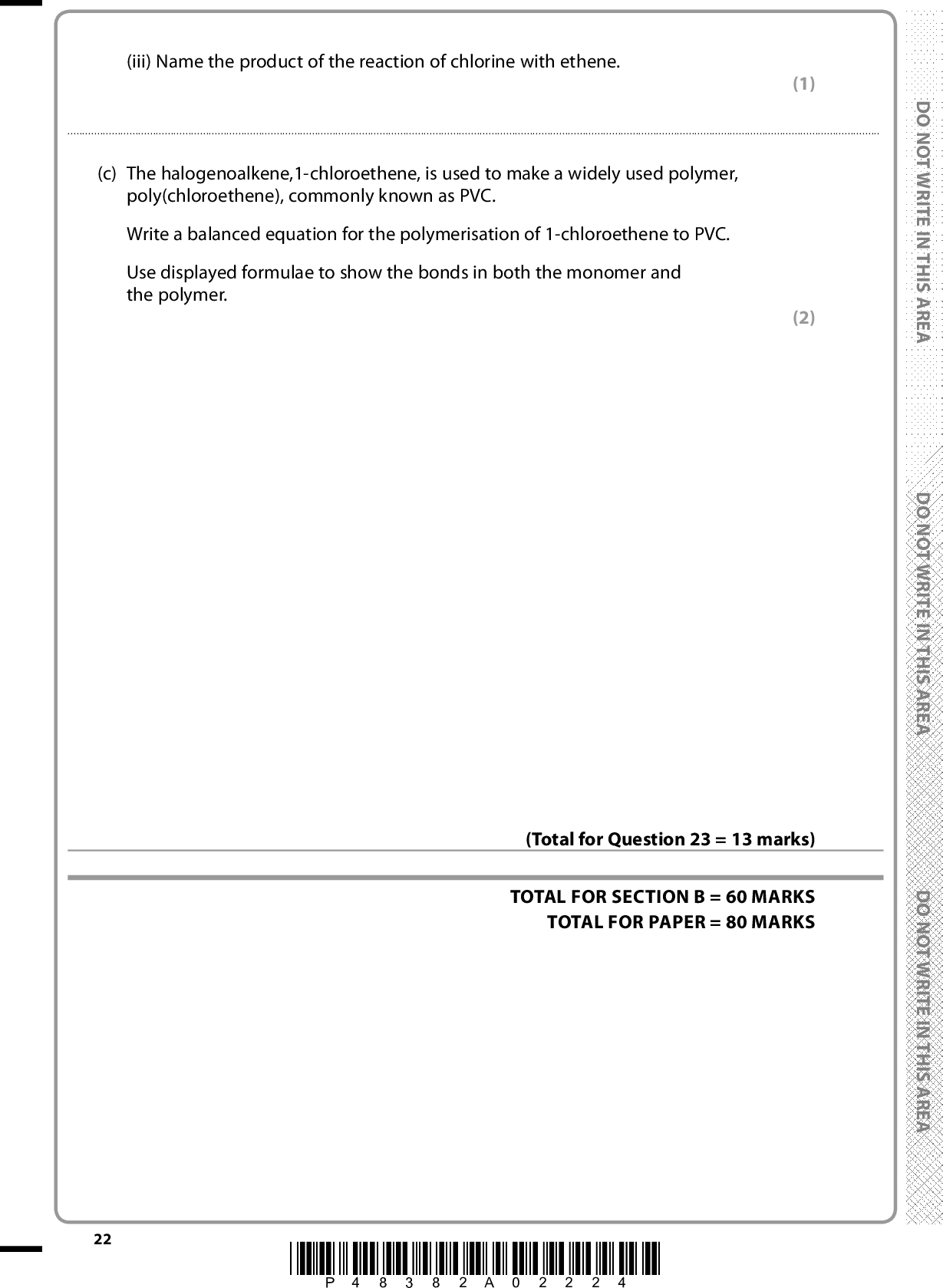
 (iii) Name the product of the reaction of chlorine with ethene. (1)(c) The halogenoalkene,1-chloroethene, is used to make a widely used polymer, poly(chloroethene), commonly known as PVC. Write a balanced equation for the polymerisation of 1-chloroethene to PVC. Use displayed formulae to show the bonds in both the monomer and the polymer. (2) (Total for Question 23 = 13 marks) TOTAL FOR SECTION B = 60 MARKS TOTAL FOR PAPER = 80 MARKS 22 *P48382A02224* D O N O T W R I T E I N T H I S A R E A D O N O T W R I T E I N T H I S A R E A D O N O T W R I T E I N T H I S A R E A<br />

Show answer