Edexcel Jun 2017 (IAL) Paper 1 Q20

Answers available below

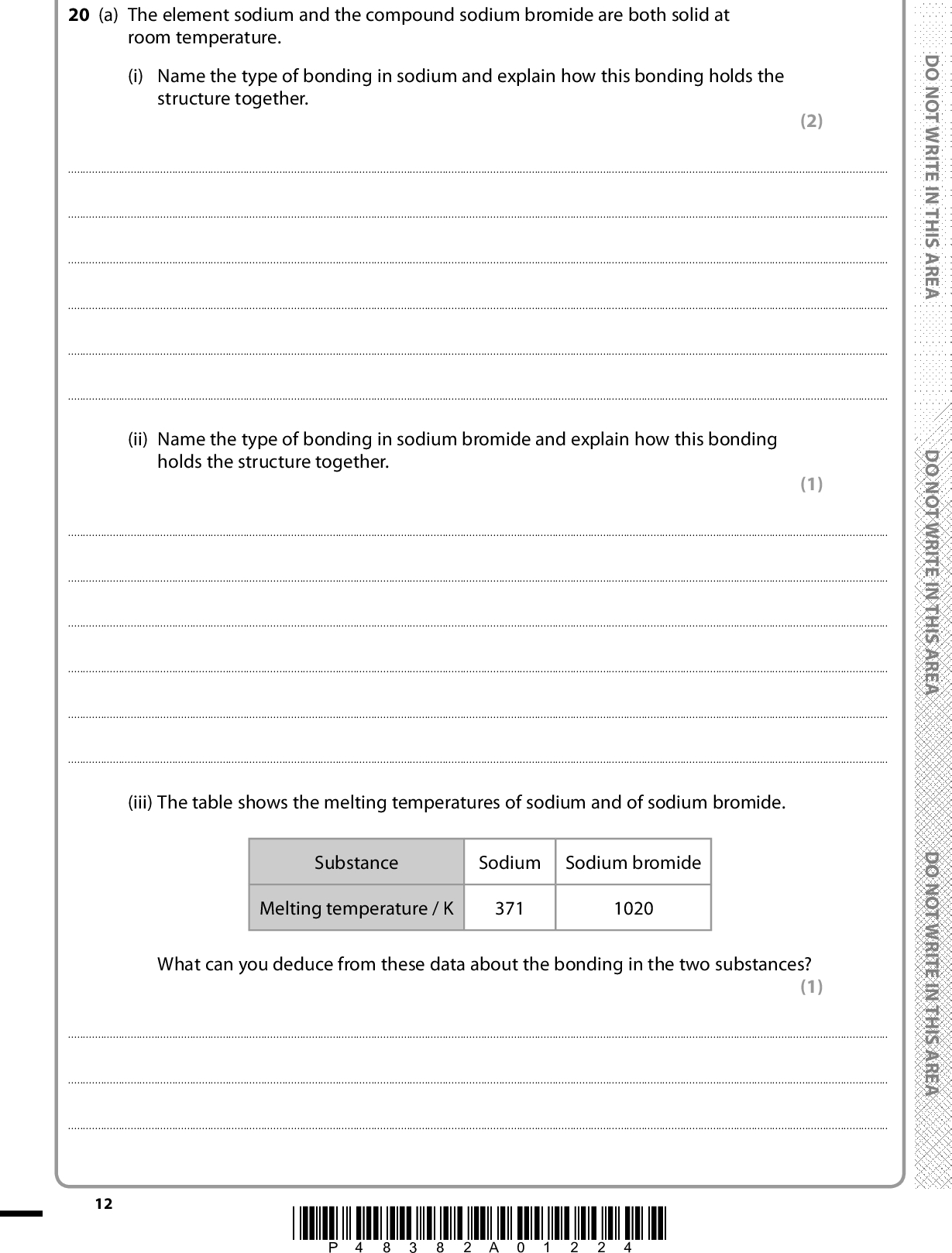
20 (a) The element sodium and the compound sodium bromide are both solid at room temperature. (i) Name the type of bonding in sodium and explain how this bonding holds the structure together. (2)(ii) Name the type of bonding in sodium bromide and explain how this bonding holds the structure together. (1)(iii) The table shows the melting temperatures of sodium and of sodium bromide. Substance Sodium Sodium bromide Melting temperature / K 371 1020 What can you deduce from these data about the bonding in the two substances? (1)12 *P48382A01224* D O N O T W R I T E I N T H I S A R E A D O N O T W R I T E I N T H I S A R E A D O N O T W R I T E I N T H I S A R E A<br />
 (iv) Name one physical property, other than melting or boiling temperature, in which sodium and sodium bromide differ due to the difference in their bonding. Describe how this property differs for each of the two substances. (2)(b) The ammonium ion, NH4 +, contains covalent bonds and a dative covalent bond. (i) Describe the difference between a covalent bond and a dative covalent bond. (2)(ii) Draw a dot and cross diagram for an ammonium ion. Use the symbol X for electrons from the hydrogen atoms and (cid:404) for electrons from the outer shell of the nitrogen atom. (2) (iii) Suggest how an electron density map of ammonium chloride would provide evidence for the presence of ions in the compound. (1)A E R A S I H T N I E T I R W T O N O D A E R A S I H T N I E T I R W T O N O D A E R A S I H T N I E T I R W T O N O D(Total for Question 20 = 11 marks) *P48382A01324* 13 Turn over<br />

Show answer