Skip to content
OCR A Jun 2017 Paper 1 Q23
Answers available below
Show answer
Question
16
17
18
19
20
21
22
23
24
25

![23 This question is about reactions of ions and compounds of transition elements. 25 (a) The flowchart shows reactions of the complex ion [Cu(H2O)6]2+. In the boxes, write down the formulae of the species responsible for the observations. (i)yellow solution Reaction 1 HCl(aq) [Cu(H2O)6]2+ pale blue solution NH3(aq) Reaction 2 KI(aq)pale blue precipitate NH3(aq) excesswhite solidbrown solutiondeep blue solution (ii) Name the type of reaction for Reaction 1 and Reaction 2. Reaction 1Reaction 2[2] [5]<br />
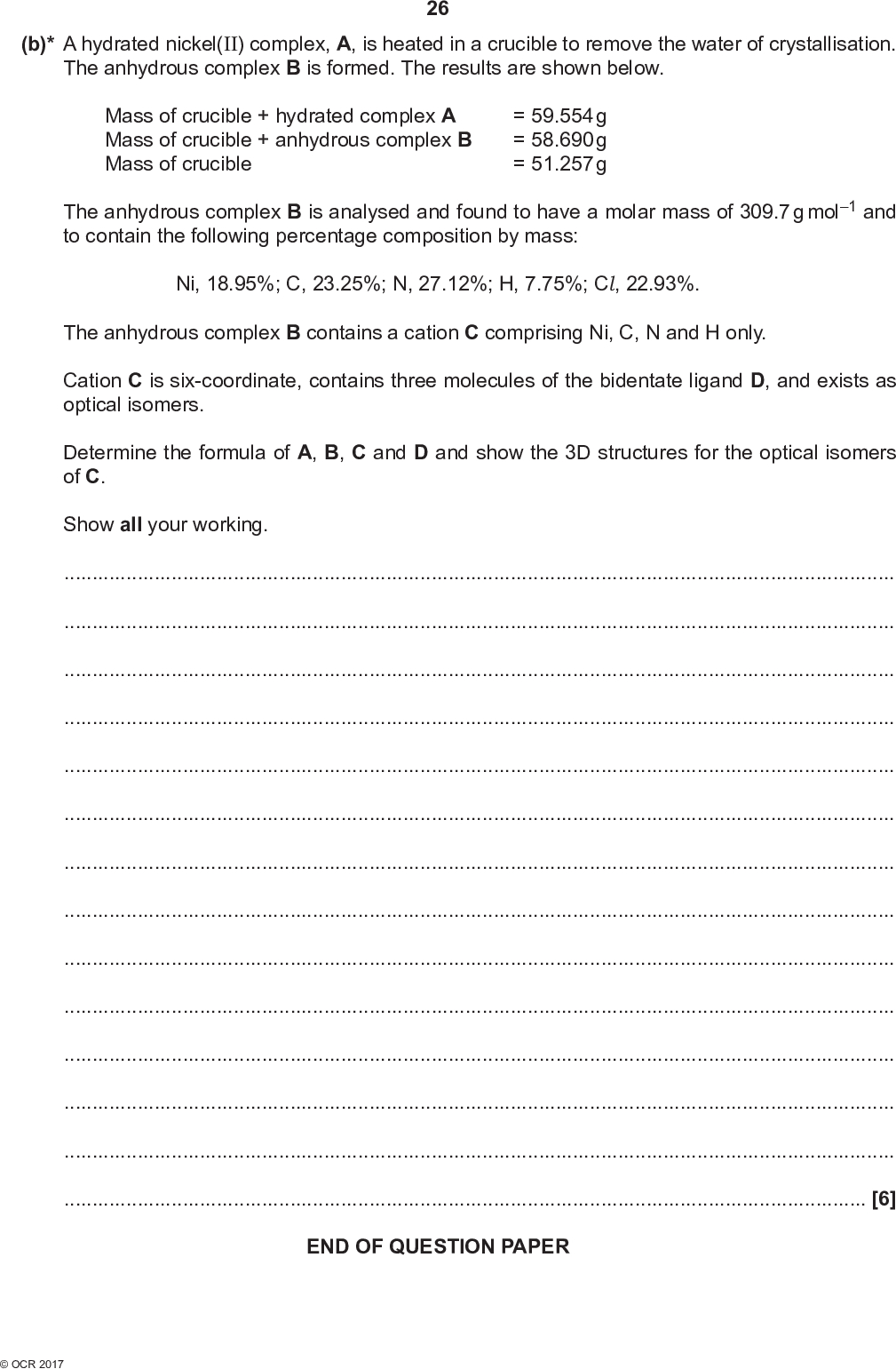
(b)* A hydrated nickel(II) complex, A, is heated in a crucible to remove the water of crystallisation. The anhydrous complex B is formed. The results are shown below. 26 Mass of crucible + hydrated complex A Mass of crucible + anhydrous complex B Mass of crucible = 59.554 g = 58.690 g = 51.257 g The anhydrous complex B is analysed and found to have a molar mass of 309.7 g mol1 and to contain the following percentage composition by mass: Ni, 18.95%; C, 23.25%; N, 27.12%; H, 7.75%; Cl, 22.93%. The anhydrous complex B contains a cation C comprising Ni, C, N and H only. Cation C is six-coordinate, contains three molecules of the bidentate ligand D, and exists as optical isomers. Determine the formula of A, B, C and D and show the 3D structures for the optical isomers of C. Show all your working.[6] END OF QUESTION PAPER<br />](https://learnah.org/wp-content/uploads/2018/08/June_2017_QP_-_Paper_1_OCR_Chemistry_A_A-Level_23-0.jpg)
![H432A/01 Question 23 (a) (i) CuCl4 2 OR [CuCl4]2Answer Mark Scheme June 2017 Marks Cu(OH)2pale blue precipitate [Cu(NH3)4(H2O)2]2+deep blue solution Guidance 2 ALLOW Cu(Cl)4 ALLOW Cu(OH)2(H2O)4 Brackets required for [Cu(NH3)4(H2O)2]2+ NOTE: Take great care to check that subscripted numbers and brackets are correct ALLOW ligand exchange ALLOW reduction AND oxidation ALLOW precipitation (ii) Reaction 1: ligand substitutionyellow solution CuIwhite solid brown solution I2Reaction 2: redox21<br />
H032/01 Question (b)* Mark Scheme June 2017 Answer Please refer to the marking instructions on page 5 of this mark scheme for guidance on how to mark this question. Level 3 (56 marks) A comprehensive conclusion using all data to obtain correct formulae for A, B, C and D AND optical isomers shown There is a well-developed line of reasoning which is clear and logically structured with use of 3D structures for both optical isomers of C, use of wedges and bonding to N. The information presented is relevant and substantiated. Level 2 (34 marks) Reaches a sound conclusion for the formula of B AND obtains the correct formula of the hydrated complex A OR a 3D diagram of one optical isomer of cation C There is a line of reasoning and supported by some evidence. Calculations are clear and can be followed to obtain correct conclusions. 3D diagram, if present, should use wedges mostly correctly. Formula of A to show water separately or formula of C to show ligands separately, as appropriate. Level 1 (12 marks) Reaches a simple conclusion to obtain the correct formula of anhydrous complex B OR shows that A contains 2H2O There is an attempt at a logical structure with a line of reasoning. The information is in the most part relevant. Attempts more than one part of the problem. 0 marks No response or no response worthy of credit. 22 Marks Guidance Indicative scientific points may include: 1. Formula of anhydrous complex B NiC6N6H24Cl2 Example of working Ni : C : N : H : Cl 22.93 35.5 18.95 58.7 23.25 12.0 27.12 14.0 7.75 1.00 There may be other methods 2. Formula of hydrated complex A NiC6N6H24Cl22H2O OR NiC6N6H24Cl2(H2O)2 Example of working n(anhydrous salt) = = 0.02400 (mol) 7.433 309.7 n(H2O) = = 0.04800 (mol)0.864 18.0 There may be other methods 3. Formula of cation C [NiC6N6H24]2+ OR [Ni(H2NCH2CH2NH2)3)]2+ (could be in structures 2+ charge can be shown on cation OR optical isomers (i.e. seen somewhere)Bidentate ligand D H2NCH2CH2NH2 or displayed so that structure is clearly unambiguous.Optical isomers Accuracy of structures<br />
H032/01 Question Mark Scheme June 2017 Answer Marks Guidance Bonding shown from Ni to N of H2NCH2CH2NH2 ALLOW CH3CH(NH2)2 for ligand For H2NCH2CH2NH2 in optical isomers, ALLOW CC without Hs and Each structure to contain 2 out wedges, 2 in wedges and 2 lines in plane of paper OR 4 lines, 1 out wedge and 1 in wedge: Bond into paper can be shown as: Total 13 23<br />](https://learnah.org/wp-content/uploads/2018/08/June_2017_MS_-_Paper_1_OCR_Chemistry_A_A-Level_23-0.jpg)

