Skip to content
Edexcel Jun 2016 (IAL) Paper 4 Q
Answers available below
Show answer
Question
12
13
14
15


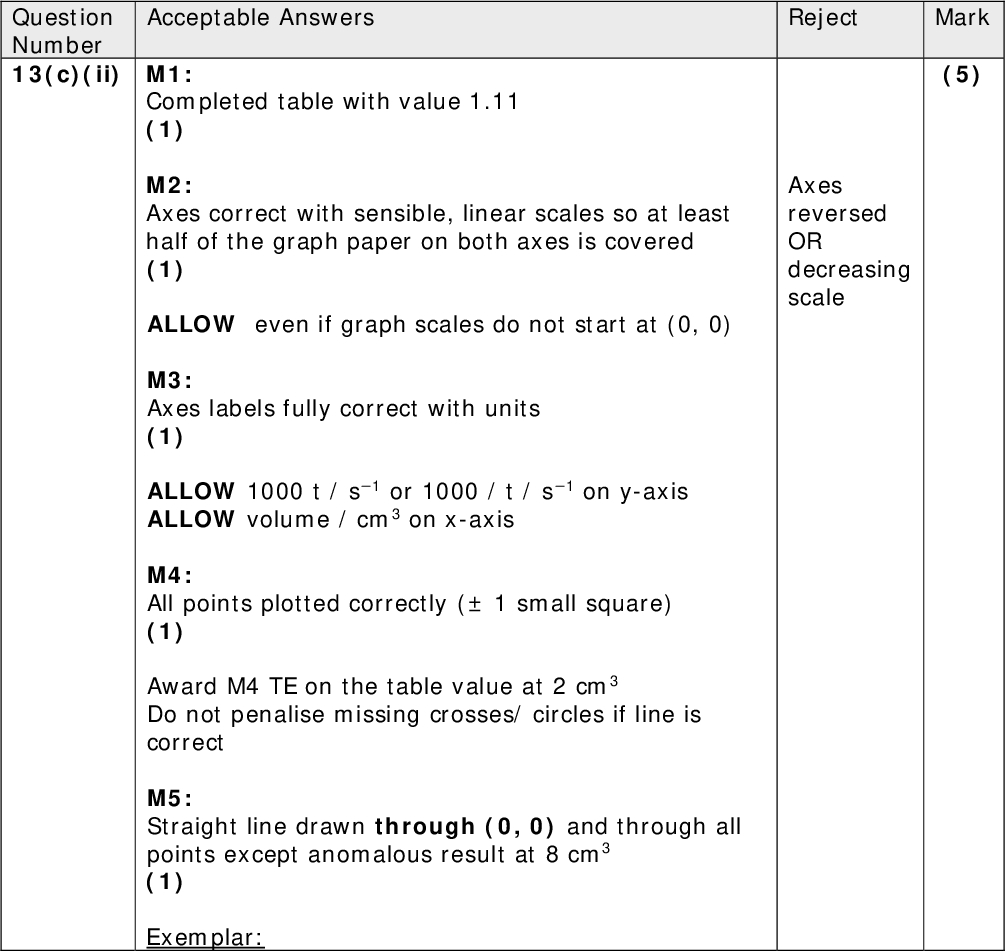
![Question Number 13(a) Question Number 13(b) Acceptable Answers blue-black / blue / black (complex) colour would never form OR no colour change would be seen OR no (excess) iodine would form OR no iodine left to react with starch OR iodine would be reduced back to iodide OR iodine would react with hydrogensulfate as soon as it forms IGNORE Just hydrogensulfate would not get used up Acceptable Answers So the kinetics of reaction 1 can be studied OR iodine complex colour would form too soon / solution would go blue-black too soon IGNORE reference to RDS Reject Mark Any other colours (1) Reject Mark (1) Reject Mark (1) Acceptable Answers Question Number 13(c)(i) Because temperature affects reaction rate ALLOW Increase in temperature increases reaction rate or reverse argument for decreasing temperature OR To keep the rate of reaction the same OR So no change in rate constant IGNORE references to validity, reliability or fair test or so temperature is not a variable<br />
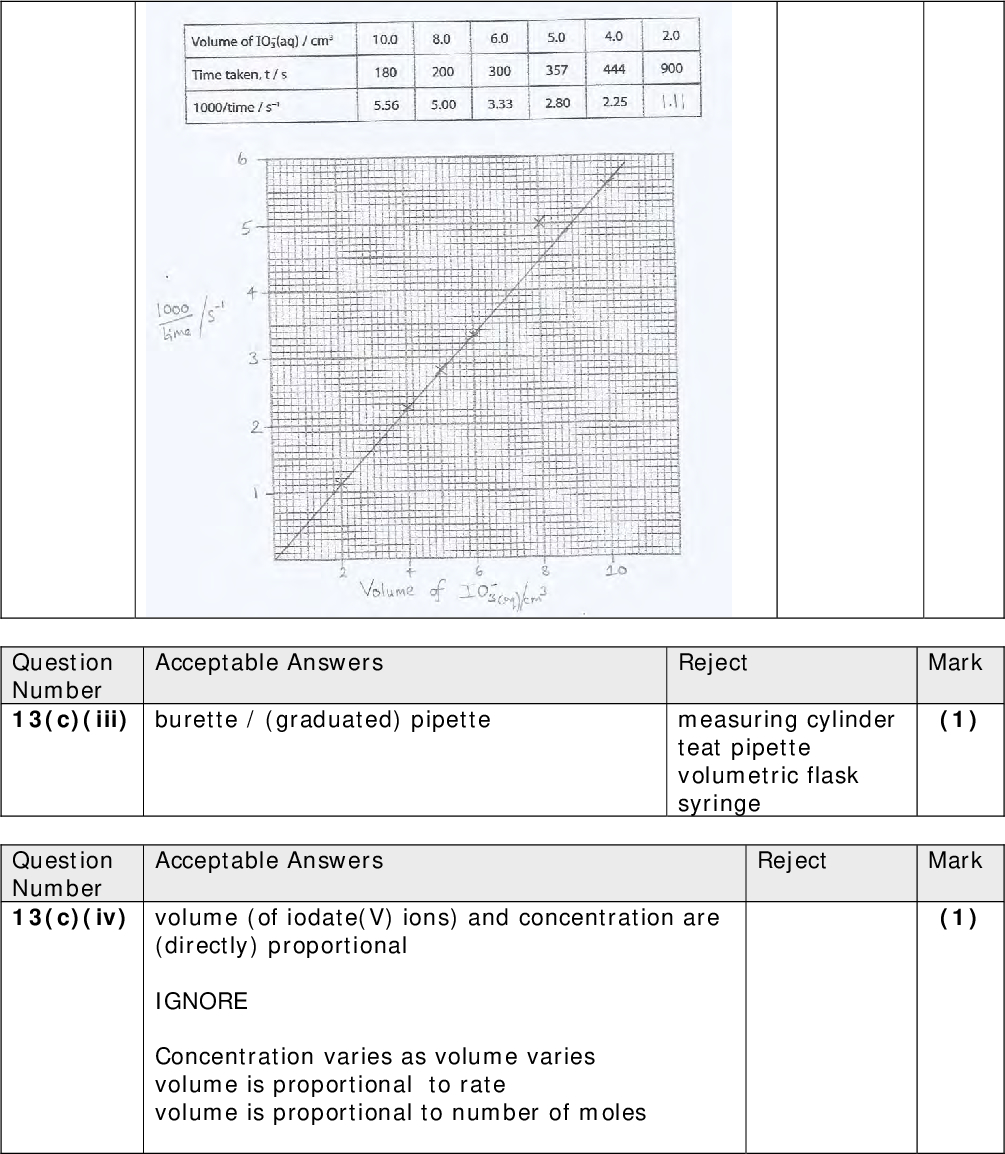
Reject Mark (5) Axes reversed OR decreasing scale Acceptable Answers Question Number 13(c)(ii) M1: Completed table with value 1.11 (1) M2: Axes correct with sensible, linear scales so at least half of the graph paper on both axes is covered (1) ALLOW even if graph scales do not start at (0, 0) M3: Axes labels fully correct with units (1) ALLOW 1000 t / s1 or 1000 / t / s1 on y-axis ALLOW volume / cm3 on x-axis M4: All points plotted correctly ( 1 small square) (1) Award M4 TE on the table value at 2 cm3 Do not penalise missing crosses/ circles if line is correct M5: Straight line drawn through (0, 0) and through all points except anomalous result at 8 cm3 (1) Exemplar:<br />
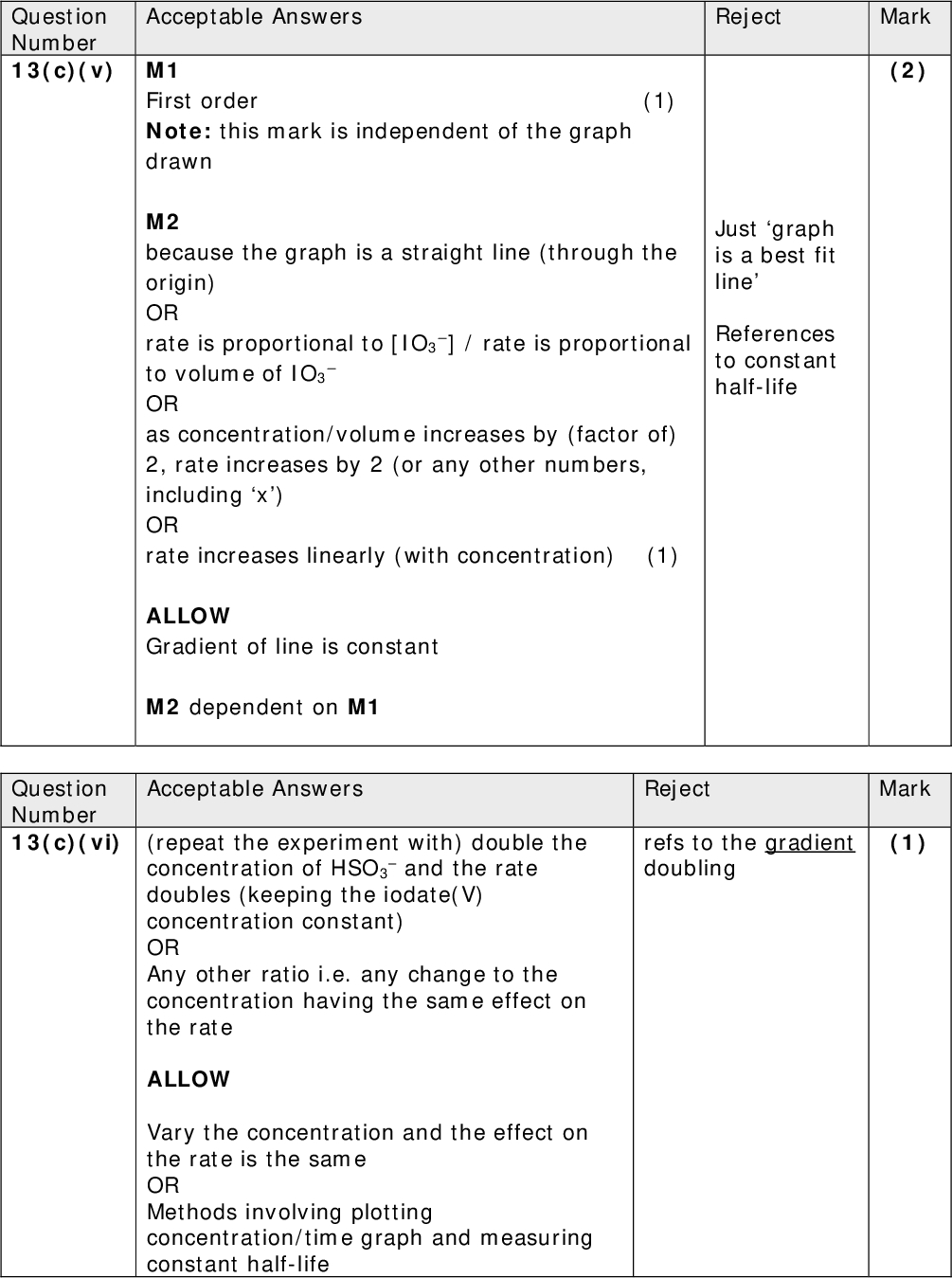
Acceptable Answers Question Number 13(c)(iii) burette / (graduated) pipette Reject measuring cylinder teat pipette volumetric flask syringe Acceptable Answers Question Number 13(c)(iv) volume (of iodate(V) ions) and concentration are (directly) proportional IGNORE Concentration varies as volume varies volume is proportional to rate volume is proportional to number of moles Reject Mark (1) Mark (1)<br />
Mark (2) Reject Just graph is a best fit line References to constant half-life Acceptable Answers Question Number 13(c)(v) M1 ] / rate is proportional (1) First order Note: this mark is independent of the graph drawn M2 because the graph is a straight line (through the origin) OR rate is proportional to [IO3 to volume of IO3 OR as concentration/volume increases by (factor of) 2, rate increases by 2 (or any other numbers, including x) OR rate increases linearly (with concentration) (1) ALLOW Gradient of line is constant M2 dependent on M1 Reject refs to the gradient doubling Mark (1) Acceptable Answers Question Number 13(c)(vi) (repeat the experiment with) double theand the rate concentration of HSO3 doubles (keeping the iodate(V) concentration constant) OR Any other ratio i.e. any change to the concentration having the same effect on the rate ALLOW Vary the concentration and the effect on the rate is the same OR Methods involving plotting concentration/time graph and measuring constant half-life<br />
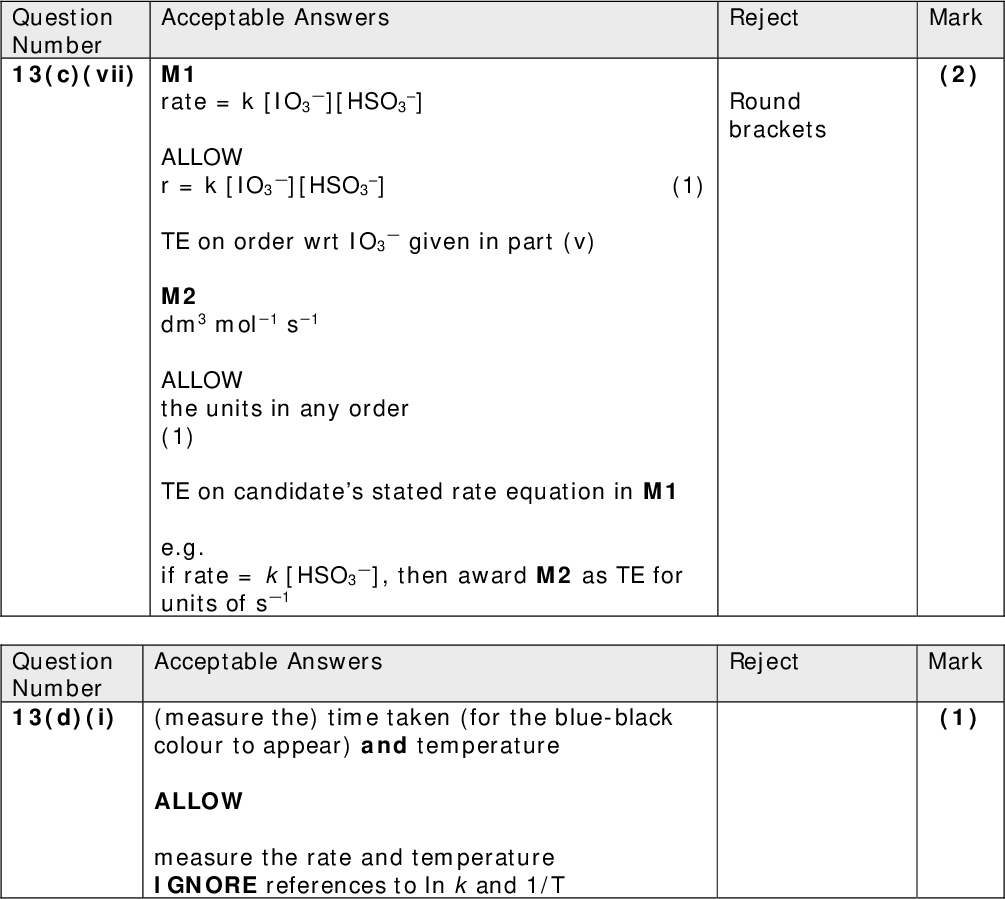
Acceptable Answers Question Number 13(c)(vii) M1 Reject Round brackets Mark (2) ] (1) ][HSO3 ] ][HSO3given in part (v) rate = k [IO3 ALLOW r = k [IO3 TE on order wrt IO3 M2 dm3 mol1 s1 ALLOW the units in any order (1) TE on candidates stated rate equation in M1 Reject Mark (1) Question Number 13(d)(i) e.g. if rate = k [HSO3 units of s1 ], then award M2 as TE for Acceptable Answers (measure the) time taken (for the blue-black colour to appear) and temperature ALLOW measure the rate and temperature IGNORE references to ln k and 1/T<br />
Acceptable Answers Question Number 13(d)(ii) M1 Temperature converted to kelvin ALLOW Kelvin given in (i) (1) COMMENT Only M1 can be transferred from (i) to (ii). Nothing can be credited from (ii) to (i) M2 The vertical axis should be ln rate / ln 1/t ALLOW ln k (1) M3 The horizontal axis should be 1/T (1) M4 Straight line (with a negative gradient) (1) ALLOW M1, M2, M3, M4 shown on a sketch graph M5 Any mention of gradient (of the line) (1) M6 States that: Ea = gradient x R (1) NB Negative sign must be shown or mentioned specifically NOTE: Plot ln rate against/vs 1/T scores M2 and M3 Plot 1/T against/vs ln rate does not score either M2 or M3 If axes clearly the wrong way round max (4) ie only marks M1, M4, M5 and M6 are possible Mark (6) Reject 1/T 1/t 1/time TOTAL FOR SECTION B = 49 MARKS (Total for question 13 =22 Marks)<br />](https://learnah.org/wp-content/uploads/2018/08/June_2016_IAL_MS_-_Unit_4_Edexcel_Chemistry_13-0.jpg)