Edexcel Jun 2016 (IAL) Paper 2 Q

Answers available below

14 This question is about 1-chlorobutane, 1-bromobutane, and 1-iodobutane. (a) 1-chlorobutane can be made by adding potassium chloride to a mixture of butan-1-ol and concentrated sulfuric acid. (i) Explain why it is not possible to make 1-iodobutane from butan-1-ol using potassium iodide and concentrated sulfuric acid. (2)(ii) 1-iodobutane is prepared by adding iodine in small portions to a mixture of red phosphorus and butan-1-ol. When all the iodine has been added, the mixture is refluxed. In this reaction, iodine reacts with phosphorus to produce phosphorus triiodide, which then reacts with the butan-1-ol to form 1-iodobutane. Write an equation for each reaction. State symbols are not required. (2) 12 *P46659A01224*<br />
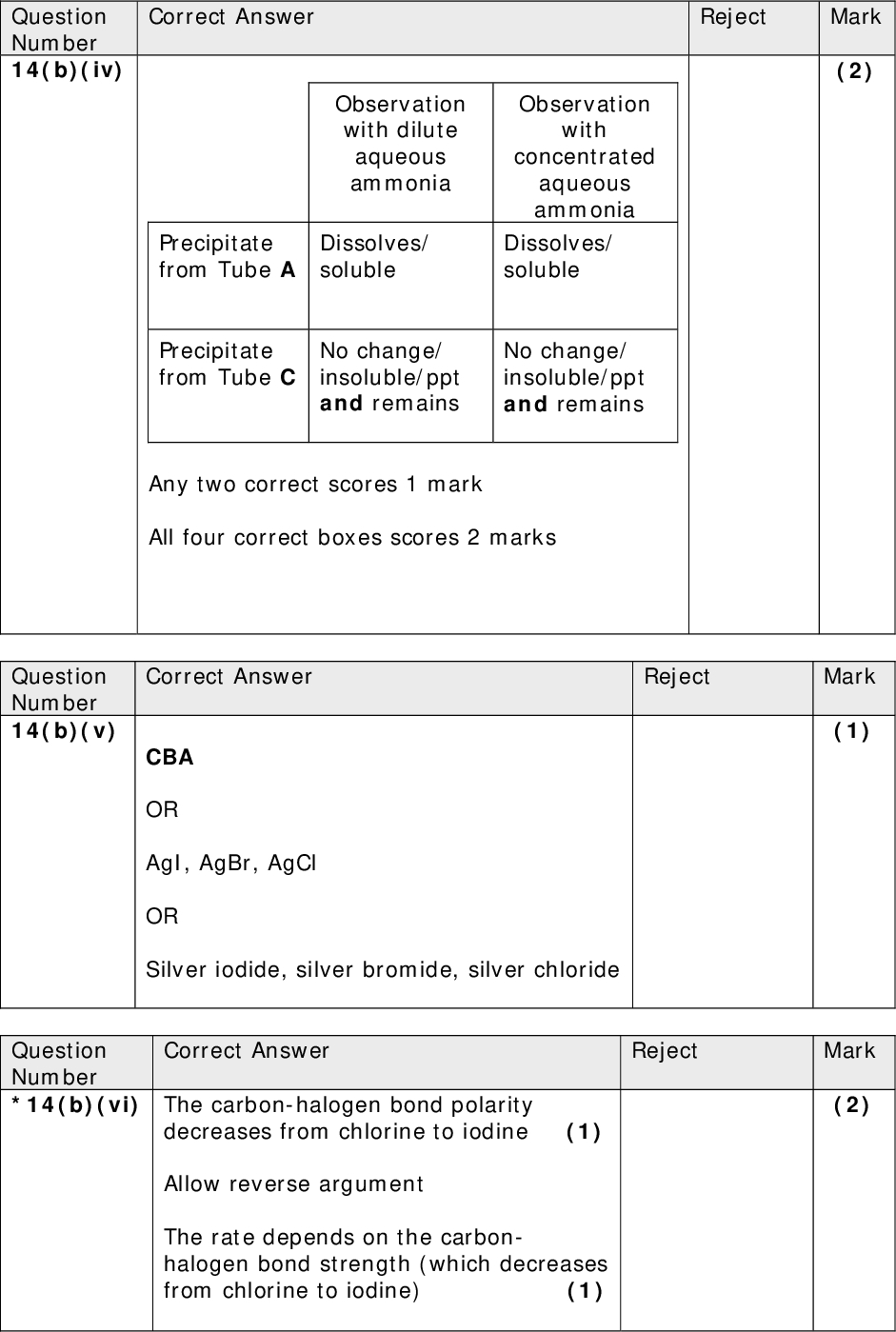
 (b) The rates of reaction of three halogenoalkanes with water are compared. 2 cm3 of ethanol is added to three test tubes, A, B and C. Three drops of the halogenoalkane are added separately to each of these three test tubes. 1-chlorobutane is added to test tube A. 1-bromobutane is added to test tube B. 1-iodobutane is added to test tube C. 2 cm3 portions of hot aqueous silver nitrate solution are added to each test tube. (i) Explain why ethanol is added to each test tube. (1)(ii) Give the name of the organic product which forms in all of these reactions. (1)(iii) The halide ion formed in each reaction reacts with the silver nitrate solution to give a precipitate. Give the colour of the precipitate formed in test tube C and give the ionic equation for the formation of this precipitate. Include state symbols in your equation. (2) ColourEquation (iv) Dilute and concentrated aqueous ammonia are added to separate samples of the precipitates formed in test tubes A and C. Complete the table. Observation with dilute aqueous ammonia Observation with concentrated aqueous ammonia (2) Precipitate from Tube A Precipitate from Tube C *P46659A01324* 13 Turn over<br />
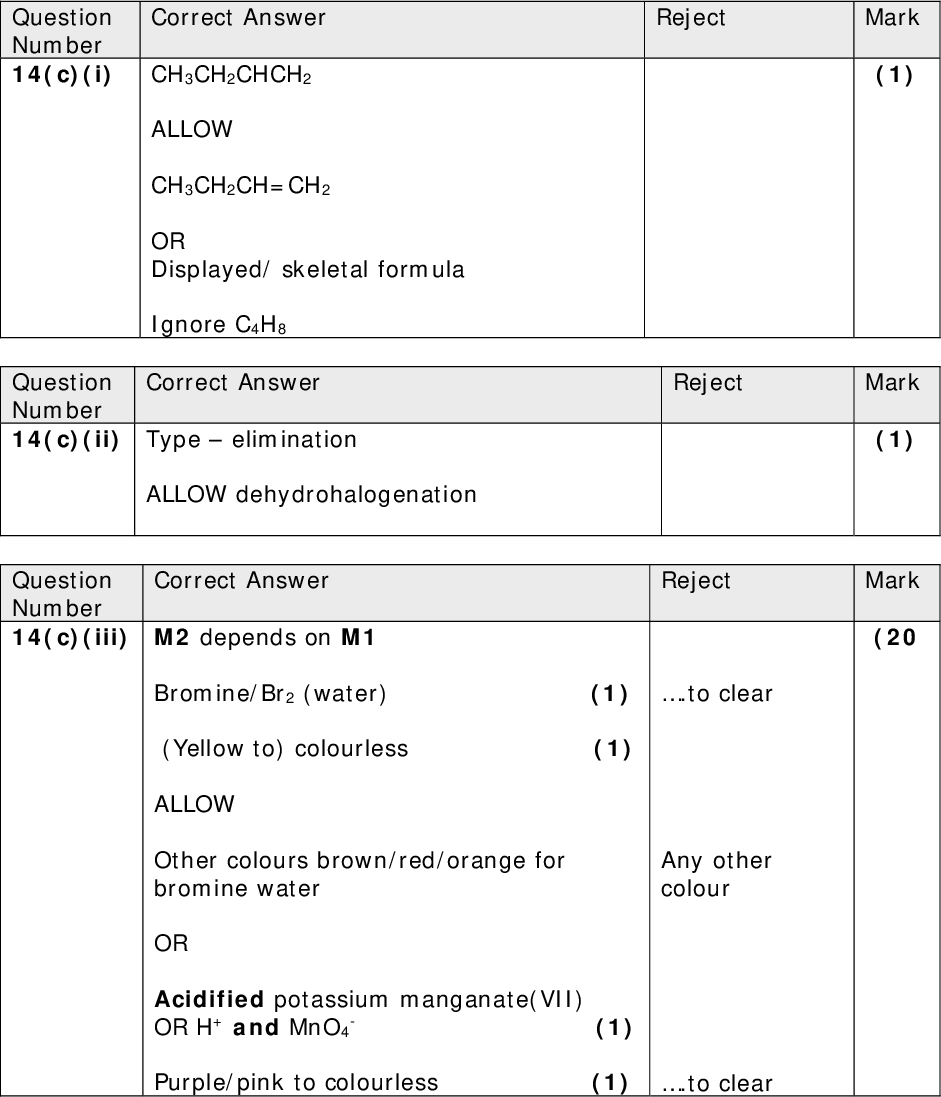
 (v) Give the order in which the precipitates form, in the test tubes A, B and C, giving the fastest first. (1)*(vi) State how the bond polarities of carbon-halogen bonds vary. Explain why bond polarity does not determine the rate of this reaction. (2)(c) When these halogenoalkanes are heated separately with concentrated potassium hydroxide in ethanol, the same gaseous organic product forms. (i) Give the structural formula for this organic product. (ii) State the type of reaction which occurs. (1) (1)(iii) Give a chemical test for this organic product and state the colour change that occurs. (2) TestColour change14 *P46659A01424*<br />
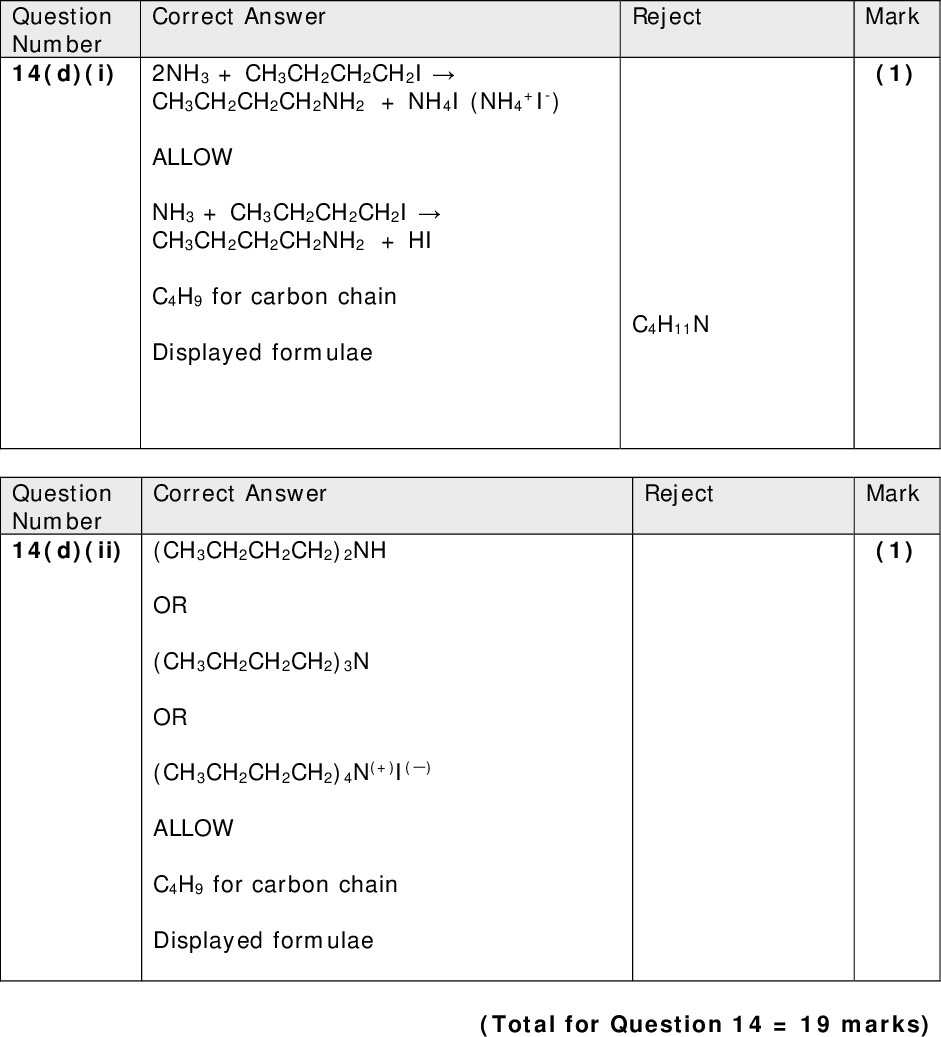
 (d) All three halogenoalkanes undergo substitution reactions with ammonia. The initial reaction forms butylamine, CH3CH2CH2CH2NH2. (i) Write the equation for the initial reaction of 1-iodobutane with ammonia. State symbols are not required. (ii) The butylamine formed also reacts with the 1-iodobutane in a further substitution reaction. Suggest a structural formula for the product of this reaction. (1) (1) (Total for Question 14 = 19 marks) *P46659A01524* 15 Turn over<br />

Show answer