Skip to content
Edexcel Jun 2014 Paper 5 Q22
Answers available below
Show answer
Question
19
20
21
22
23
24

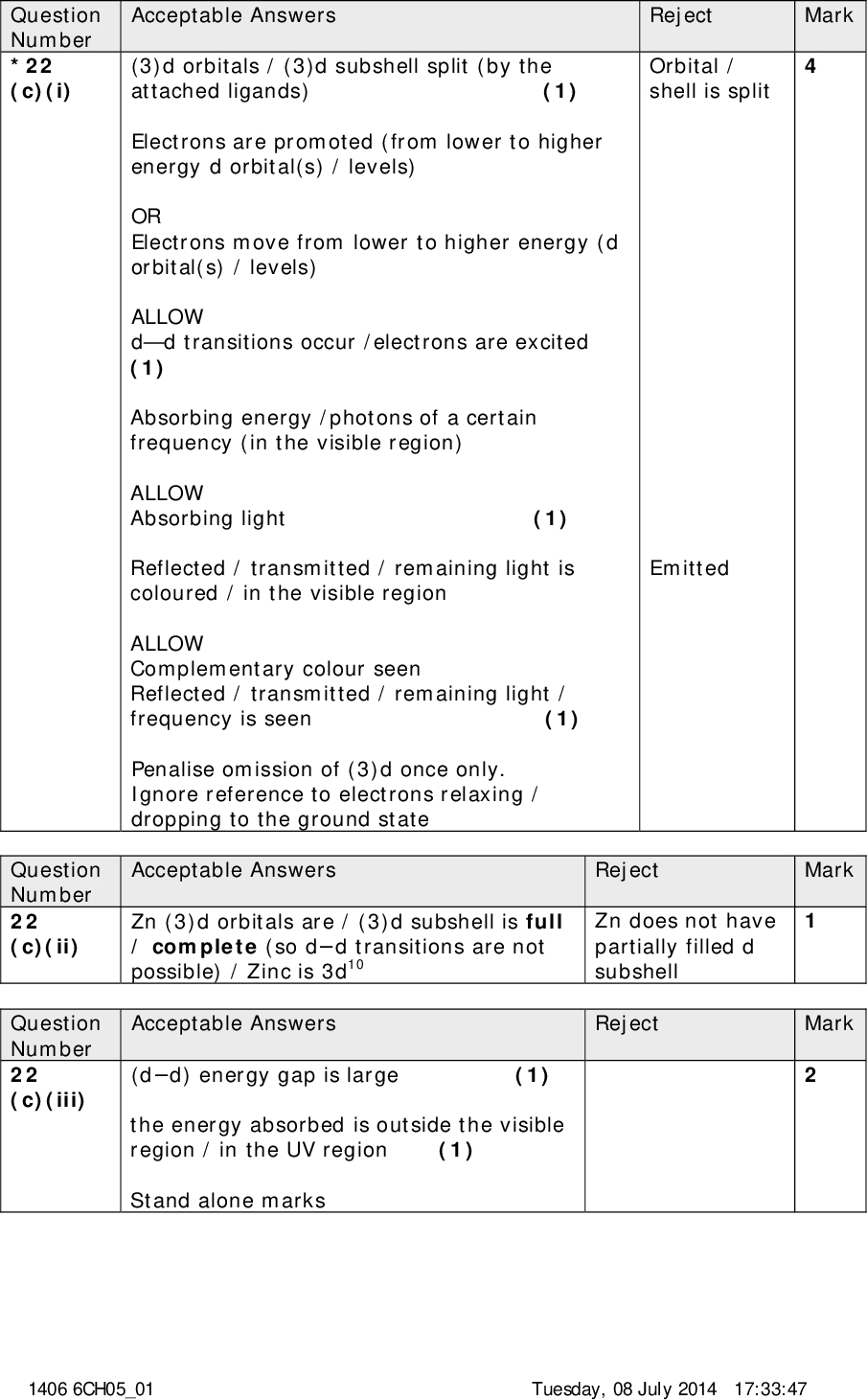
![Answer ALL the questions. Write your answers in the spaces provided. SECTION C 22 Metal Complexes Complexes involve ligands forming dative covalent bonds with a central cation; the number of dative covalent bonds is the coordination number of the cation in the complex. Complexes may be positive, negative or neutral. The ligands may be neutral or negatively charged, but are never positively charged. The ligands must have a lone pair of electrons. In some complexes the central atom is neutral, as is the case with nickel carbonyl which is used in the Mond process for the purification of nickel: Ni(s) + 4CO(g) (cid:85)(cid:1)(cid:1)Ni(CO)4(g) The formation of complexes is typical of transition metals but other elements also form complexes. Zinc, which is a d block element but not a transition metal, and aluminium, which is a Group 3 element, both form complexes. Transition metal complexes are usually coloured, but if the interaction between the ligand and the central ion is very strong, then the resulting complex may well be colourless. This is the case with the complex [FeF6]3. The ligand in a complex affects its redox properties and this is apparent from considering the relevant standard electrode potentials. For example, with copper(II) species: [Cu(H2O)6]2+(aq) + 2e (cid:85) Cu(s) + 6H2O(l) E (cid:57) = +0.34 V [Cu(H2O)2(NH3)4]2+(aq) + 2e (cid:85) Cu(s) + 2H2O(l) + 4NH3(aq) E (cid:57) = 0.05 V Complexes are industrially important, for example in the purification of nickel mentioned above and in the extraction of gold which involves the complex [Au(CN)2]. Complex formation is used in estimating the concentrations of metal ions in solution. Examples of this are the use of EDTA in titration and dimethylglyoxime in gravimetric analysis. Complexes are also used in qualitative analysis, for example, in Tollens reagent. This reagent is usually prepared by the addition of sodium hydroxide solution to an aqueous solution of silver nitrate followed by aqueous ammonia. The resulting solution contains diamminesilver(I) ions. *P42973A02328* 23 Turn over<br />
(a) The hydrated copper(II) ion is classed as a complex but the hydrated sodium ion is not. By considering the interaction between the water molecules and the sodium ion, explain why the hydrated sodium ion is not considered to be a complex. (2)(b) Suggest how the aluminium ion is able to form dative covalent bonds in its complexes such as [AlF6]3. (1)*(c) (i) Transition metal complexes are usually coloured. Explain how the colours occur. (4)(ii) Why are zinc complexes such as [Zn(NH3)4]2+ colourless? (1)24 *P42973A02428*<br />
(iii) Suggest why the strong interactions between the F ligands and Fe3+ ion result in the complex [FeF6]3 being colourless. (2)(d) Use the standard electrode potentials given in the passage to predict whether it is feasible for thiosulfate ions, S2O3 the case when the copper(II) ions are dissolved in water, and when they are dissolved in aqueous ammonia. Give chemical equations to support your answer. 2, to reduce copper(II) ions to copper. Consider (3) The relevant redox reaction for thiosulfate ions is S4O6 2(aq) + 2e (cid:85) 2S2O3 2(aq) E (cid:57) = +0.09 V*P42973A02528* 25 Turn over<br />
(e) The proportion of nickel in nisil, an alloy of nickel and silicon used in thermocouples, may be determined by the following gravimetric analysis. Finely ground nisil is dissolved in concentrated hydrochloric acid and, after neutralization, excess dimethylglyoxime dissolved in ethanol is added to the solution formed. The resulting red precipitate is filtered, washed, dried and weighed. The equation for the formation of the precipitate is HO OH Ni2+ + 2 H3C CH3 O HO Ni2+ H3C CH3 + 2H+ H3C CH3 OH O (i) State the coordination number of the nickel in the complex ion. (1)(ii) In an experiment, 1.02 g of nisil formed 4.82 g of the complex. Calculate the percentage by mass of nickel in the alloy. The molar mass of the complex is 288.7 g mol1. (2) 26 *P42973A02628*<br />
(f) Suggest why the nickel carbonyl complex is used to purify nickel ores. (1)(g) Use the equilibria below to explain why ammonia is used to prepare Tollens reagent, as described in the passage. 2Ag+(aq) + 2OH(aq) (cid:85) Ag2O(s) + H2O(l) Equilibrium 1 Ag+(aq) + 2NH3(aq) (cid:85) Ag(NH3)2 +(aq) Equilibrium 2 (3)(Total for Question 22 = 20 marks) TOTAL FOR SECTION C = 20 MARKS TOTAL FOR PAPER = 90 MARKS *P42973A02728* 27<br />](https://learnah.org/wp-content/uploads/2018/08/l_smalljpgJune_2014_QP_-_Unit_5_Edexcel_Chemistry_A-level_22-0.jpg)


![Mark Acceptable Answers Reject Oxygen atoms in water molecules havecharge. (1) Which form electrostatic / ion-dipole attractions with sodium (ion). (1) ALLOW for one mark copper(II) ions form dative covalent bonds but sodium ions do not (both needed) Ionic bonds / attractions Intermolecular forces Hydrogen bonds Acceptable Answers Reject Mark Partially filled for vacant Additional (dative covalent bond) lone pairs are accommodated in vacant (3)d orbitals / (3)d sub-shell ALLOW Vacant higher energy orbitals / sub- shells IGNORE 3s/3p Section C Question Number 22 (a) Question Number 22 (b) 1406 6CH0501 Tuesday, 08 July 2014 17:33:47<br />
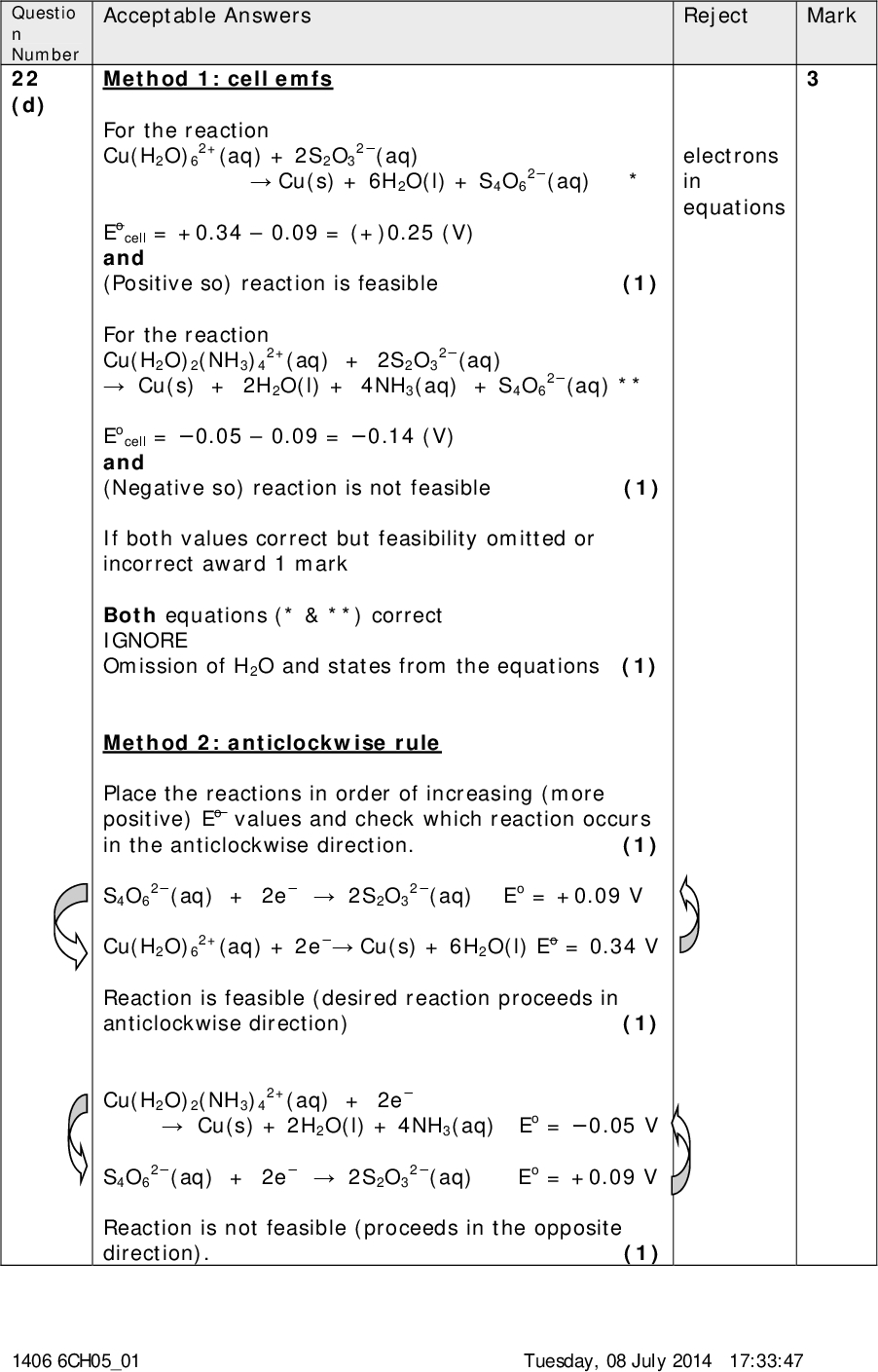
Acceptable Answers Reject Mark Orbital / shell is split Emitted (3)d orbitals / (3)d subshell split (by the attached ligands) (1) Electrons are promoted (from lower to higher energy d orbital(s) / levels) OR Electrons move from lower to higher energy (d orbital(s) / levels) ALLOW dd transitions occur /electrons are excited (1) Absorbing energy /photons of a certain frequency (in the visible region) ALLOW Absorbing light (1) Reflected / transmitted / remaining light is coloured / in the visible region ALLOW Complementary colour seen Reflected / transmitted / remaining light / frequency is seen (1) Penalise omission of (3)d once only. Ignore reference to electrons relaxing / dropping to the ground state Acceptable Answers Reject Zn (3)d orbitals are / (3)d subshell is full / complete (so dd transitions are not possible) / Zinc is 3d10 Zn does not have partially filled d subshell Acceptable Answers (dd) energy gap is large (1) the energy absorbed is outside the visible region / in the UV region (1) Stand alone marks Reject Mark Mark Question Number *22 (c)(i) Question Number 22 (c)(ii) Question Number 22 (c)(iii) 1406 6CH0501 Tuesday, 08 July 2014 17:33:47<br />
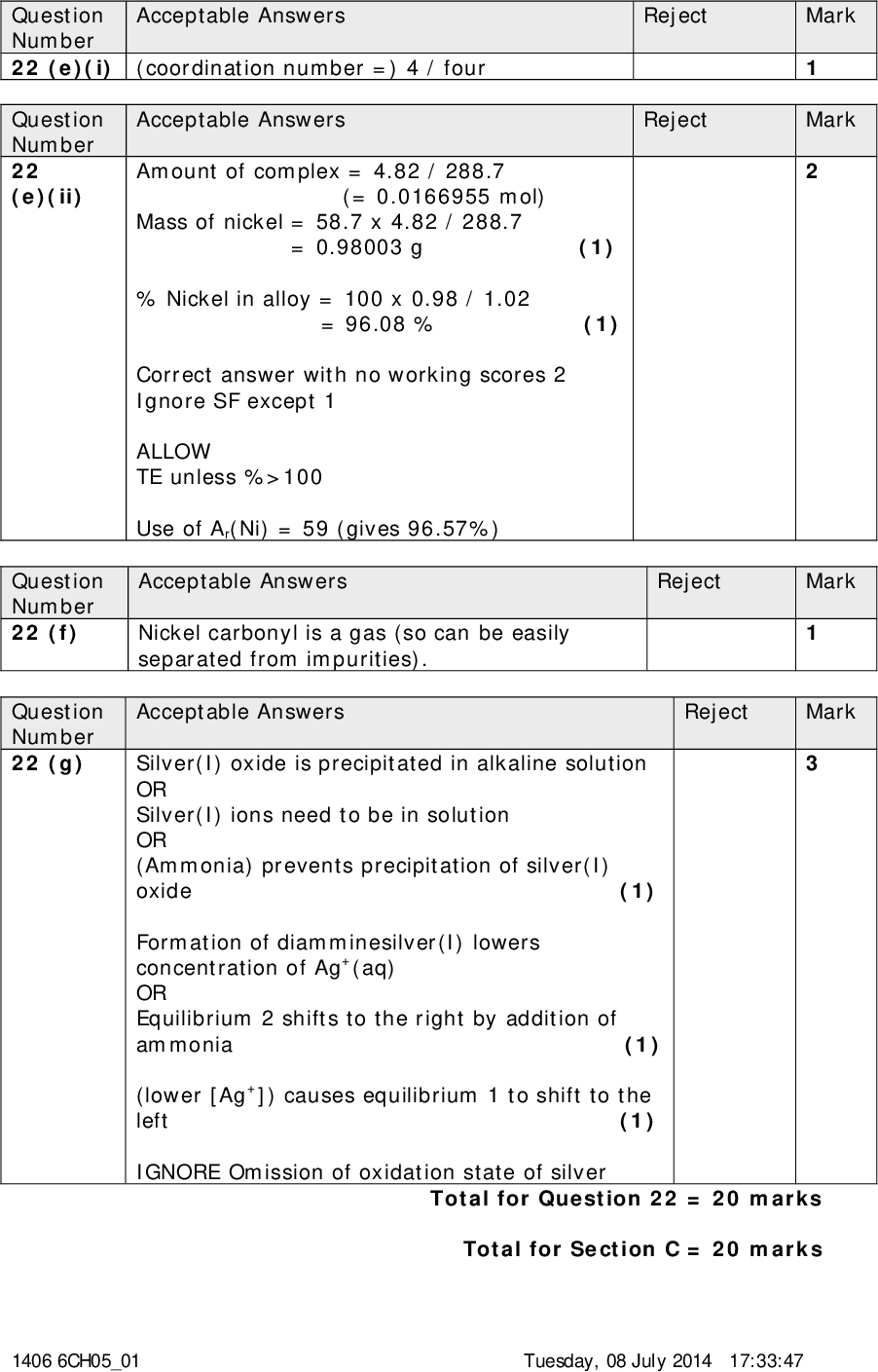
Questio n Number 22 (d) Acceptable Answers Reject Mark electrons in equations 2+(aq) + 2S2O3 2(aq) 2(aq) * 2+(aq) + 2S2O3 2(aq) 2(aq) ** cell = 0.050.09 = 0.14 (V) cell = +0.340.09 = (+)0.25 (V) Method 1: cell emfs For the reaction Cu(H2O)6Cu(s) + 6H2O(l) + S4O6 Eo and (Positive so) reaction is feasible (1) For the reaction Cu(H2O)2(NH3)4Cu(s) + 2H2O(l) + 4NH3(aq) + S4O6 Eo and (Negative so) reaction is not feasible (1) If both values correct but feasibility omitted or incorrect award 1 mark Both equations (* & **) correct IGNORE Omission of H2O and states from the equations (1) Method 2: anticlockwise rule Place the reactions in order of increasing (more positive) Eo values and check which reaction occurs in the anticlockwise direction. (1) S4O6 Cu(H2O)6 Reaction is feasible (desired reaction proceeds in anticlockwise direction) (1) Cu(H2O)2(NH3)4Cu(s) + 2H2O(l) + 4NH3(aq) Eo = 0.05 V S4O6 Reaction is not feasible (proceeds in the opposite direction). (1) 2+(aq) + 2e Cu(s) + 6H2O(l) Eo = 0.34 V 2(aq) + 2e2S2O3 2(aq) + 2e2S2O3 2(aq) Eo = +0.09 V 2+(aq) + 2e 2(aq) Eo = +0.09 V 1406 6CH0501 Tuesday, 08 July 2014 17:33:47<br />
Reject Reject Mark Mark Acceptable Answers Question Number 22 (e)(i) (coordination number =) 4 / four Question Number 22 (e)(ii) Acceptable Answers Amount of complex = 4.82 / 288.7 (= 0.0166955 mol) Mass of nickel = 58.7 x 4.82 / 288.7 = 0.98003 g (1) % Nickel in alloy = 100 x 0.98 / 1.02 = 96.08 % (1) Correct answer with no working scores 2 Ignore SF except 1 ALLOW TE unless %>100 Use of Ar(Ni) = 59 (gives 96.57%) Question Number 22 (f) Question Number 22 (g) Acceptable Answers Nickel carbonyl is a gas (so can be easily separated from impurities). Reject Mark Reject Mark Acceptable Answers Silver(I) oxide is precipitated in alkaline solution OR Silver(I) ions need to be in solution OR (Ammonia) prevents precipitation of silver(I) oxide (1) Formation of diamminesilver(I) lowers concentration of Ag+(aq) OR Equilibrium 2 shifts to the right by addition of ammonia (1) (lower [Ag+]) causes equilibrium 1 to shift to the left (1) IGNORE Omission of oxidation state of silver Total for Question 22 = 20 marks Total for Section C = 20 marks 1406 6CH0501 Tuesday, 08 July 2014 17:33:47<br />
Pearson Education Limited. Registered company number 872828 with its registered office at Edinburgh Gate, Harlow, Essex CM20 2JE 1406 6CH0501 Tuesday, 08 July 2014 17:33:47<br />](https://learnah.org/wp-content/uploads/2018/08/June_2014_MS_-_Unit_5_Edexcel_Chemistry_A-level_22-0.jpg)