Edexcel Jun 2014 (IAL) Paper 1 Q21

Answers available below

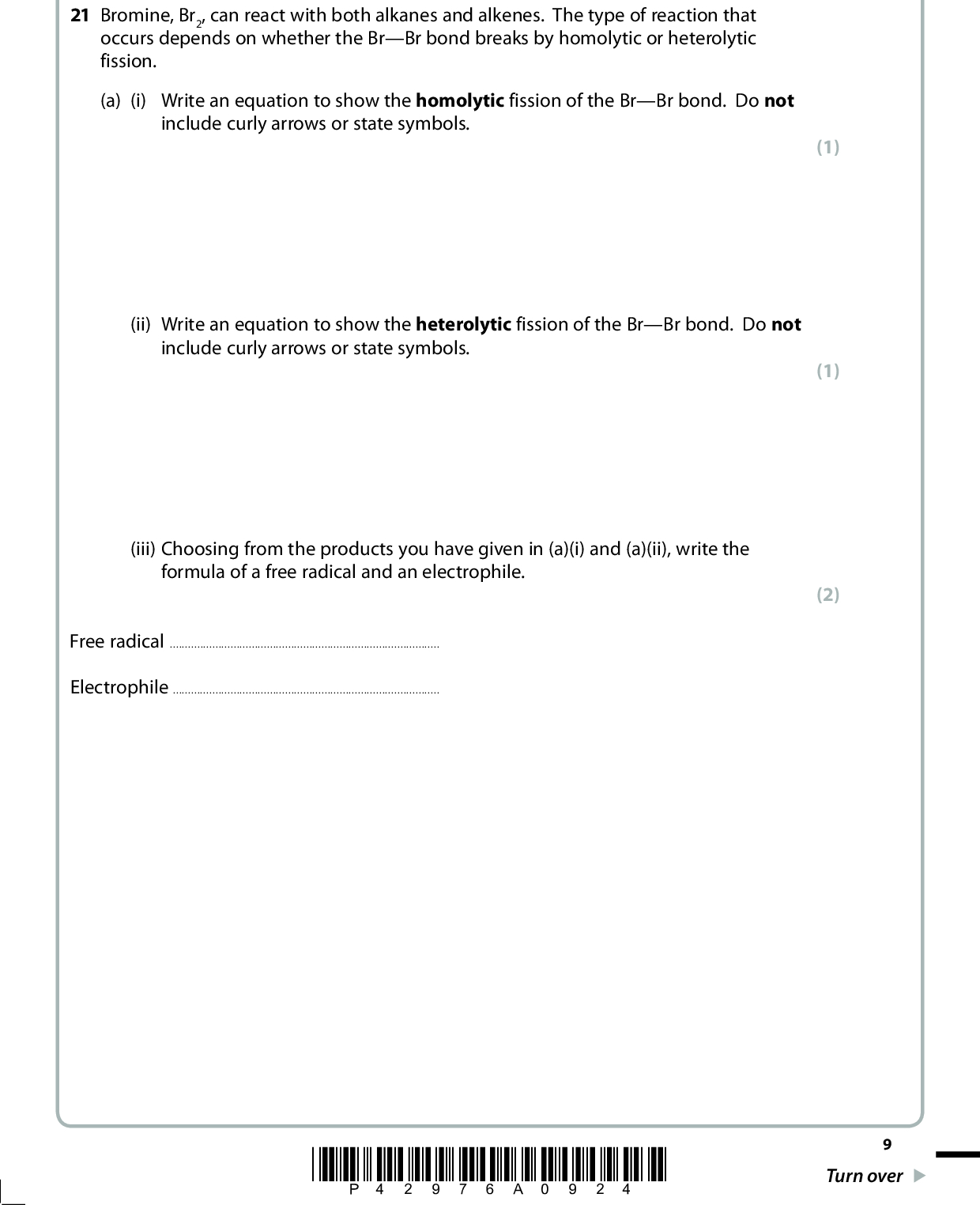
SECTION B Answer ALL the questions. Write your answers in the spaces provided. 21 Bromine, Br2, can react with both alkanes and alkenes. The type of reaction that occurs depends on whether the BrBr bond breaks by homolytic or heterolytic fission. (a) (i) Write an equation to show the homolytic fission of the BrBr bond. Do not include curly arrows or state symbols. (ii) Write an equation to show the heterolytic fission of the BrBr bond. Do not include curly arrows or state symbols. (iii) Choosing from the products you have given in (a)(i) and (a)(ii), write the formula of a free radical and an electrophile. Free radicalElectrophile(1) (1) (2) *P42976A0924* Turn over<br />
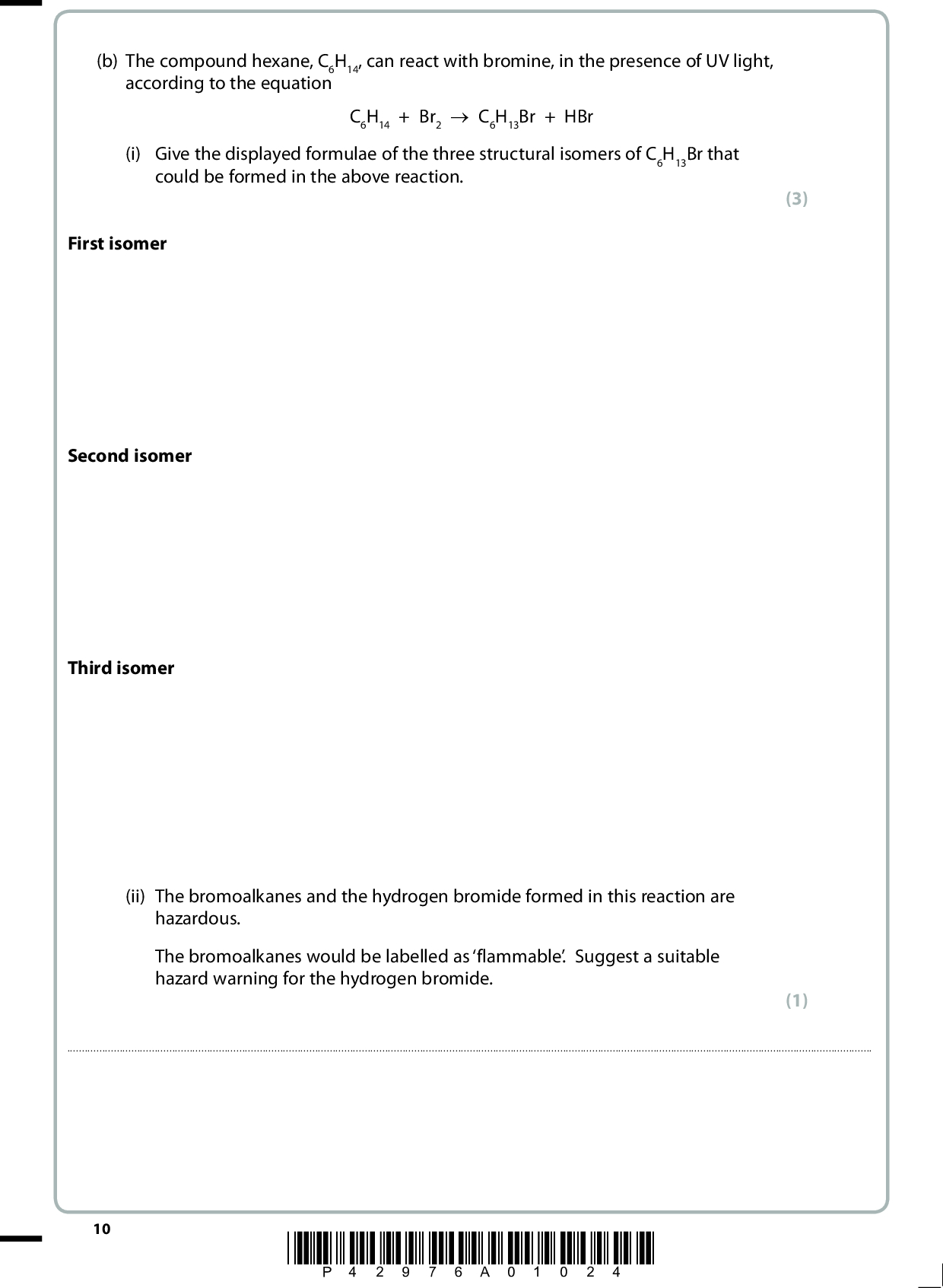
 (b) The compound hexane, C6H14, can react with bromine, in the presence of UV light, according to the equation C6H14 + Br2 (cid:111)(cid:3) C6H13Br + HBr (i) Give the displayed formulae of the three structural isomers of C6H13Br that could be formed in the above reaction. First isomer Second isomer Third isomer (ii) The bromoalkanes and the hydrogen bromide formed in this reaction are hazardous. The bromoalkanes would be labelled as flammable. Suggest a suitable hazard warning for the hydrogen bromide. (3) (1)10 *P42976A01024*<br />
 (iii) Calculate the percentage atom economy by mass for the formation of C6H13Br. Give your answer to three significant figures. Use the expression atom economy = molar mass of the desired product sum of thhe molar masses of all products100% (c) Fluorine, F2, and chlorine, Cl2, react with methane, CH4, by a similar mechanism, although the rates of reaction are very different. (i) Write an equation for the reaction between methane and fluorine, assuming they react in a 1:1 mole ratio. State symbols are not required. *(ii) On the basis of comparing the relative sizes of the fluorine and chlorine atoms, it might be predicted that the FF bond energy would be greater than the ClCl bond energy. Suggest an explanation for this prediction. (2) (1) (2)*P42976A01124* 11 Turn over<br />
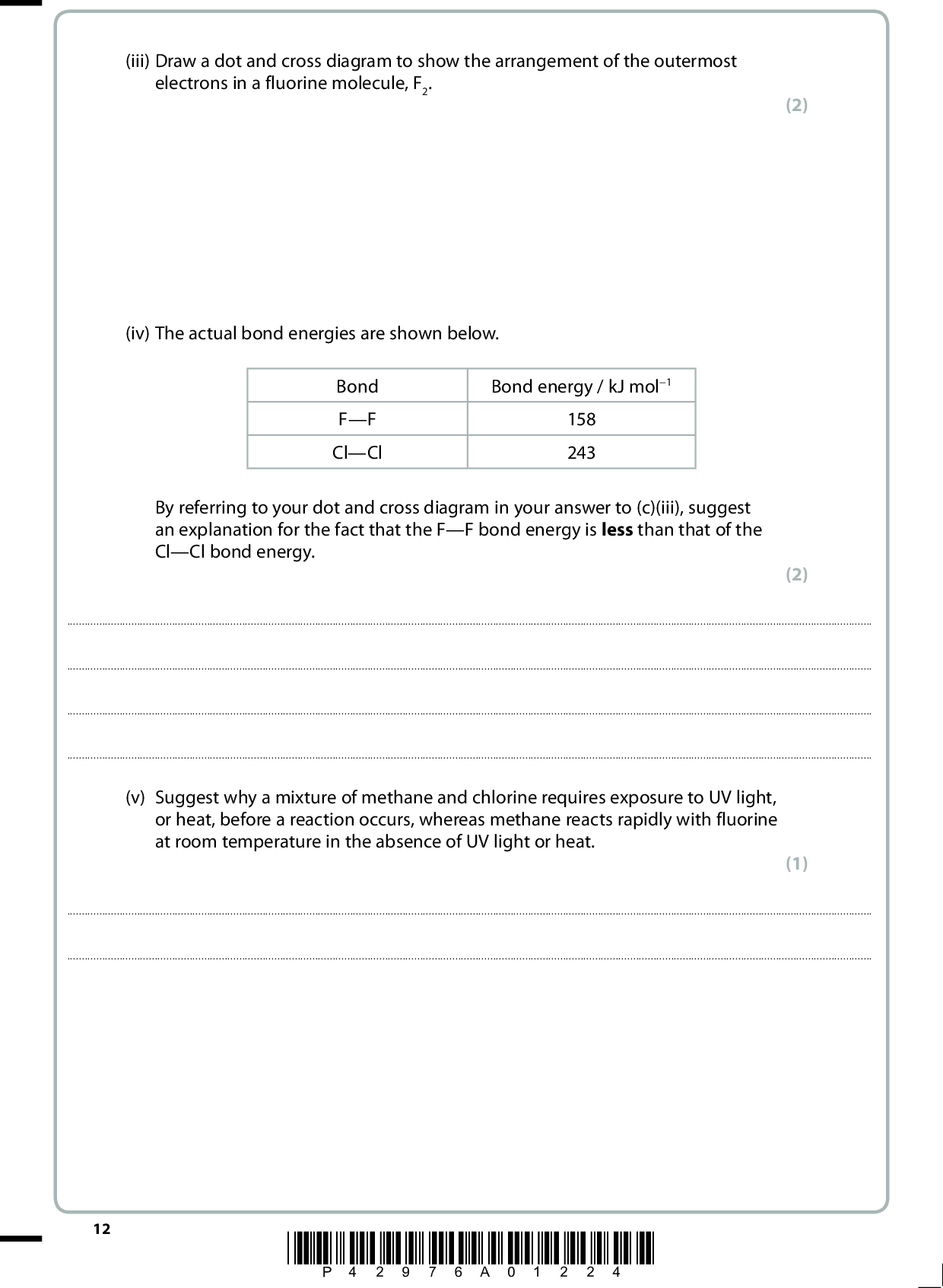
 (iii) Draw a dot and cross diagram to show the arrangement of the outermost electrons in a fluorine molecule, F2. (iv) The actual bond energies are shown below. Bond FF ClCl Bond energy / kJ mol1 158 243 By referring to your dot and cross diagram in your answer to (c)(iii), suggest an explanation for the fact that the FF bond energy is less than that of the ClCl bond energy. (2) (2)(v) Suggest why a mixture of methane and chlorine requires exposure to UV light, or heat, before a reaction occurs, whereas methane reacts rapidly with fluorine at room temperature in the absence of UV light or heat. (1)12 *P42976A01224*<br />
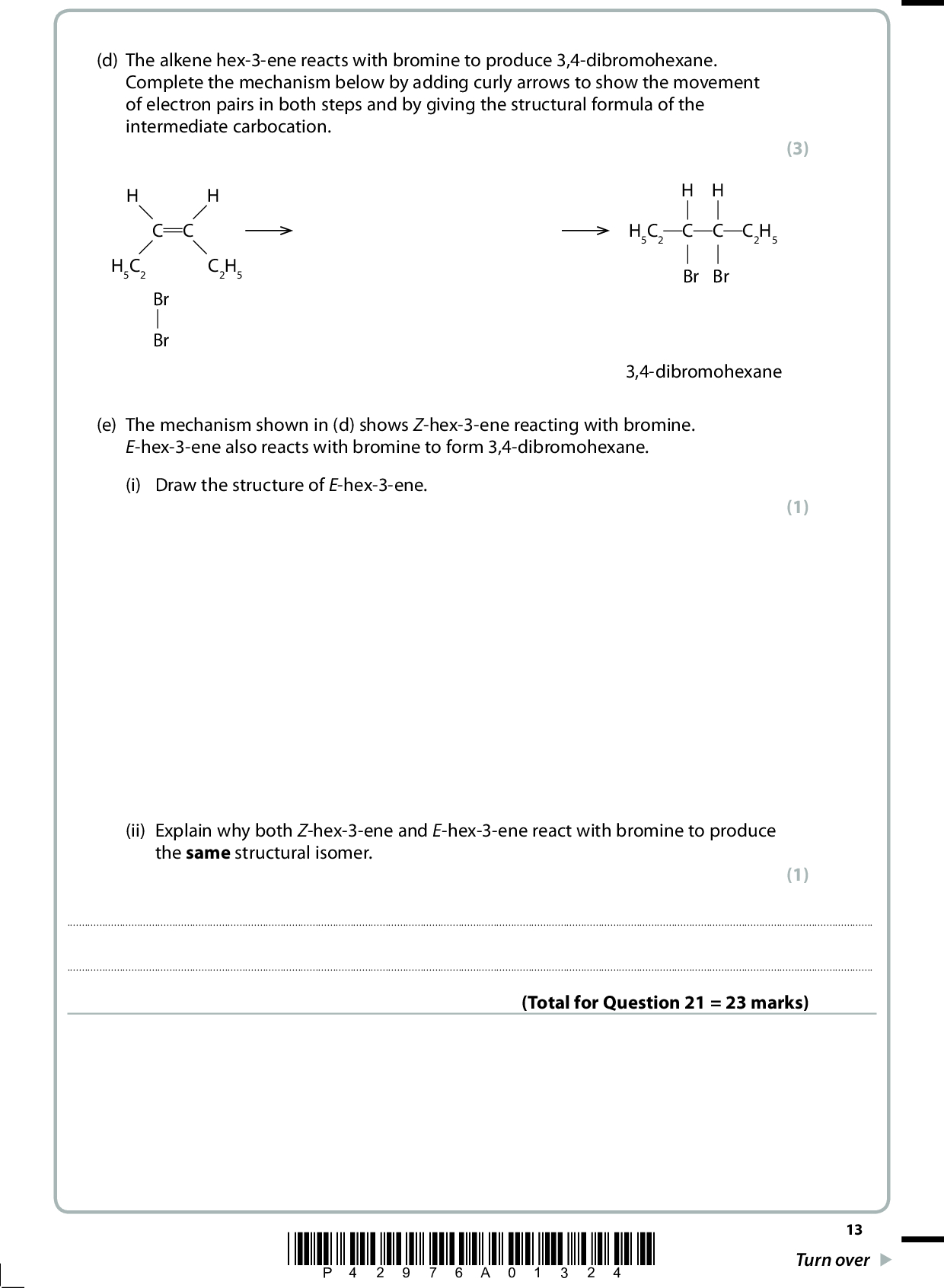
 (d) The alkene hex-3-ene reacts with bromine to produce 3,4-dibromohexane. Complete the mechanism below by adding curly arrows to show the movement of electron pairs in both steps and by giving the structural formula of the intermediate carbocation. C C H5C2 C2H5 Br Br H H H5C2 C C C2H5 Br Br 3,4-dibromohexane (e) The mechanism shown in (d) shows Z-hex-3-ene reacting with bromine. E-hex-3-ene also reacts with bromine to form 3,4-dibromohexane. (i) Draw the structure of E-hex-3-ene. (ii) Explain why both Z-hex-3-ene and E-hex-3-ene react with bromine to produce the same structural isomer. (3) (1) (1)(Total for Question 21 = 23 marks) *P42976A01324* 13 Turn over<br />

Show answer