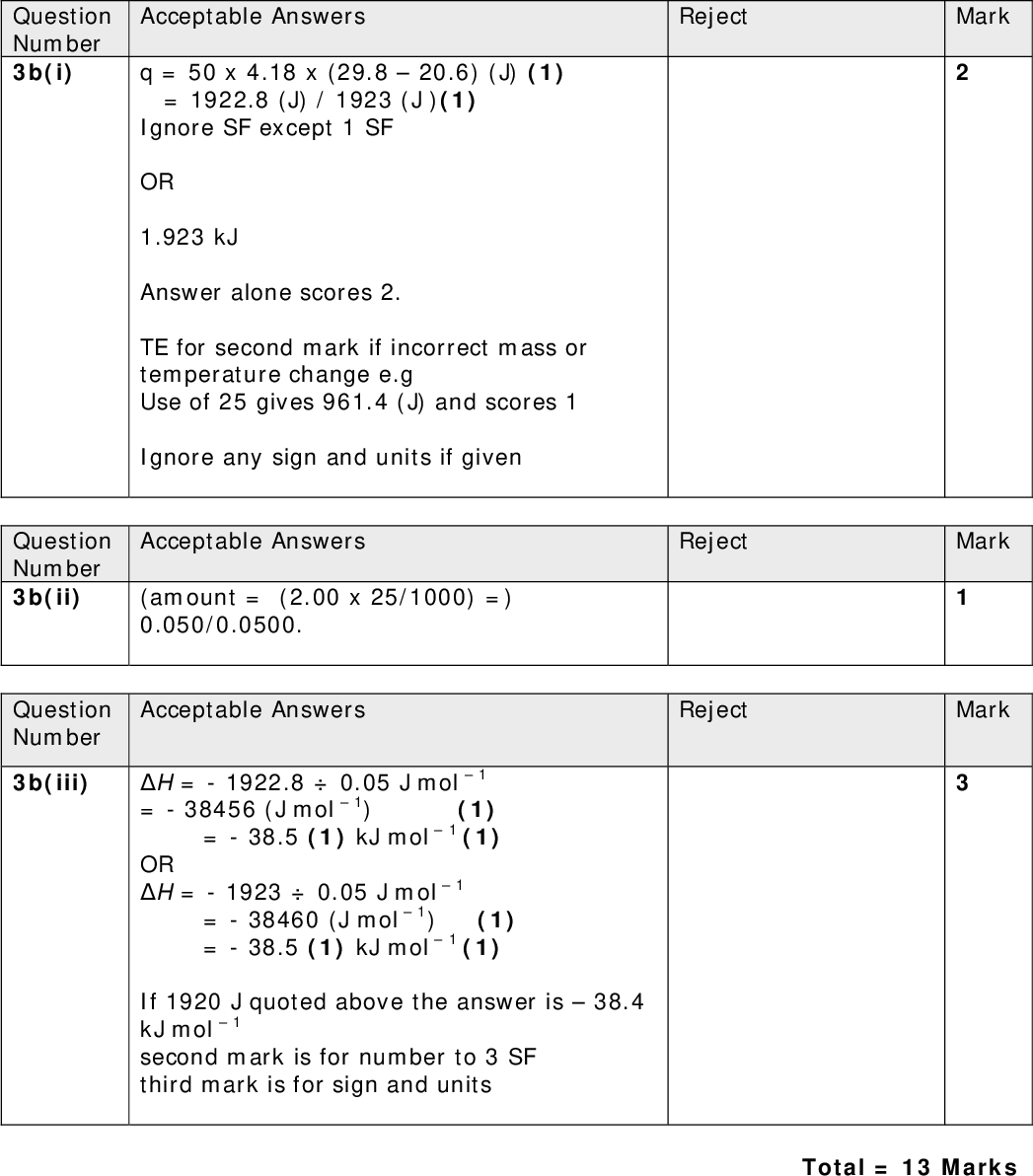
Edexcel Jan 2013 Paper 3 Q3

Answers available below

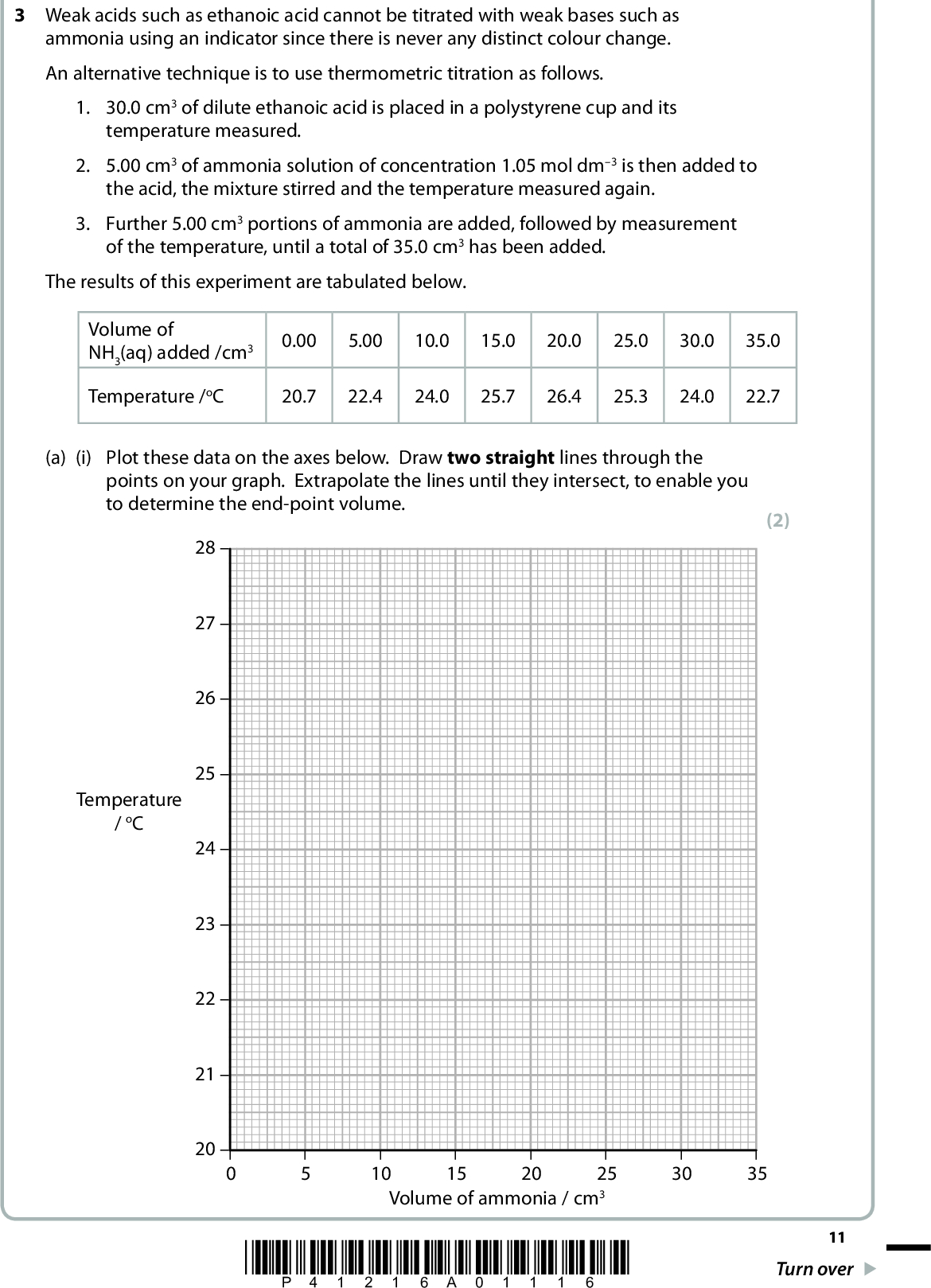
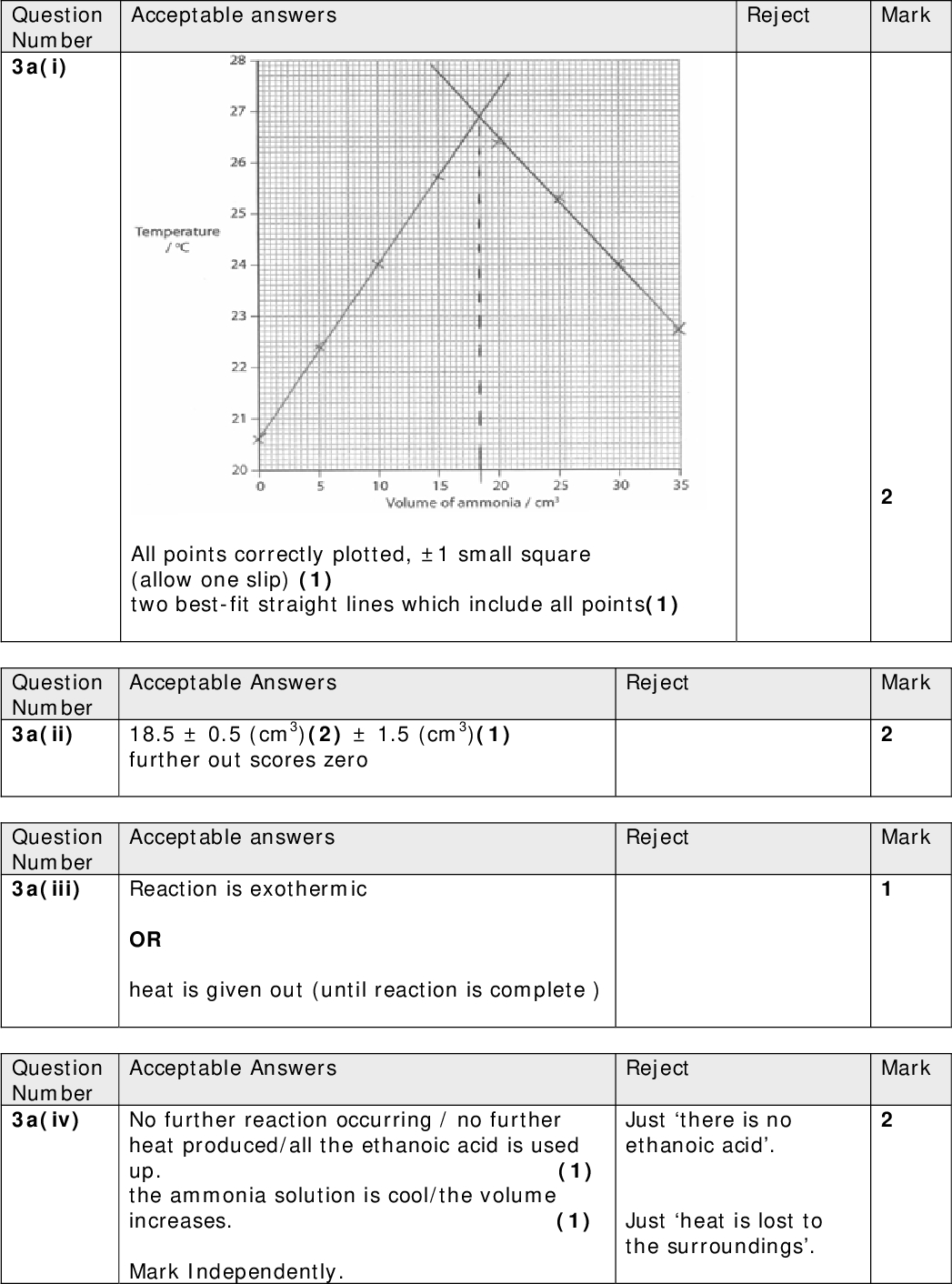
3 Weak acids such as ethanoic acid cannot be titrated with weak bases such as ammonia using an indicator since there is never any distinct colour change. An alternative technique is to use thermometric titration as follows. 1. 30.0 cm3 of dilute ethanoic acid is placed in a polystyrene cup and its temperature measured. 2. 5.00 cm3 of ammonia solution of concentration 1.05 mol dm3 is then added to the acid, the mixture stirred and the temperature measured again. 3. Further 5.00 cm3 portions of ammonia are added, followed by measurement of the temperature, until a total of 35.0 cm3 has been added. The results of this experiment are tabulated below. Volume of NH3(aq) added /cm3 0.00 5.00 10.0 15.0 20.0 25.0 30.0 35.0 Temperature /oC 20.7 22.4 24.0 25.7 26.4 25.3 24.0 22.7 (a) (i) Plot these data on the axes below. Draw two straight lines through the points on your graph. Extrapolate the lines until they intersect, to enable you to determine the end-point volume. (2) Temperature / oC 2827262524232221200 10 15 20 25 30 35 Volume of ammonia / cm3 *P41216A01116* 11 Turn over<br />
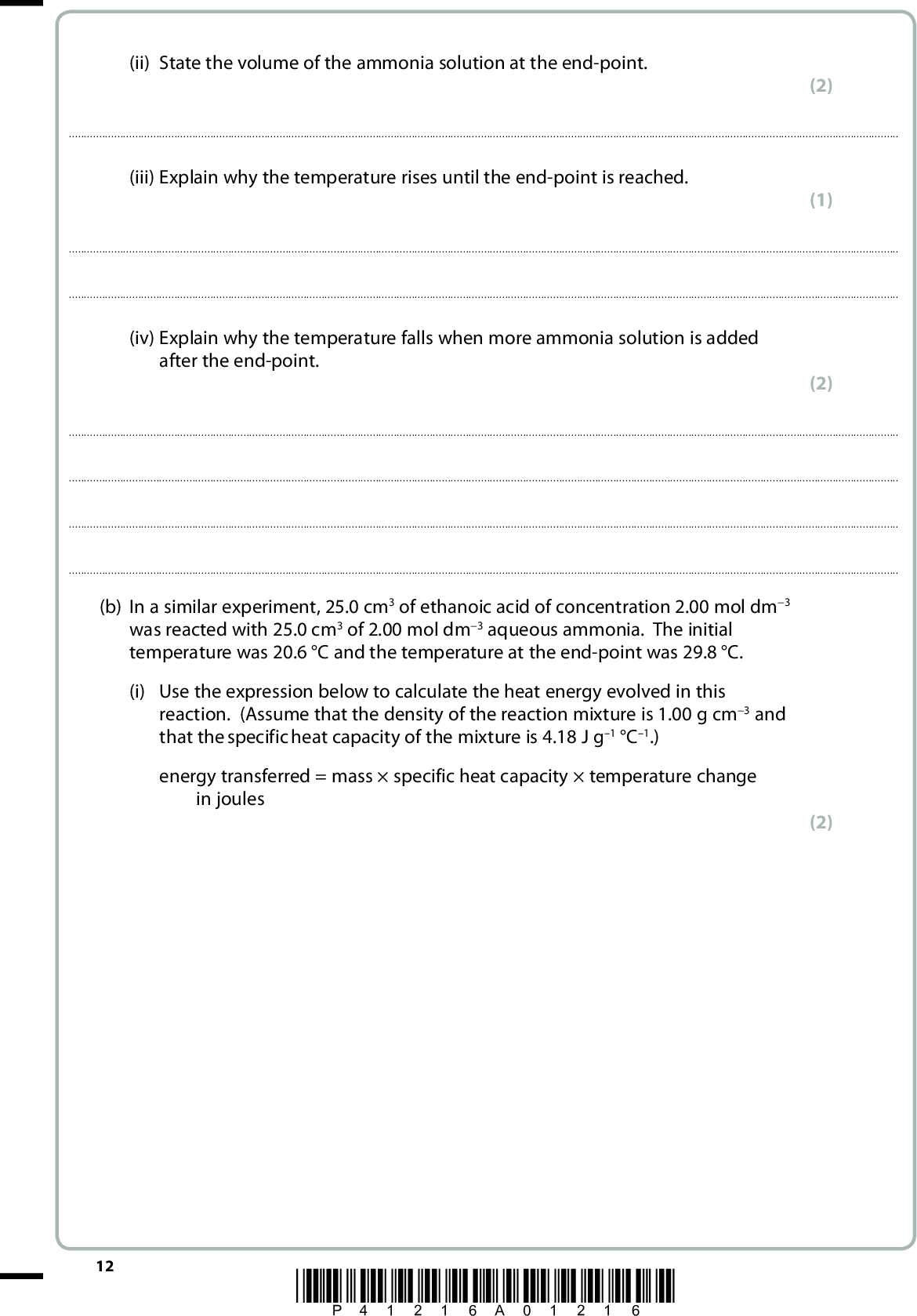
 (ii) State the volume of the ammonia solution at the end-point. (2)(iii) Explain why the temperature rises until the end-point is reached. (1)(iv) Explain why the temperature falls when more ammonia solution is added after the end-point. (2)(b) In a similar experiment, 25.0 cm3 of ethanoic acid of concentration 2.00 mol dm3 was reacted with 25.0 cm3 of 2.00 mol dm3 aqueous ammonia. The initial temperature was 20.6 C and the temperature at the end-point was 29.8 C. 12 (i) Use the expression below to calculate the heat energy evolved in this reaction. (Assume that the density of the reaction mixture is 1.00 g cm3 and that the specific heat capacity of the mixture is 4.18 J g1 C1.) energy transferred = massspecific heat capacitytemperature change in joules (2) *P41216A01216*<br />
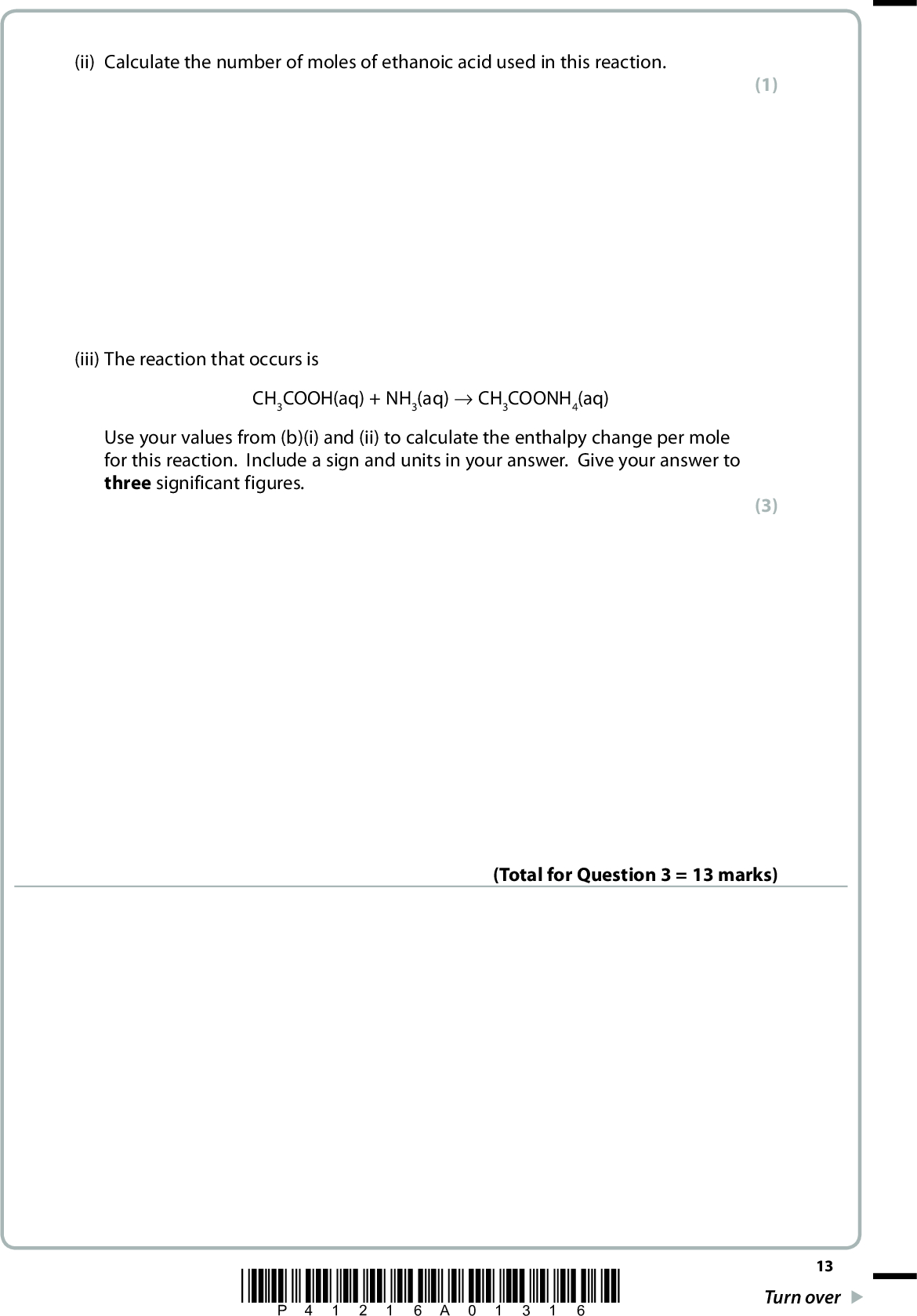
 (ii) Calculate the number of moles of ethanoic acid used in this reaction. (iii) The reaction that occurs is CH3COOH(aq) + NH3(aq)CH3COONH4(aq) Use your values from (b)(i) and (ii) to calculate the enthalpy change per mole for this reaction. Include a sign and units in your answer. Give your answer to three significant figures. (1) (3) (Total for Question 3 = 13 marks) *P41216A01316* 13 Turn over<br />

Show answer