Edexcel Jan 2013 Paper 1 Q17

Answers available below

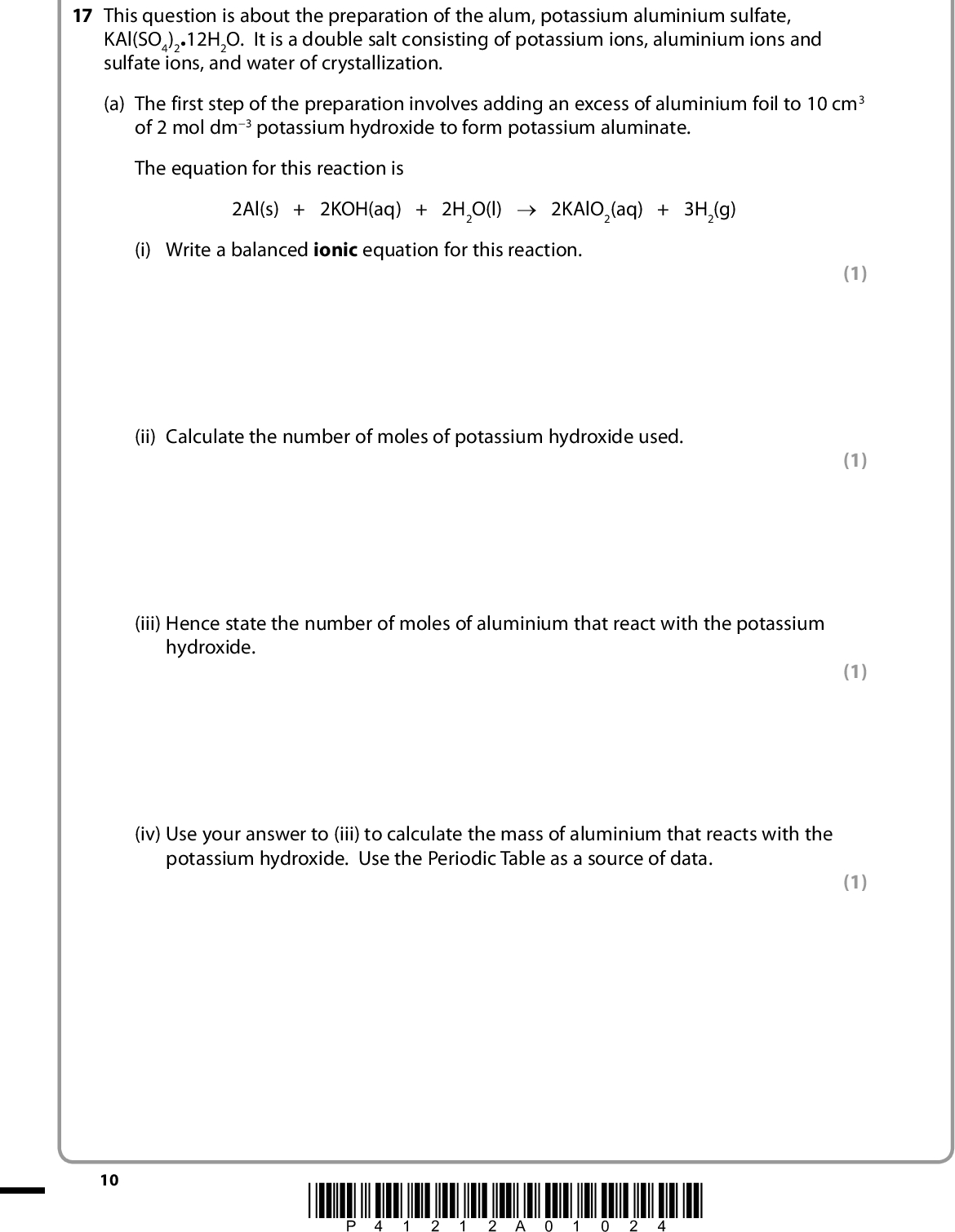
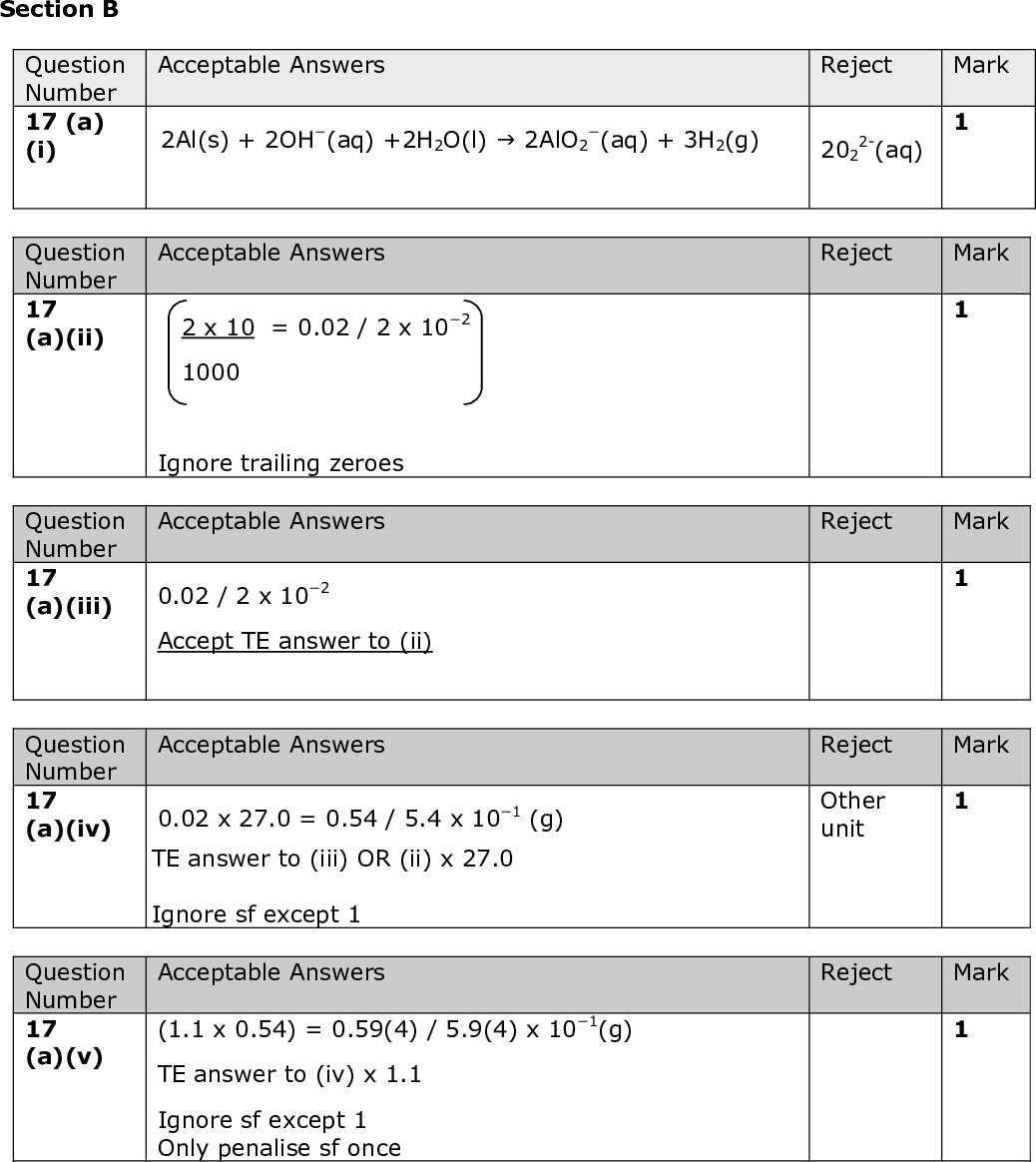
SECTION B Answer ALL the questions. Write your answers in the spaces provided. 17 This question is about the preparation of the alum, potassium aluminium sulfate, KAl(SO4)2(cid:116)12H2O. It is a double salt consisting of potassium ions, aluminium ions and sulfate ions, and water of crystallization. (a) The first step of the preparation involves adding an excess of aluminium foil to 10 cm3 of 2 mol dm3 potassium hydroxide to form potassium aluminate. The equation for this reaction is 2Al(s) + 2KOH(aq) + 2H2O(l) o 2KAlO2(aq) + 3H2(g) (i) Write a balanced ionic equation for this reaction. (1) (1) (1) (1) (ii) Calculate the number of moles of potassium hydroxide used. (iii) Hence state the number of moles of aluminium that react with the potassium hydroxide. (iv) Use your answer to (iii) to calculate the mass of aluminium that reacts with the potassium hydroxide. Use the Periodic Table as a source of data. 10 *P41212A01024*<br />
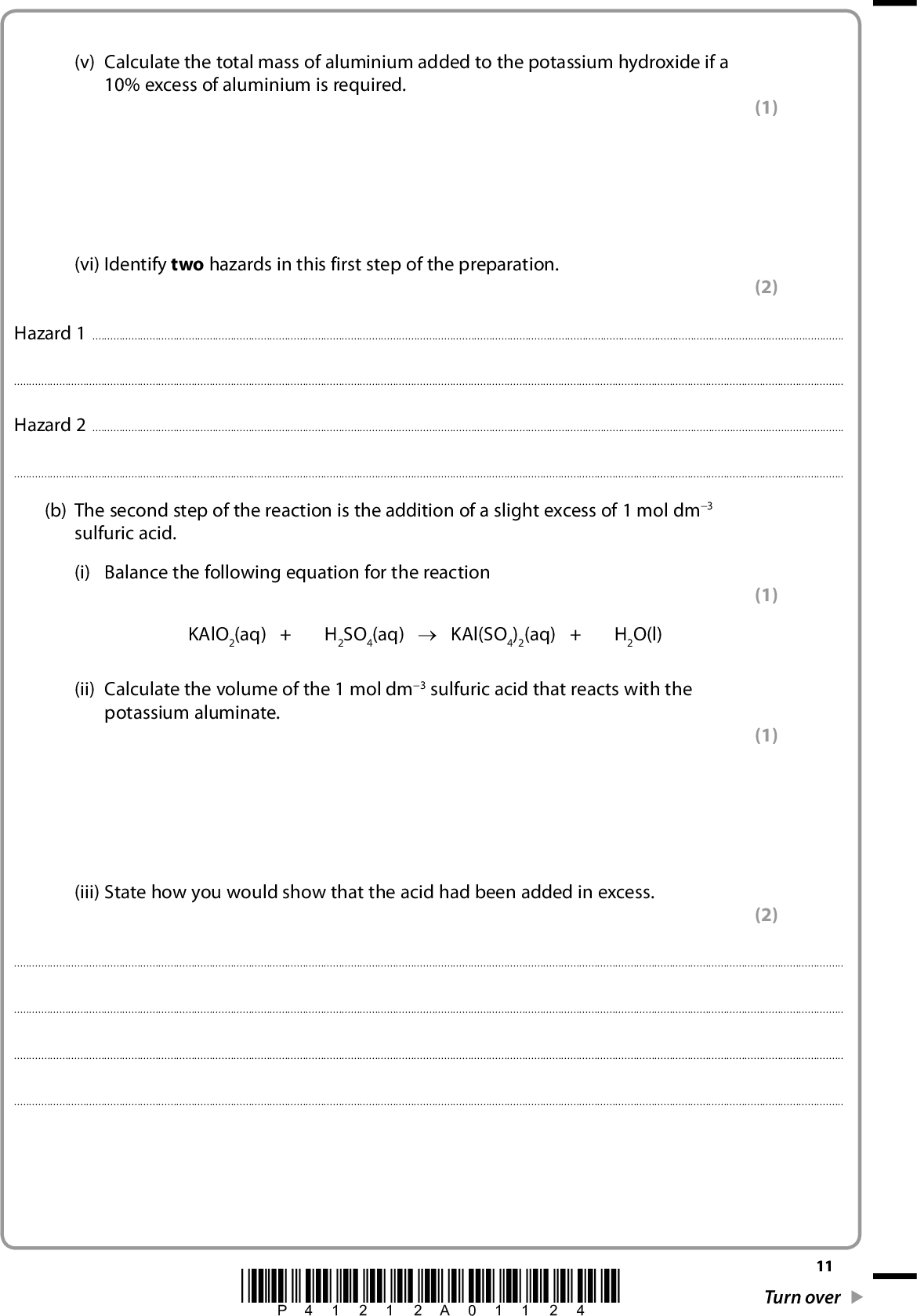
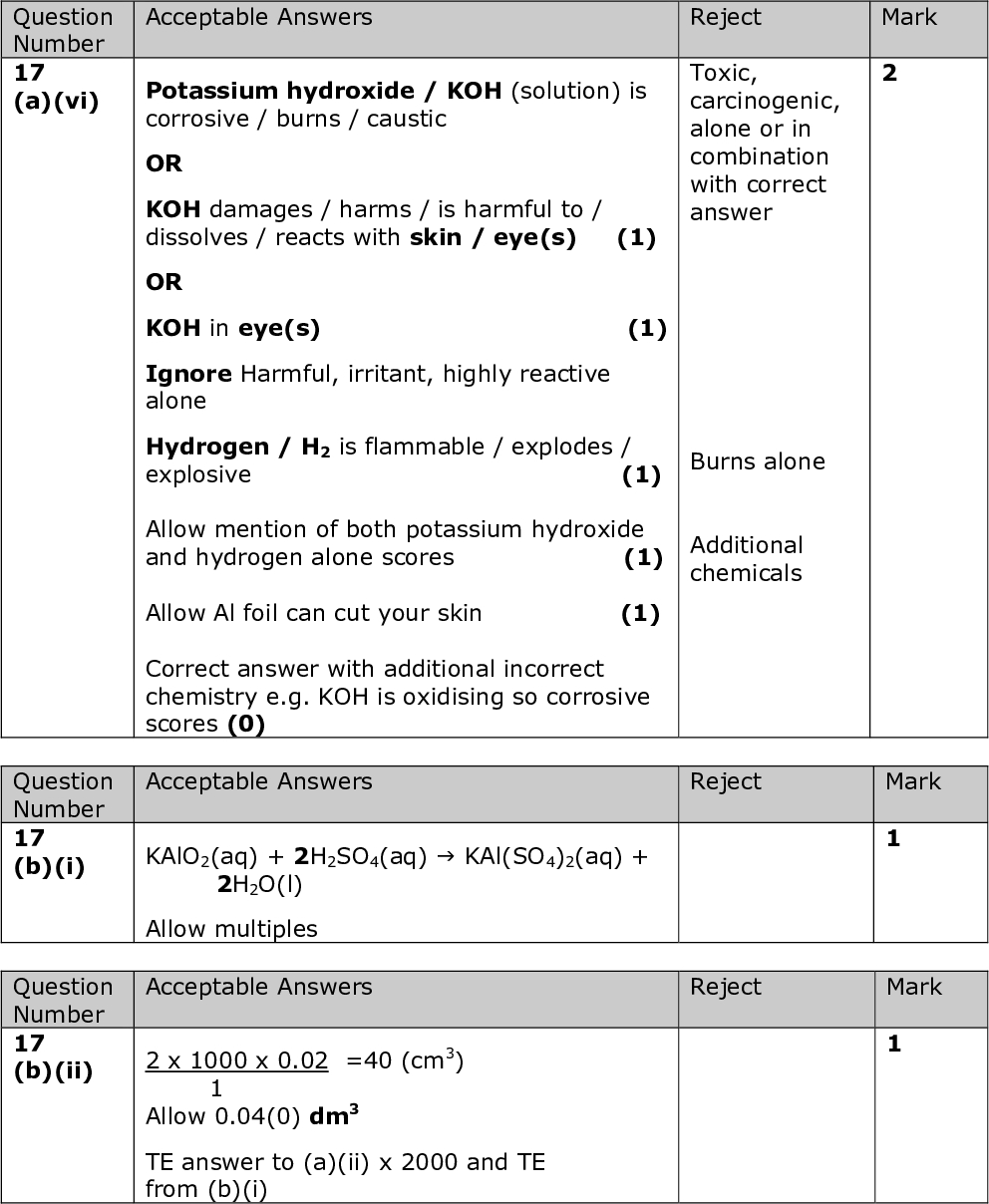
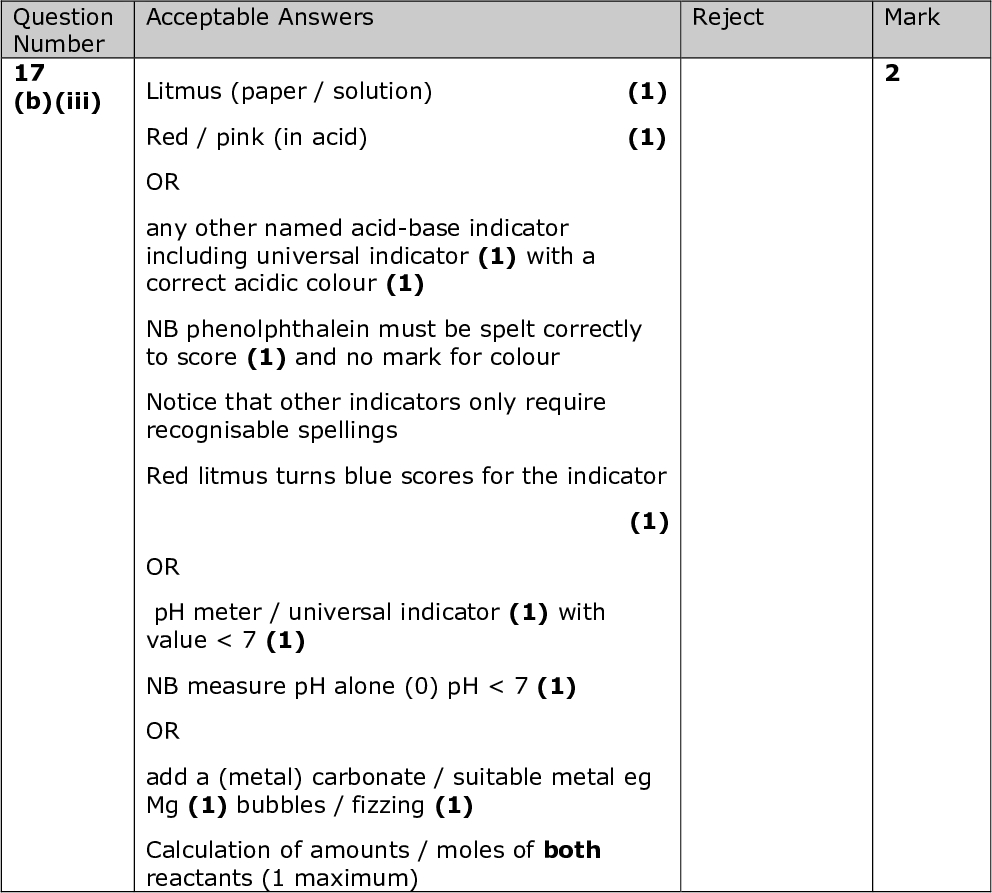
 (v) Calculate the total mass of aluminium added to the potassium hydroxide if a 10% excess of aluminium is required. (vi) Identify two hazards in this first step of the preparation. (1) (2) Hazard 1Hazard 2(b) The second step of the reaction is the addition of a slight excess of 1 mol dm3 sulfuric acid. (i) Balance the following equation for the reaction KAlO2(aq) + H2SO4(aq) o KAl(SO4)2(aq) + H2O(l) (ii) Calculate the volume of the 1 mol dm3 sulfuric acid that reacts with the potassium aluminate. (iii) State how you would show that the acid had been added in excess. (1) (1) (2)*P41212A01124* 11 Turn over<br />
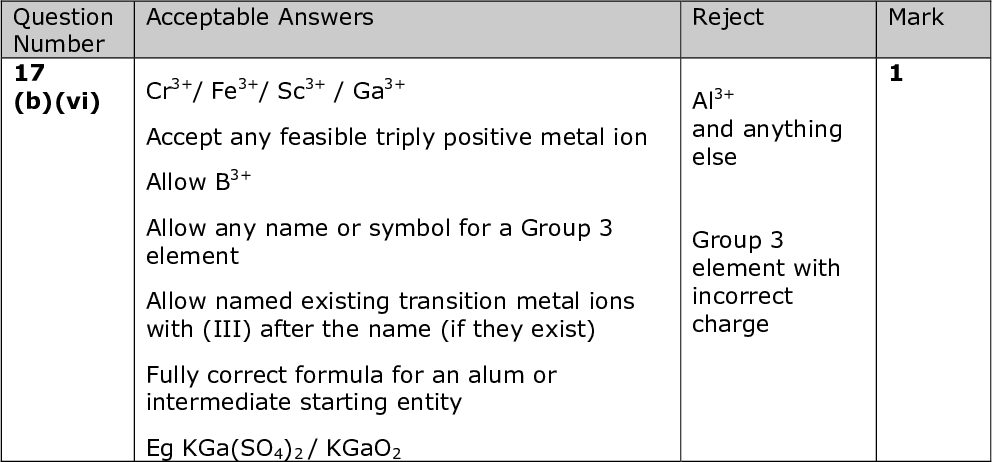
 *(iv) State and explain the steps necessary to obtain pure, dry crystals from the mixture. (4)(v) Suggest the colour of the crystals. (1)(vi) Suggest the formula of another metal ion which could form an alum, in combination with potassium and sulfate ions. (1)(Total for Question 17 = 17 marks) 12 *P41212A01224*<br />

Show answer