Skip to content
Edexcel Jan 2011 Paper 1 Q16
Answers available below
Show answer
Question
15
16
17
18
19

![PMT 16 (a) Coral reefs are produced by living organisms and predominantly made up of calcium carbonate. It has been suggested that coral reefs will be damaged by global warming because of the increased acidity of the oceans due to higher concentrations of carbon dioxide. (i) Write a chemical equation to show how the presence of carbon dioxide in water results in the formation of carbonic acid. State symbols are not required. (ii) Write the ionic equation to show how acids react with carbonates. State symbols are not required. (1) (2) *N37962A01124* 11 Turn over<br />
(b) One method of determining the proportion of calcium carbonate in a coral is to dissolve a known mass of the coral in excess acid and measure the volume of carbon dioxide formed. In such an experiment, 1.13 g of coral was dissolved in 25 cm3 of hydrochloric acid (an excess) in a conical flask. When the reaction was complete, 224 cm3 of carbon dioxide had been collected over water using a 250 cm3 measuring cylinder. (i) Draw a labelled diagram of the apparatus that could be used to carry out this experiment. (ii) Suggest how you would mix the acid and the coral to ensure that no carbon dioxide escaped from the apparatus. PMT (2) (1) . . . . . . . . . . . . . . . . . . . . . . . . . . . . . . . . . . . . . . . . . . . . . . . . . . . . . . . . . . . . . . . . . . . . . . . . . . . . . . . . . . . . . . . . . . . . . . . . . . . . . . . . . . . . . . . . . . . . . . . . . . . . . . . . . . . . . . . . . . . . . . . . . . . . . . . . . . . . . . . . . . . . . . . . . . . . . . . . . . . . . . . . . . . . . . . . . . . . . . . . . . . . . . . . . . . . . . . . . . . . . . . . . . . . . . . . . . . . . . . . . . . . . . . . . . . . . . . . . . . . . . . . . . . . . . . . . . . . . . . . . . . . . . . . . . . . . . . . . . . . . . . . . . . . . . . . . . . . . . . . . . . . . . . . . . . . . . . . . . . . . . . . . . . . . . . . . . . . . . . . . . . . . . . . . . . . . . . . . . . . . . . . . . . . . . . . . . . . . . . . . . . . . . . . . . . . . . . . . . . . . . . . . . . . . . . . . . . . . . . . . . . . . . . . . . . . . . . . . . . . . . . . . . . . . . . . . . . . . . . . . . . . . . . . . . . . . . . . . . . . . . . . . . . . . . . . . . . . . . . . . . . . . . . . . . . . . . . . . . . . . . . . . . . . . . . . . . . . . . . . . . . . . . . . . . . . . . . . . . . . . . . . . . . . . . . . . . . . . . . . . . . . . . . . . . . . . . . . . . . . . . . . . . . . . . . . . . . . . . . . . . . . . . . . . . . . . . . . . . . . . . . . . . . . . . . . . . . . . . . . . . . . . . . . . . . . . . . . . . . . . . . . . . . . . . . . . . . . . . . . (iii) Calculate the number of moles of carbon dioxide collected in the experiment. [The molar volume of any gas is 24 000 cm3 mol1 at room temperature and pressure.] (1) 12 *N37962A01224*<br />
PMT (iv) Complete the equation below for the reaction between calcium carbonate and hydrochloric acid by inserting the missing state symbols. CaCO3(. . . . . . . . . . . . . .) + 2HCl(. . . . . . . . . . . . . .) (cid:111) CaCl2(. . . . . . . . . . . . . .) + H2O(l) + CO2(. . . . . . . . . . . . . .) (v) Calculate the mass of 1 mol of calcium carbonate. [Assume relative atomic masses: Ca = 40, C = 12, O = 16.] (1) (1) (vi) Use your data and the equation in (iv) to calculate the mass of calcium carbonate in the sample and the percentage by mass of calcium carbonate in the coral. Give your final answer to three significant figures. (2) (1) (vii) When this experiment is repeated, the results are inconsistent. Suggest a reason for this other than errors in the procedure, measurements or calculations. . . . . . . . . . . . . . . . . . . . . . . . . . . . . . . . . . . . . . . . . . . . . . . . . . . . . . . . . . . . . . . . . . . . . . . . . . . . . . . . . . . . . . . . . . . . . . . . . . . . . . . . . . . . . . . . . . . . . . . . . . . . . . . . . . . . . . . . . . . . . . . . . . . . . . . . . . . . . . . . . . . . . . . . . . . . . . . . . . . . . . . . . . . . . . . . . . . . . . . . . . . . . . . . . . . . . . . . . . . . . . . . . . . . . . . . . . . . . . . . . . . . . . . . . . . . . . . . . . . . . . . . . . . . . . . . . . . . . . . . . . . . . . . . . . . . . . . . . . . . . . . . . . . . . . . . . . . . . . . . . . . . . . . . . . . . . . . . . . . . . . . . . . . . . . . . . . . . . . . . . . . . . . . . . . . . . . . . . . . . . . . . . . . . . . . . . . . . . . . . . . . . . . . . . . . . . . . . . . . . . . . . . . . . . . . . . . . . . . . . . . . . . . . . . . . . . . . . . . . . . . . . . . . . . . . . . . . . . . . . . (Total for Question 16 = 12 marks) *N37962A01324* 13 Turn over<br />](https://learnah.org/wp-content/uploads/2018/08/l_smalljpgJanuary_2011_QP_-_Unit_1_Edexcel_Chemistry_A-level_16-0.jpg)


![Question Number 16 (a) (i) Question Number 16 (a) (ii) Question Number 16 (b) (i) Mark Mark Mark Acceptable Answers H2O + CO2 (cid:138) H2CO3 (Allow atoms in H2CO3 in any order) Or H2O + CO2 (cid:138) H+ + HCO3 Or H2O + CO2 (cid:138) 2H+ + CO3 Or H3O+ in place of H+ IGNORE STATE SYMBOLS EVEN IF INCORRECT2 Reject Acceptable Answers Reject 2 (cid:138) H2O + CO2 2H+ + CO3 LHS (1) RHS (1) OR 2H3O+ + CO3 LHS (1) RHS (1) IGNORE STATE SYMBOLS, EVEN IF INCORRECT IGNOREarrows 2 (cid:138) 3H2O + CO22 (cid:138) HCO3 H2CO3 as a product H+ + CO3 Any other ions including spectator ions (e.g. Ca2+, Cl) in the equation scores zero Acceptable Answers Reject If collection over water is not somehow evident Conical flask and a delivery tube leaving the conical flask (1) IGNORE heat beneath conical flask Inverted measuring cylinder with collection over water shown and cylinder above mouth of delivery tube (1) ALLOW collection over water to be shown/implied in the diagram without labels or other annotation 6CH01/01 1101<br />
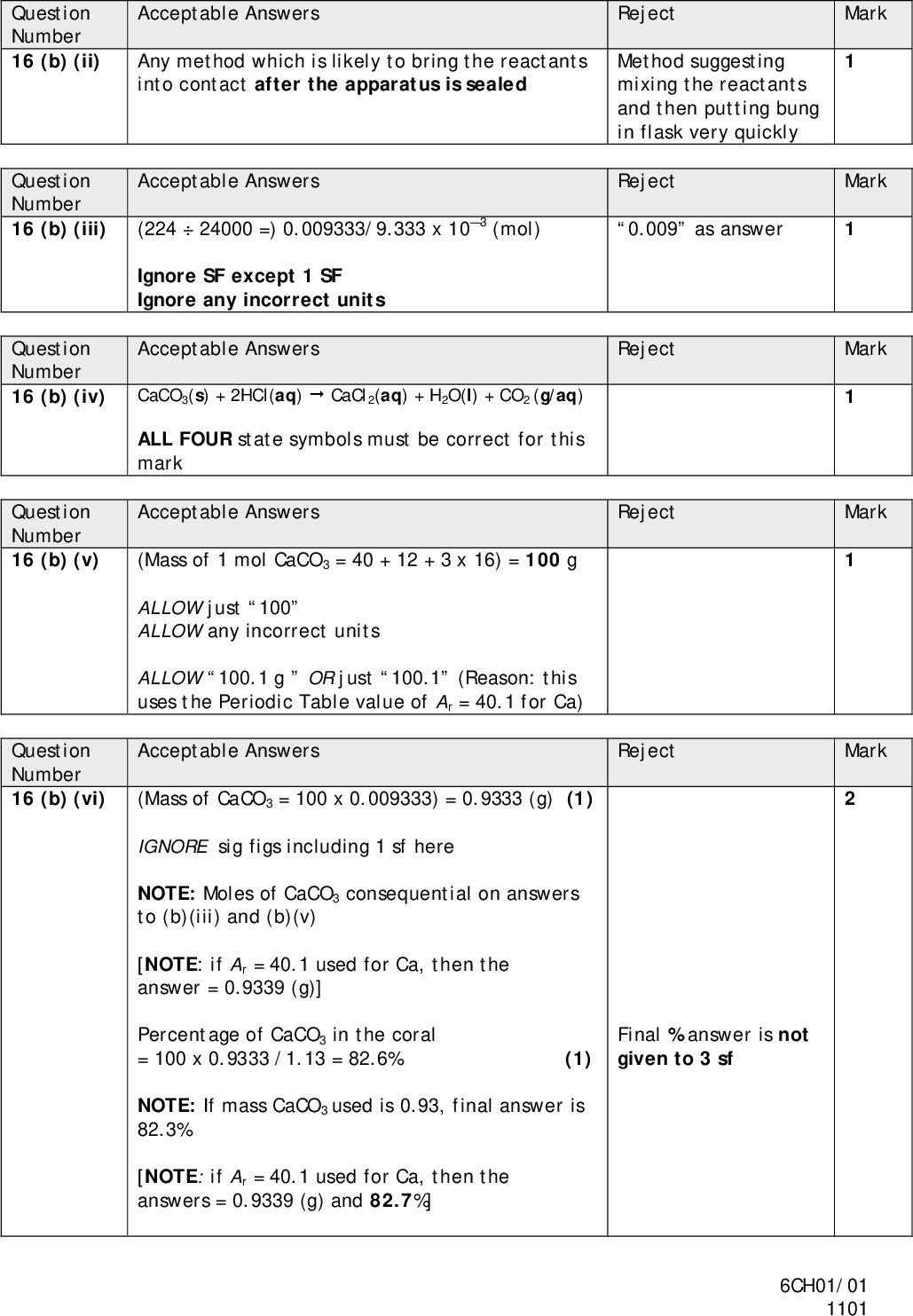
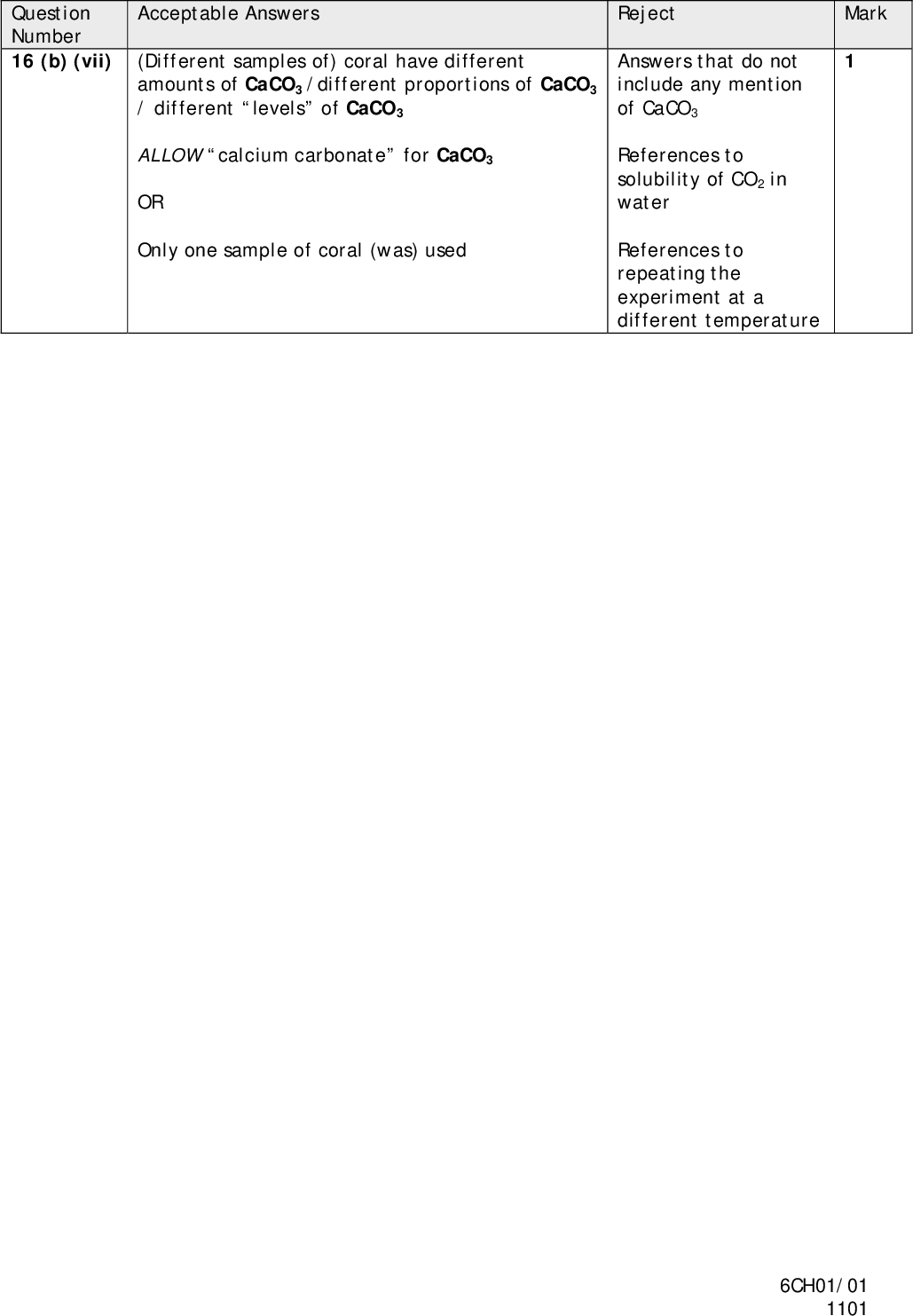
Question Number 16 (b) (ii) Question Number 16 (b) (iii) Question Number 16 (b) (iv) Question Number 16 (b) (v) Question Number 16 (b) (vi) Acceptable Answers Reject Any method which is likely to bring the reactants into contact after the apparatus is sealed Method suggesting mixing the reactants and then putting bung in flask very quickly Mark Acceptable Answers (22424000 =) 0.009333/9.333 x 103 (mol) Ignore SF except 1 SF Ignore any incorrect units Reject Mark 0.009 as answer Mark Mark Mark Acceptable Answers Reject CaCO3(s) + 2HCl(aq) (cid:138) CaCl2(aq) + H2O(l) + CO2 (g/aq) ALL FOUR state symbols must be correct for this mark Acceptable Answers (Mass of 1 mol CaCO3 = 40 + 12 + 3 x 16) = 100 g ALLOW just 100 ALLOW any incorrect units ALLOW 100.1 gOR just 100.1 (Reason: this uses the Periodic Table value of Ar = 40.1 for Ca) Reject Acceptable Answers Reject Final % answer is not given to 3 sf (Mass of CaCO3 = 100 x 0.009333) = 0.9333 (g) (1) IGNORE sig figs including 1 sf here NOTE: Moles of CaCO3 consequential on answers to (b)(iii) and (b)(v) [NOTE: if Ar = 40.1 used for Ca, then the answer = 0.9339 (g)] Percentage of CaCO3 in the coral = 100 x 0.9333 /1.13 = 82.6% (1) NOTE: If mass CaCO3 used is 0.93, final answer is 82.3% [NOTE: if Ar = 40.1 used for Ca, then the answers = 0.9339 (g) and 82.7%] 6CH01/01 1101<br />
Question Number 16 (b) (vii) Mark Acceptable Answers Reject (Different samples of) coral have different amounts of CaCO3 /different proportions of CaCO3 / different levels of CaCO3 ALLOW calcium carbonate for CaCO3 OR Only one sample of coral (was) used Answers that do not include any mention of CaCO3 References to solubility of CO2 in water References to repeating the experiment at a different temperature 6CH01/01 1101<br />](https://learnah.org/wp-content/uploads/2018/08/January_2011_MS_-_Unit_1_Edexcel_Chemistry_A-level_16-0.jpg)