Skip to content
CIE Nov 2017 v3 Paper 4 Q1
Answers available below
Show answer
Question
1
2
3
4
5
6
7
8

![Answer all the questions in the spaces provided. The compound nitrosyl bromide, NOBr, can be formed by the reaction shown. PMT (a) Using oxidation numbers, explain why this reaction is a redox reaction. 2NO + Br2 2NOBr[2] (b) Nitrosyl bromide contains a trivalent nitrogen atom. Draw the dot-and-cross diagram for NOBr. Show outer electrons only. (c) The rate of the reaction was measured at various concentrations of the two reactants, NO and Br2, and the following results were obtained. [2] experiment [NO] / mol dm3 [Br2] / mol dm3 1 2 3 4 0.03 0.03 0.09 0.12 0.02 0.04 0.04 0.06 initial rate / mol dm3 s1 3.4103 6.8103 6.1102 to be calculated The general form of the rate equation for this reaction is as follows. rate = k [NO]a[Br2]b (i) What is meant by the term order of reaction with respect to a particular reagent?[1]UCLES 2017 9701/43/O/N/17<br />
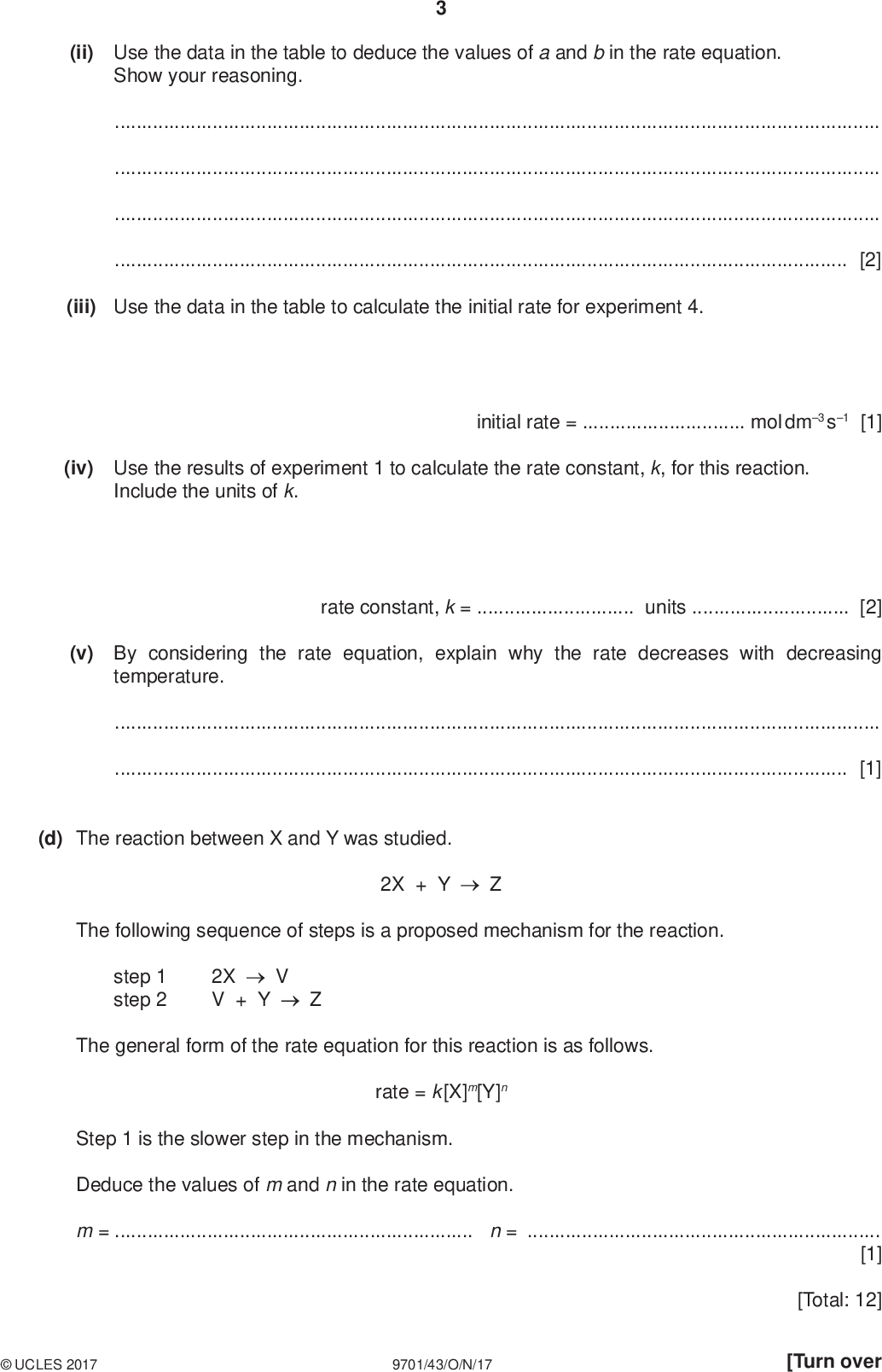
PMT (ii) Use the data in the table to deduce the values of a and b in the rate equation. Show your reasoning.[2] (iii) Use the data in the table to calculate the initial rate for experiment 4. (iv) Use the results of experiment 1 to calculate the rate constant, k, for this reaction. Include the units of k. initial rate =mol dm3 s1 [1] rate constant, k =units[2] (v) By considering the rate equation, explain why the rate decreases with decreasing temperature.[1] (d) The reaction between X and Y was studied. 2X + Y The following sequence of steps is a proposed mechanism for the reaction. step 1 step 2 V 2X V + Y The general form of the rate equation for this reaction is as follows. rate = k [X]m[Y]n Step 1 is the slower step in the mechanism. Deduce the values of m and n in the rate equation. m =n =[1]UCLES 2017 9701/43/O/N/17 [Total: 12] [Turn over<br />](https://learnah.org/wp-content/uploads/2018/08/November_2017_v3_QP_-_Paper_4_CIE_Chemistry_A-level_1-0.jpg)
![9701/43 Question Cambridge International AS/A LevelMark Scheme PUBLISHED Answer 1(a) N +2 to +3 (and oxidised) Br2 / Br 0 to 1 (and reduced) 1(b) PMT October/November 2017 Marks 1 1 1(c)(i) 1(c)(ii) (c)(iii) 1(c)(iv) 1(c)(v) 3 bonding pairs around N (in a structure involving NOBr) rest of molecule correct the power to which a concentration of a reactant is raised in the rate equation using expt. 2 and 3 a = 2 or [NO] 2nd order and conc3 rate9 or 6.1102 using expt. 1 and 2 b = 1 or [Br2] 1st order and conc2 rate2 or 6.8103 initial rate = 0.16(32) / 6.8103 = (0.09 / 0.03)a / 3.4103 = (0.04 / 0.02)b (0.0034 = k(0.03)2(0.02)) k = 188.9 s1 dm6 mol2 k decreases (as rate decreases)UCLES 2017 Page 2 of 13 1 1 1 1 1 1 1 1<br />
9701/43 Question 1(d) m = 2 and n = 0 Cambridge International AS/A LevelMark Scheme PUBLISHED Answer PMT October/November 2017 Marks 1 Question 2(a) 2(b)(i) it / solubility decreases down the group and Ksp decreases MgCO3(s)Mg2+(aq) + CO3 2(aq) Answer 2(b)(ii) (white) solid appears / precipitation (of MgCO3) as [CO3 2] increases shifting equilibrium to the LHS (precipitating out MgCO3) 2(c) 2(d)(i) 2(d)(ii) 2(d)(iii) mol dm3 solubility = 1.010-5 = 3.16103 solubility= 3.210384.3 = 0.27 g dm3 Mg2+ ion is smaller than Ba2+ ion or ionic radii increase down group ora (Mg2+) distorts / polarises / the anion / nitrate group / nitrate ion / NO3 (1) / NO3 ion more easily (than Ba2+) ora Ba(NO3)2BaO + 2NO2 + O2 BaO + H2OBa(OH)2 Ba(OH)2 + H2SO4BaSO4 + 2H2O Marks 1 1 1 1 1 1 1 1 1 1 1UCLES 2017 Page 3 of 13<br />](https://learnah.org/wp-content/uploads/2018/08/November_2017_v3_MS_-_Paper_4_CIE_Chemistry_A-level_1-0.jpg)
