Skip to content
CIE Nov 2016 v1 Paper 3 Q1
Answers available below
Show answer
Question
1
2
3

![In Questions 1 and 2 you will determine the percentage purity of industrial grade calcium carbonate, CaCO3, by two different methods. PMT In the first method you will collect and measure the volume of gas given off in the reaction between a known mass of industrial grade calcium carbonate, in the form of small marble chips, and a known amount of dilute hydrochloric acid. The acid will be in excess. The impurities in the calcium carbonate will not react with the acid. CaCO3(s) + 2HCl (aq)CaCl 2(aq) + H2O(l) + CO2(g) FA 1 is industrial grade calcium carbonate, CaCO3, in the form of small marble chips. FA 2 is 2.00 mol dm3 hydrochloric acid, HCl. (a) Method Read through the whole method before starting any practical work. The diagram below may help you in setting up your apparatus. clamp clamp water tubFill the tub with water to a depth of about 5 cm. Fill the 250 cm3 measuring cylinder completely with water. Hold a piece of paper towel firmly over the top, invert the measuring cylinder and place it in the water in the tub. Remove the paper towel and clamp the inverted measuring cylinder so the open end is in the water just above the base of the tub. Pipette 25.0 cm3 of FA 2 into the reaction flask labelled X. Check that the bung fits tightly in the neck of flask X, clamp flask X and place the end of the delivery tube into the inverted 250 cm3 measuring cylinder. Weigh the container with FA 1 and record the mass in the space on page 3. Remove the bung from the neck of the flask. Tip FA 1 into the acid and replace the bung immediately. Remove the flask from the clamp and swirl it to mix the contents. Swirl the flask occasionally until no more gas is evolved. Replace the flask in the clamp. Reweigh the container and any residue of FA 1 and record the mass in the space on page 3. Calculate and record in the space on page 3 the mass of FA 1 used. When no more gas is given off, measure and record the final volume of gas in the measuring cylinder in the space on page 3. Keep the contents of flask X for use in Question 2.UCLES 2016 9701/31/O/N/16<br />
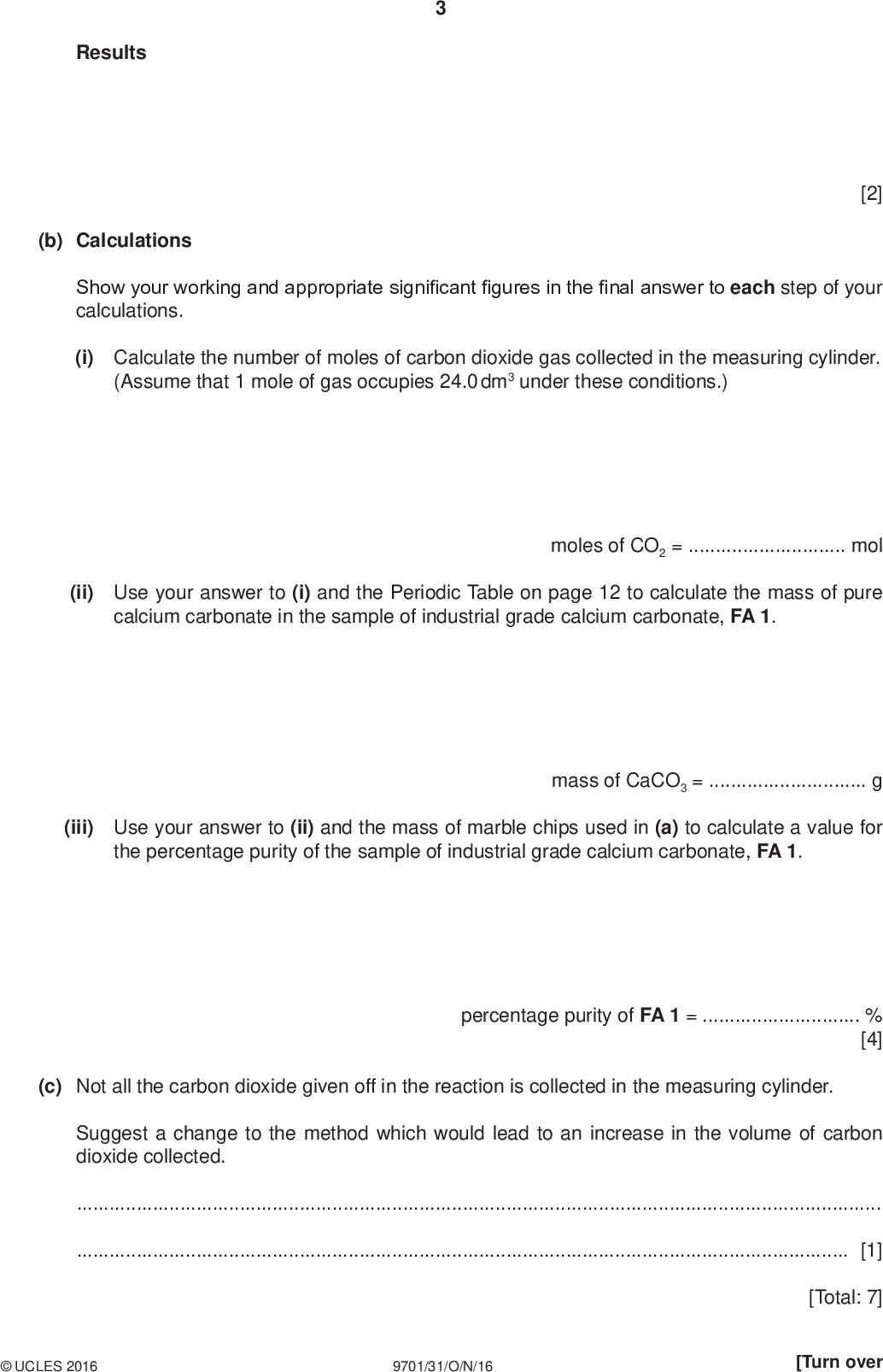
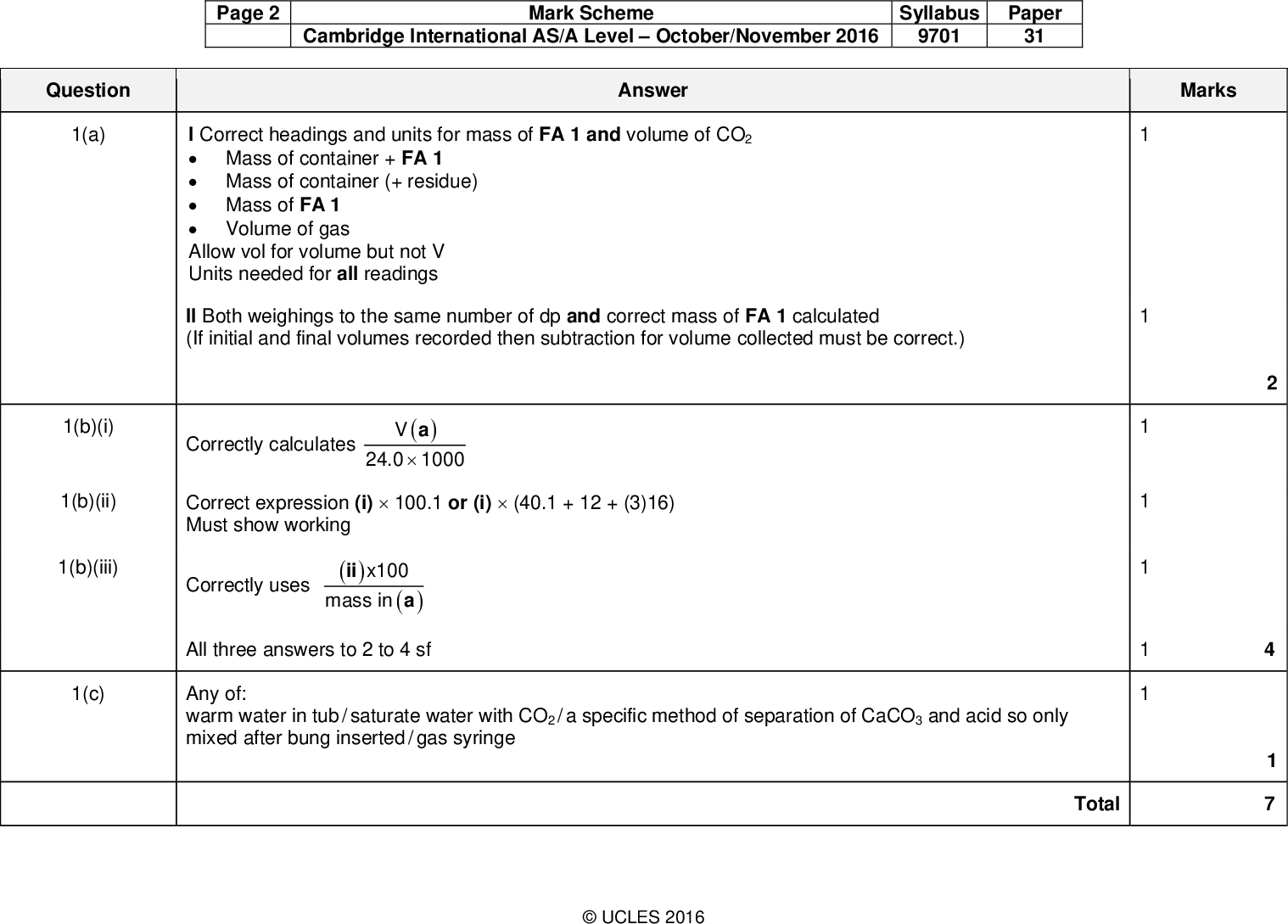
Results PMT [2] (b) Calculations Show your working and appropriate significant figures in the final answer to each step of your calculations. (i) Calculate the number of moles of carbon dioxide gas collected in the measuring cylinder. (Assume that 1 mole of gas occupies 24.0 dm3 under these conditions.) (ii) Use your answer to (i) and the Periodic Table on page 12 to calculate the mass of pure calcium carbonate in the sample of industrial grade calcium carbonate, FA 1. moles of CO2 =mol (iii) Use your answer to (ii) and the mass of marble chips used in (a) to calculate a value for the percentage purity of the sample of industrial grade calcium carbonate, FA 1. mass of CaCO3 =g percentage purity of FA 1 =% [4] (c) Not all the carbon dioxide given off in the reaction is collected in the measuring cylinder. Suggest a change to the method which would lead to an increase in the volume of carbon dioxide collected.[1]UCLES 2016 9701/31/O/N/16 [Total: 7] [Turn over<br />
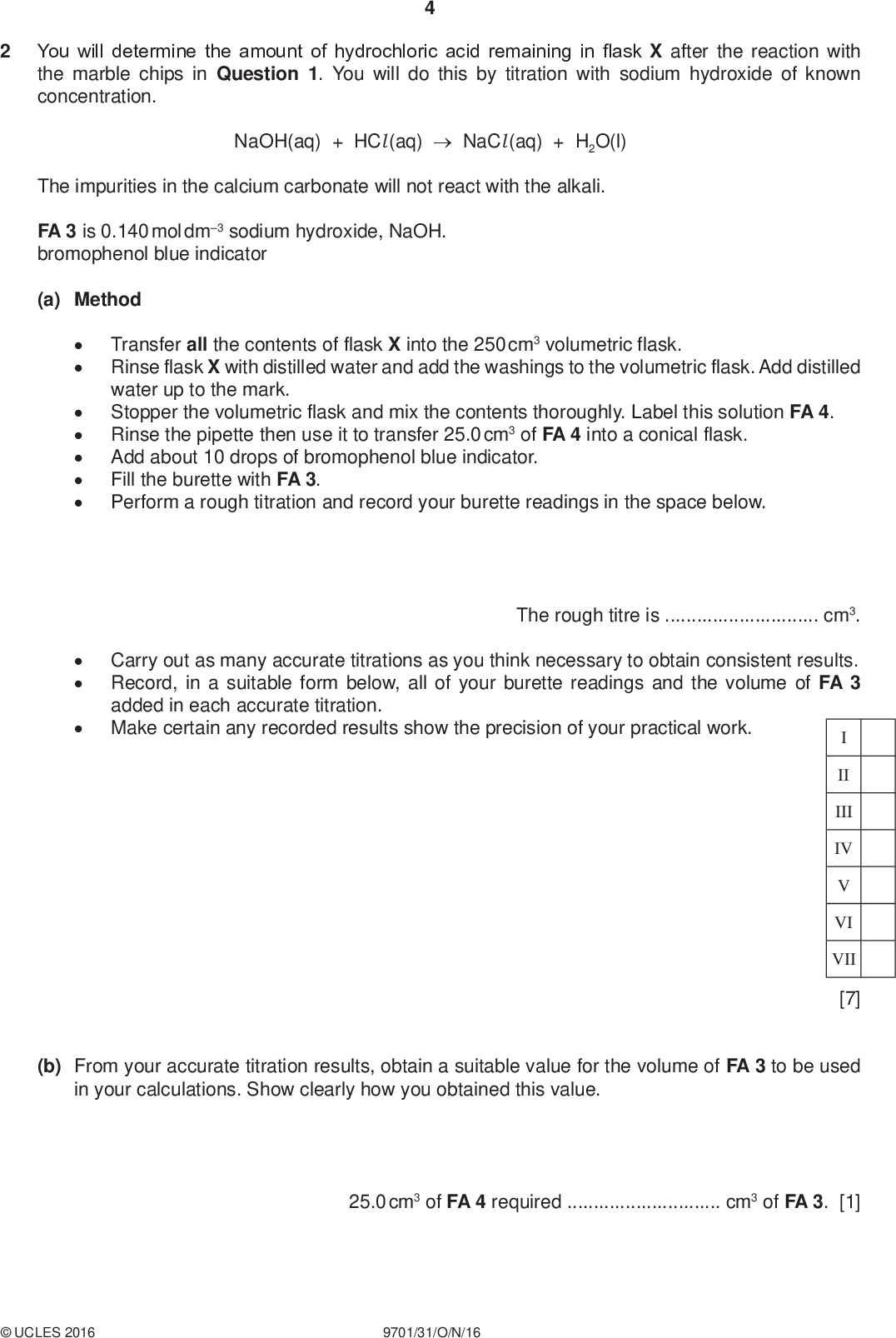
You will determine the amount of hydrochloric acid remaining in flask X after the reaction with the marble chips in Question 1. You will do this by titration with sodium hydroxide of known concentration. PMT NaOH(aq) + HCl (aq)NaCl (aq) + H2O(l) The impurities in the calcium carbonate will not react with the alkali. FA 3 is 0.140 mol dm3 sodium hydroxide, NaOH. bromophenol blue indicator (a) MethodTransfer all the contents of flask X into the 250 cm3 volumetric flask. Rinse flask X with distilled water and add the washings to the volumetric flask. Add distilled water up to the mark. Stopper the volumetric flask and mix the contents thoroughly. Label this solution FA 4. Rinse the pipette then use it to transfer 25.0 cm3 of FA 4 into a conical flask. Add about 10 drops of bromophenol blue indicator. Fill the burette with FA 3. Perform a rough titration and record your burette readings in the space below. The rough titre iscm3. Carry out as many accurate titrations as you think necessary to obtain consistent results. Record, in a suitable form below, all of your burette readings and the volume of FA 3 added in each accurate titration. Make certain any recorded results show the precision of your practical work. II III IV VI VII [7] (b) From your accurate titration results, obtain a suitable value for the volume of FA 3 to be used in your calculations. Show clearly how you obtained this value. 25.0 cm3 of FA 4 requiredcm3 of FA 3. [1]UCLES 2016 9701/31/O/N/16<br />](https://learnah.org/wp-content/uploads/2018/08/November_2016_v1_QP_-_Paper_3_CIE_Chemistry_A-level_1-0.jpg)