Skip to content
CIE Nov 2015 v3 Paper 3 Q3
Answers available below
Show answer
Question
1
2
3

![Qualitative Analysis PMT At each stage of any test you are to record details of the following.colour changes seen the formation of any precipitate the solubility of such precipitates in an excess of the reagent added Where gases are released they should be identi ed by a test, described in the appropriate place in your observations. You should indicate clearly at what stage in a test a change occurs. No additional tests for ions present should be attempted. If any solution is warmed, a boiling tube MUST be used. Rinse and reuse test-tubes and boiling tubes where possible. Where reagents are selected for use in a test, the name or correct formula of the element or compound must be given. (a) (i) FA 5, FA 6 and FA 7 are aqueous solutions each containing one anion and one cation. Carry out the experiments described below and record your observations for each solution in the table. FA 5 FA 6 FA 7 To a 1 cm depth in a test-tube, add a 1 cm depth of aqueous sodium carbonate. To a 1 cm depth in a test-tube, add a 1 cm depth of aqueous copper(II) sulfate. To a 1 cm depth in a test-tube, add a 1 cm depth of aqueous barium chloride or aqueous barium nitrate. (ii) What ion is present in both FA 6 and FA 7?(iii) The anion in FA 5 is one of carbonate, chloride, nitrate or sulfate. Which anion is present in FA 5?(iv) Write the ionic equation, including state symbols, for the reaction between FA 5 and aqueous copper(II) sulfate.[7]UCLES 2015 9701/33/O/N/15 [Turn over<br />
PMT (b) FA 8 contains two anions and two cations from the lists on pages 10 and 11.To a 5 cm depth of distilled water in a boiling tube, add all the FA 8. Shake the boiling tube thoroughly for one minute to make sure that no more of the solid will dissolve. Filter the mixture into a clean boiling tube. Place the filter funnel in a conical flask and wash the residue with a little distilled water. Keep both filtrate and residue for tests (i) and (ii) below. (i) Tests on theltrate (the solution in the boiling tube) Carry out the following tests and record your observations in the table below. test observations To a 1 cm depth of theltrate in a test-tube, add aqueous sodium hydroxide, then add aqueous hydrogen peroxide. (ii) Tests on the residue Carry out the following tests and record your observations in the table below. test observations Place the funnel containing the residue into a clean boiling tube. Pour approximately 5 cm3 of dilute nitric acid onto the residue. Collect a 1 cm depth of solution in the boiling tube. Remove the funnel and return it to the conicalask. To this solution in the boiling tube, add aqueous sodium hydroxide.UCLES 2015 9701/33/O/N/15<br />
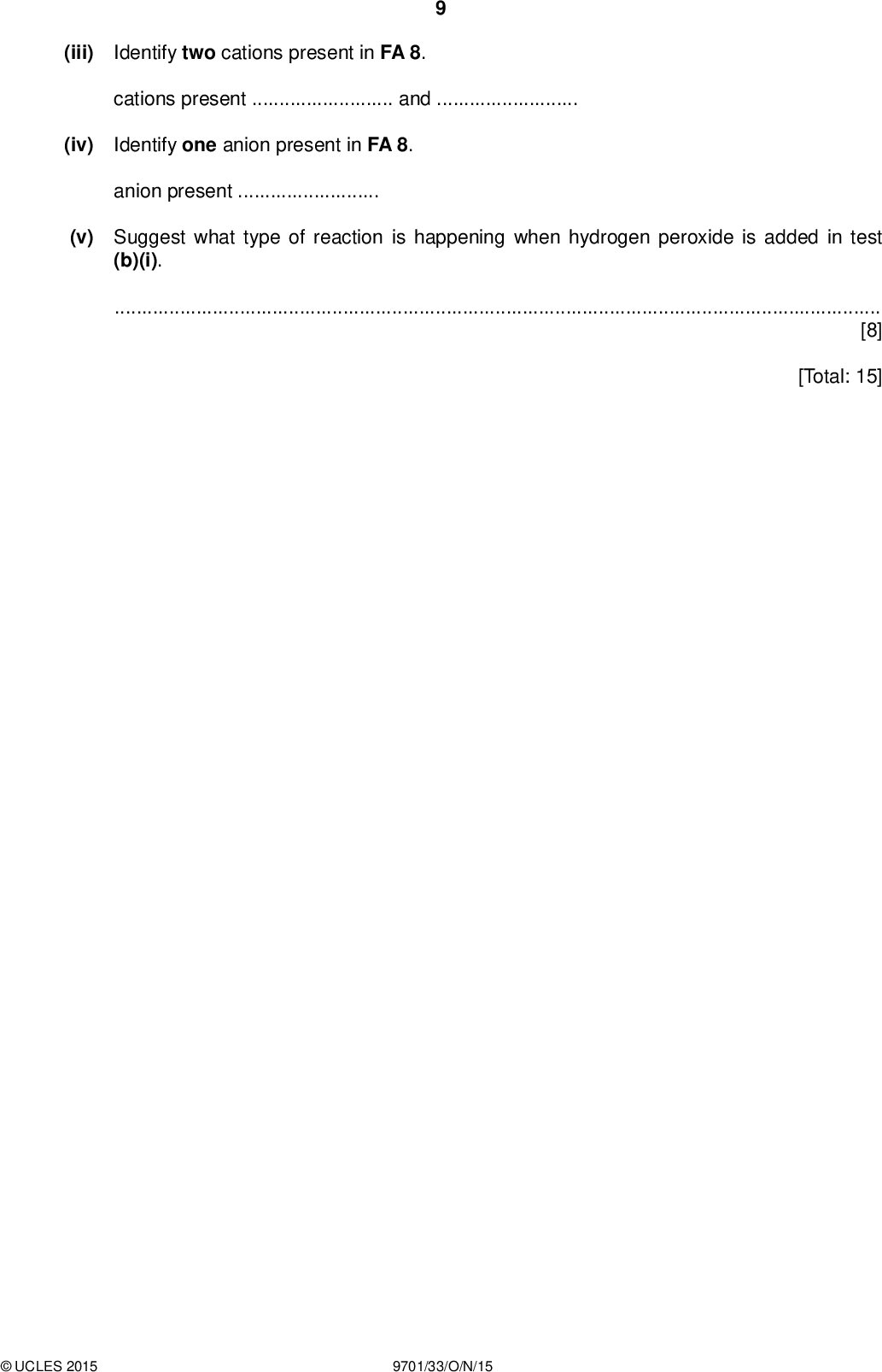
PMT (iii) Identify two cations present in FA 8. cations presentand(iv) Identify one anion present in FA 8. anion present(v) Suggest what type of reaction is happening when hydrogen peroxide is added in test (b)(i).[8] [Total: 15]UCLES 2015 9701/33/O/N/15 [Turn over<br />](https://learnah.org/wp-content/uploads/2018/08/November_2015_v3_QP_-_Paper_3_CIE_Chemistry_A-level_3-0.jpg)

![Page 5 Mark Scheme Syllabus Paper Cambridge International AS/A LevelOctober/November 2015 9701 33 Question Indicative material Mark Total FA 5 is Na2CO3(aq); FA 6 is H2SO4(aq); FA 7 is CH3COOH(aq); FA 8 is MnSO4(s) and MgCO3(s) (a) (i) See table FA 5 FA 6 FA 7 + Na2CO3 no reaction + CuSO4 blue ppt (not dark blue) effervescence / bubbling / fizzing or gas turns limewater milky / cloudy white / white ppt no reaction / no change / no ppt / pale or light blue (solution) (notor no observation) effervescence / bubbling / fizzing or gas turns limewater milky / cloudy white / white ppt no reaction / no change / no ppt / pale or light blue (solution) (notor no observation) + BaCl2 / Ba(NO3)2 white ppt white ppt no reaction / no change / no ppt (ii) H+ / hydrogen ion (iii) CO3 2 / carbonate (iv) Cu2+(aq) + CO3 2(aq)CuCO3(s) [7]Cambridge International Examinations 2015<br />
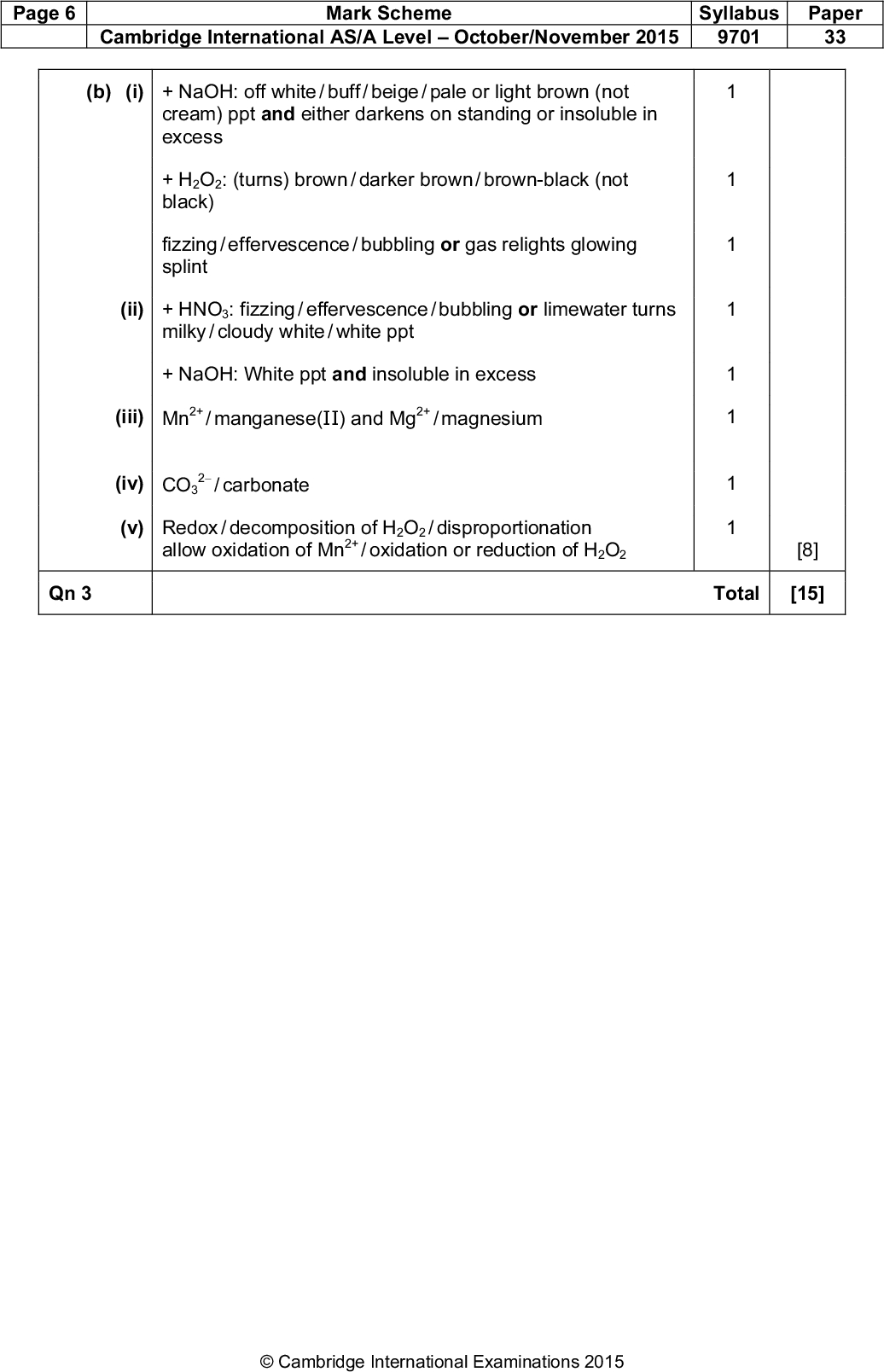
Page 6 Mark Scheme Syllabus Paper Cambridge International AS/A LevelOctober/November 2015 9701 33 (b) (i) + NaOH: off white / buff / beige / pale or light brown (not cream) ppt and either darkens on standing or insoluble in excess Qn 3 [8] Total [15] + H2O2: (turns) brown / darker brown / brown-black (not black) fizzing / effervescence / bubbling or gas relights glowing splint (ii) + HNO3: fizzing / effervescence / bubbling or limewater turns milky / cloudy white / white ppt + NaOH: White ppt and insoluble in excess (iii) / manganese(II) and Mg2+ / magnesium Mn2+ (iv) CO3 2 / carbonate (v) Redox / decomposition of H2O2 / disproportionation allow oxidation of Mn2+ / oxidation or reduction of H2O2Cambridge International Examinations 2015<br />](https://learnah.org/wp-content/uploads/2018/08/November_2015_v3_MS_-_Paper_3_CIE_Chemistry_A-level_3-0.jpg)