Skip to content
CIE Nov 2014 v4 Paper 3 Q2
Answers available below
Show answer
Question
1
2
3

![In this experiment you will determine the enthalpy change, H, for the catalytic decomposition of hydrogen peroxide into water and oxygen. PMT H2O2(aq)H2O(l) + 2 1 O2(g) FB 3 is aqueous hydrogen peroxide, H2O2. FB 5 is manganese(IV) oxide, MnO2, the catalyst for the decomposition. (a) Method Read through the method before starting any practical work and prepare a table for your results in the space below.For the first experiment, support the plastic cup inside the 250 cm3 beaker. Use a measuring cylinder to transfer 40 cm3 of distilled water into the plastic cup. Use a measuring cylinder to add 10 cm3 of FB 3 into the plastic cup. Measure and record the initial temperature of the mixture. Add a heaped spatula measure of FB 5 to the mixture in the plastic cup. Stir constantly until the maximum temperature is reached and record this temperature. Calculate and record the temperature rise. Wash and wipe out your plastic cup and rinse the thermometer, ready for the second experiment. For the second experiment, support the plastic cup inside the 250 cm3 beaker. Use a measuring cylinder to transfer 30 cm3 of distilled water into the plastic cup. Use a measuring cylinder to add 20 cm3 of FB 3 into the plastic cup. Measure and record the initial temperature of the mixture. Add a heaped spatula measure of FB 5 to the mixture in the plastic cup. Stir constantly until the maximum temperature is reached and record this temperature. Calculate and record the temperature rise. Wash and wipe out your plastic cup and rinse the thermometer, ready for the third experiment. Carry out the third experiment in a similar way. Transfer 20 cm3 of distilled water into the plastic cup. Add 30 cm3 of FB 3 into the plastic cup. Measure and record the initial temperature of the mixture. Add a heaped spatula measure of FB 5 to the mixture in the plastic cup. Record the maximum temperature, then calculate and record the temperature rise. For the fourth experiment, use 10 cm3 of distilled water and 40 cm3 of FB 3. II III IV [5]UCLES 2014 9701/34/O/N/14<br />
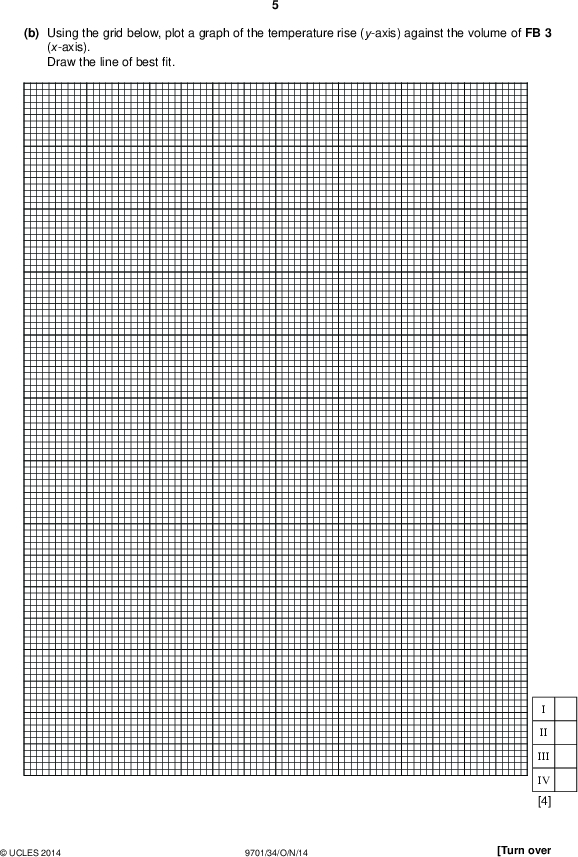
(b) Using the grid below, plot a graph of the temperature rise (y-axis) against the volume of FB 3 (x-axis). Draw the line of bestt. PMT II III IV [4]UCLES 2014 9701/34/O/N/14 [Turn over<br />
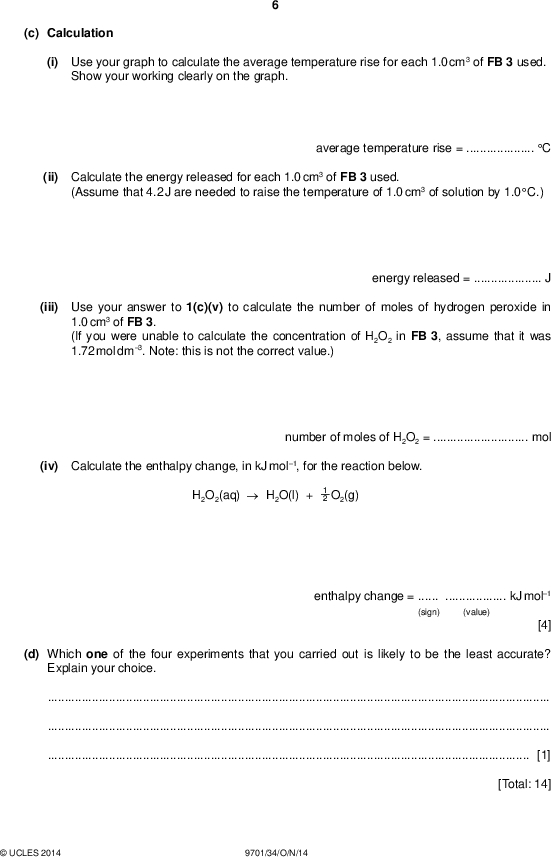
(c) Calculation (i) Use your graph to calculate the average temperature rise for each 1.0 cm3 of FB 3 used. Show your working clearly on the graph. PMT (ii) Calculate the energy released for each 1.0 cm3 of FB 3 used. (Assume that 4.2 J are needed to raise the temperature of 1.0 cm3 of solution by 1.0 C.) average temperature rise =C (iii) Use your answer to 1(c)(v) to calculate the number of moles of hydrogen peroxide in 1.0 cm3 of FB 3. (If you were unable to calculate the concentration of H2O2 in FB 3, assume that it was 1.72 mol dm3. Note: this is not the correct value.) energy released =J number of moles of H2O2 =mol (iv) Calculate the enthalpy change, in kJ mol1, for the reaction below. H2O2(aq)H2O(l) + 2 1 O2(g) enthalpy change =kJ mol1 (sign) (value) [4] (d) Which one of the four experiments that you carried out is likely to be the least accurate? Explain your choice.[1] [Total: 14]UCLES 2014 9701/34/O/N/14<br />](https://learnah.org/wp-content/uploads/2018/08/November_2014_v4_QP_-_Paper_3_CIE_Chemistry_A-level_2-0.jpg)
![Page 4 Mark Scheme Syllabus Paper Cambridge International AS/A LevelOctober/November 2014 9701 34 Indicative material Mark Total Question (a) 1 1 1 [5] [4] I Table of data, showing all of the following:All data must be tabulated in the space provided on page 4. unambiguous headings (ignore units) four initial temperature four final temperatures four temperature rises correctly calculated II Recording of datacorrect units covering all temperature readings. all readings recorded to .0 or .5 C, with at least one shown as .5 C or .0 C Minimum of six temperatures required to qualifyExaminer checks Supervisors subtraction for temperature rise for experiment 4.Examiner corrects thermometer readings to nearest .5 C then subtracts.Examiner calculates the difference between the [corrected] candidates and Supervisors temperature rise for experiment 4. Award III if T increases with increase in volume of FA 3. Experiment 4 Award IV if2.0 C Award V if1.0 C If expt 4 was not carried out, examiners may award mark IV if experiment 3 is within 1.0 C of Supervisor. (b) I Suitable axes and scales to graphboth axes clearly labelled (units not required) temperature (rise) as y-axis suitable linear scales (Points are plotted using more than half of the grid in both directions from (0,0). Must have at least one point plotted. ) II Four points plotted clearly and correctly (All points plotted to within half a square and in the correct square for y-axis and on line for x-axis.) III 0,0 point either plotted or used for line (within one small square) IV Best fit lineMinimum 4 points on the grid are needed. This may include (0,0) if plotted.Points above and below best fit line are balanced. (c) (i) Correctly calculates temp rise per cm3 (gradient of straight line)All points from the best fit line must be correctly read to the nearest half square.Points used must differ by a minimum of two large squares, along each axis.Cambridge International Examinations 2014<br />
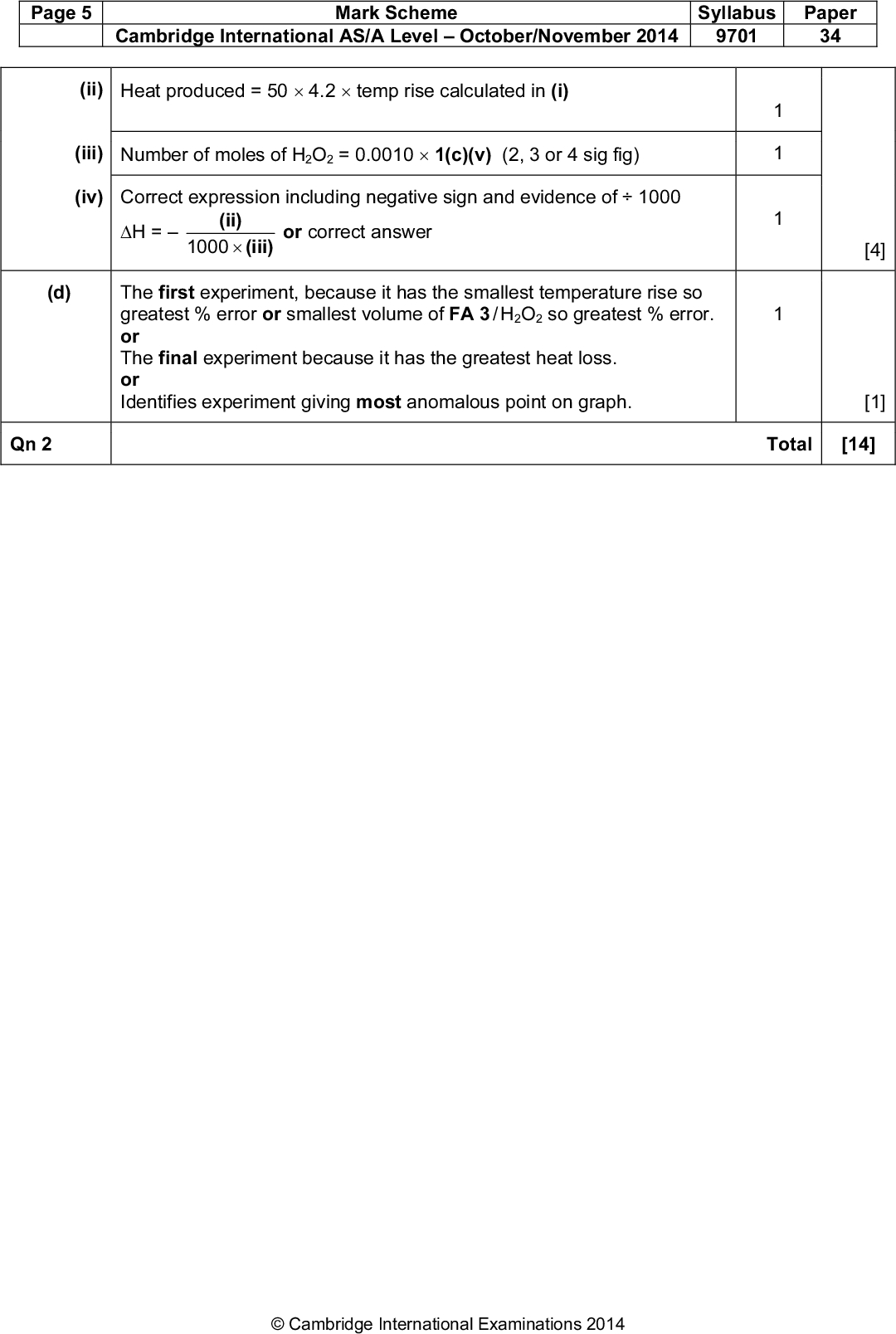
Page 5 Mark Scheme Syllabus Paper Cambridge International AS/A LevelOctober/November 2014 9701 34 (ii) Heat produced = 504.2temp rise calculated in (i) (iii) Number of moles of H2O2 = 0.00101(c)(v) (2, 3 or 4 sig fig) (iv) Correct expression including negative sign and evidence of1000 H =(ii) 1000 (iii) or correct answer (d) The first experiment, because it has the smallest temperature rise so greatest % error or smallest volume of FA 3 / H2O2 so greatest % error. or The final experiment because it has the greatest heat loss. or Identifies experiment giving most anomalous point on graph. Qn 2 [4] [1] Total [14]Cambridge International Examinations 2014<br />](https://learnah.org/wp-content/uploads/2018/08/November_2014_v4_MS_-_Paper_3_CIE_Chemistry_A-level_2-0.jpg)