Skip to content
CIE Mar 2016 v2 Paper 5 Q1
Answers available below
Show answer
Question
1
2

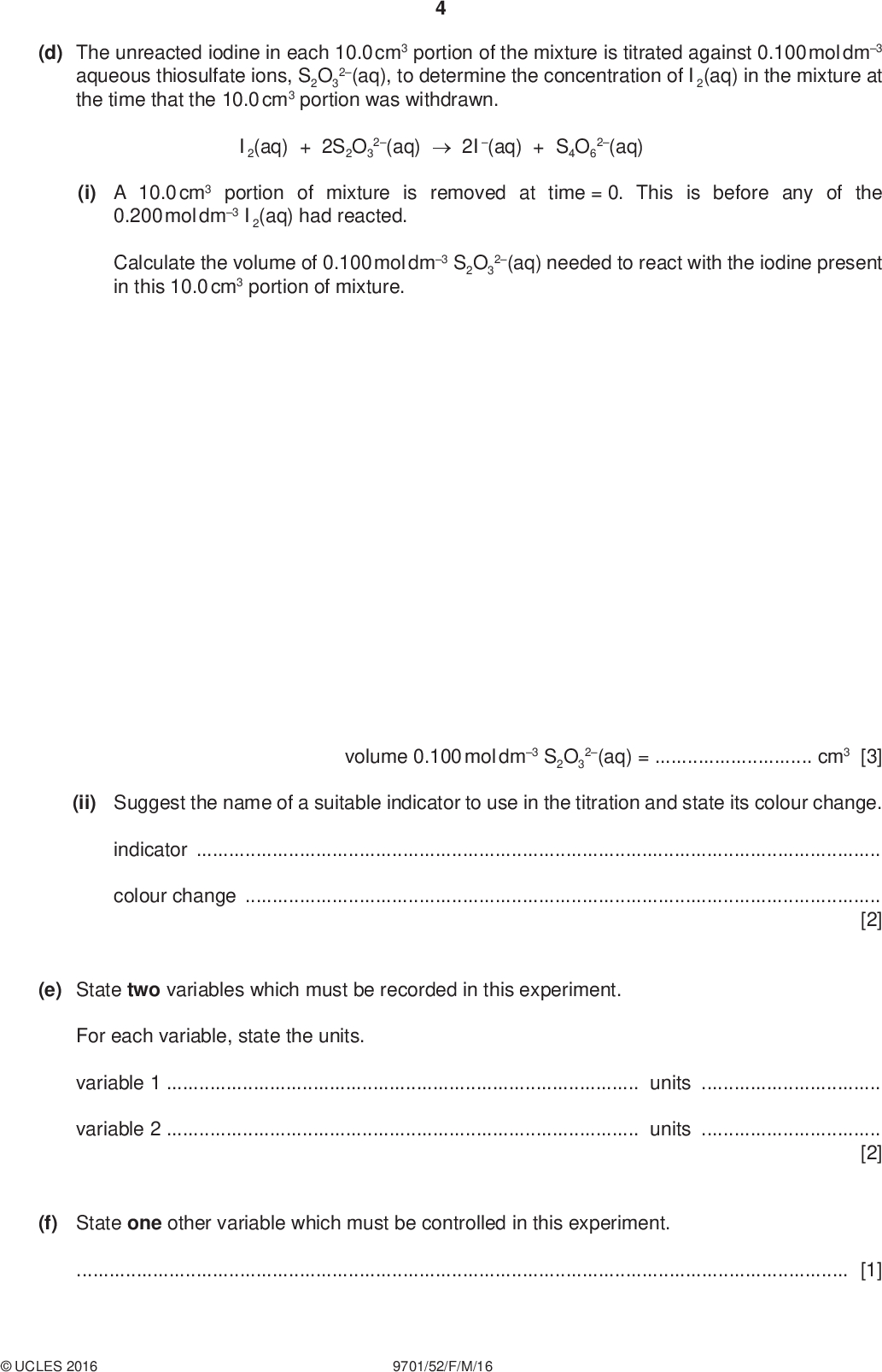
![PMT Propanone, CH3COCH3, is an organic liquid which is soluble in water. Aqueous propanone reacts with aqueous iodine. The reaction is catalysed by H+(aq) ions. CH3COCH3(aq) + I2(aq)CH3COCH2I(aq) + HI(aq) The order of reaction with respect to iodine can be determined experimentally. An experiment is carried out using the following solutions.solution A, 25.0 cm3 of 1.00 mol dm3 CH3COCH3(aq) solution B, 25.0 cm3 of 1.00 mol dm3 H2SO4(aq) solution C, 50.0 cm3 of 0.200 mol dm3 I2(aq) The solutions are mixed to start the reaction. At certain time intervals, a 10.0 cm3 portion of the mixture is withdrawn and transferred to a conical flask containing excess sodium hydrogencarbonate, NaHCO3(aq). This prevents any further significant reaction taking place by removing the H+(aq) ions. The concentration of unreacted I2(aq) in each 10.0 cm3 portion of the mixture can then be determined by titration with aqueous thiosulfate ions, S2O3 2(aq). (a) State the size and type of apparatus needed to prepare a suitable volume of a standard solution of 1.00 mol dm3 CH3COCH3(aq) from liquid propanone. Calculate the mass of propanone needed to prepare this standard solution. [Ar: C, 12.0; H, 1.0; O, 16.0] apparatusmass of propanoneg [3]UCLES 2016 9701/52/F/M/16<br />
(b) Solutions A, B and C need to be added in a specific order and the clock started as the third solution is added. PMT (i) Suggest the best order of adding the solutions. 123(ii) Explain your choice. [1][1] (c) Each 10.0 cm3 portion of mixture removed from the main reaction is added to a separate solution of sodium hydrogencarbonate, NaHCO3(aq), in a conical flask to remove H+(aq) ions. (i) Which piece of apparatus should be used to transfer each 10.0 cm3 portion of mixture to the conical flask?[1] (ii) Suggest two reasons why NaHCO3(aq) is preferred to NaOH(aq) as the reagent used to remove H+(aq) ions. reason 1reason 2[2]UCLES 2016 9701/52/F/M/16 [Turn over<br />
PMT (d) The unreacted iodine in each 10.0 cm3 portion of the mixture is titrated against 0.100 mol dm3 2(aq), to determine the concentration of I2(aq) in the mixture at aqueous thiosulfate ions, S2O3 the time that the 10.0 cm3 portion was withdrawn. I2(aq) + 2S2O3 2(aq)2I(aq) + S4O6 2(aq) (i) A 10.0 cm3 portion of mixture is removed at time = 0. This is before any of the 0.200 mol dm3 I2(aq) had reacted. Calculate the volume of 0.100 mol dm3 S2O3 in this 10.0 cm3 portion of mixture. 2(aq) needed to react with the iodine present volume 0.100 mol dm3 S2O3 2(aq) =cm3 [3] (ii) Suggest the name of a suitable indicator to use in the titration and state its colour change. indicatorcolour change[2] (e) State two variables which must be recorded in this experiment. For each variable, state the units. variable 1unitsvariable 2units[2] (f) State one other variable which must be controlled in this experiment.[1]UCLES 2016 9701/52/F/M/16<br />
(g) The order of reaction with respect to iodine is expected to be first order. (i) Use the axes below to draw a sketch graph of how the concentration of iodine changes during the experiment. Label both axes. PMT (ii) How could the graph be used to prove that the order of reaction with respect to iodine is first order?[1] [2] (h) A student suggested that the temperature at which the experiment was carried out would affect the order of reaction with respect to iodine. State if the student was correct and explain your answer.[1] [Total: 20]UCLES 2016 9701/52/F/M/16 [Turn over<br />](https://learnah.org/wp-content/uploads/2018/08/March_2016_v2_QP_-_Paper_5_CIE_Chemistry_A-level_1-0.jpg)


![Cambridge International AS/A LevelMarch 2016 Mark Scheme Syllabus Paper 9701 52 Page 2 question (a) expected answer M1 (apparatus mark) volumetric flask in range 25250 cm3; M2 mol propanone = 1.00(flask volume / 1000); e.g. mol of propanone = 1.0025 / 1000 = 0.025 mol M3 M258.0; e.g.0.02558.0 = 1.45 g mark [3] [1] [1] [1] [2] [3] [2] [2] [1] [2] (b) (i) B must be added before first or second reactant (ii) the reactants are A and C so one of these must be mixed last; or the reaction must not start before all three substances are present; (c) (i) (10 cm3) pipette (ii) M1 NaHCO3 will effervesce so when effervescence finishes it shows that all H+ ions have been removed; M2 NaOH will react with I2 / CH3COCH3 / reactants; (d) (i) M1 mol I2 = (10 / 100)0.200(50 / 1000) = 1.(00)103 M2 mol S2O3 M3 volume 0.100 mol dm3 S2O3 2 = 21.00103 = 2.(00)103 2 = (10002.00103) / 0.100 = 20(.0) cm3; mol; mol; (ii) indicator = starch; colour change = blue-black to colourless; (e) time and units of s; volume of thiosulfate and units of cm3; (f) temperature; (g) (i) M1 (labels) x-axis = time y-axis = concentration of iodine M2 curved line decreasing from left to right starting from x = 0Cambridge International Examinations 2016<br />
Cambridge International AS/A LevelMarch 2016 Mark Scheme Syllabus Paper 9701 52 expected answer idea of constant half-life: determine at least two half-lives from the graph and ensure that they are the same; or half-lives determined from the graph should be constant; or determine the gradient (rate) at different points on the graph and plot rate v. concentration to determine if the plot is linear and goes through the origin; mark [1] Page 3 question (ii) (h) (a) (incorrect and) half-life will still be constant; or temperature has no effect upon order (of reaction); M1 column amount of ethanol burned correctly completed M2 column energy transferred to the water correctly completed experiment number amount of ethanol burned / mol 0.00850 0.0106 0.0110 0.0122 0.0158 0.0130 0.00891 0.0148 energy transferred to the water / kJ 3.26 3.95 4.10 4.50 5.62 5.20 3.39 5.30 (b) (c) (d) M1 at least eight correctly plotted points; M2 correct straight line; experiment 6; M1 co-ordinates, e.g. (0.0106, 3.95) and (0.0158, 5.62); M2 gradient correctly calculated from points, e.g. 321 (kJ mol1); (e) because the reaction is exothermic; (f) (i) ((20.0005) / 0.391)100 = 0.256% and (0.05 / 40.0)100 = 0.125%;Cambridge International Examinations 2016 [1] [2] [2] [1] [2] [1] [1]<br />](https://learnah.org/wp-content/uploads/2018/08/March_2016_v2_MS_-_Paper_5_CIE_Chemistry_A-level_1-0.jpg)
