Skip to content
CIE Mar 2016 v2 Paper 4 Q3
Answers available below
Show answer
Question
1
2
3
4
5
6
7
8
9

![(a) Complete the electronic structures of the following species. Co [Ar]Co2+ [Ar]PMT [2] (b) In an isolated transition metal atom the five d orbitals have the same energy. When a transition metal ion forms a tetrahedral complex the d orbitals are split into two groups of different energies. Complete an orbital energy diagram to show this, indicating the number of orbitals in each group. increasing energy isolated transition metal ion tetrahedral complex [1] (c) Cobalt(II) forms a six co-ordinate complex containing three water molecules and three chloride ions. (i) Write the formula of this complex showing the overall charge, if appropriate.[1] (ii) Explain, with the aid of diagrams, how many isomers of the complex in (i) exist. (d) Platinum(II) forms a four co-ordinate complex containing two ammonia molecules and two chloride ions. (i) Write the formula of this complex showing the overall charge, if appropriate.[1] [2]UCLES 2016 9701/42/F/M/16<br />
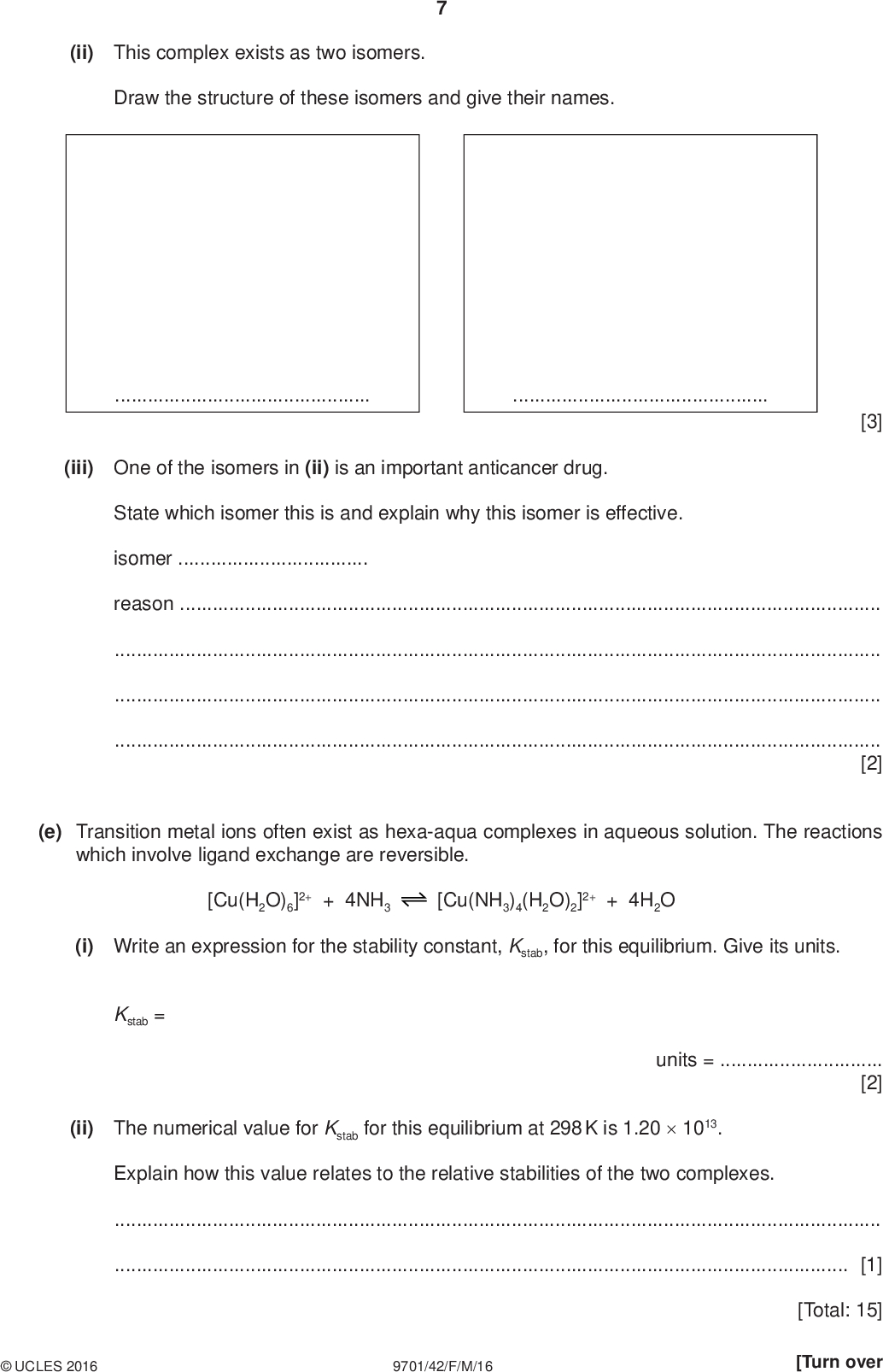
(ii) This complex exists as two isomers. Draw the structure of these isomers and give their names. PMT[3] (iii) One of the isomers in (ii) is an important anticancer drug. State which isomer this is and explain why this isomer is effective. isomerreason[2] (e) Transition metal ions often exist as hexa-aqua complexes in aqueous solution. The reactions which involve ligand exchange are reversible. [Cu(H2O)6]2+ + 4NH3 [Cu(NH3)4(H2O)2]2+ + 4H2O (i) Write an expression for the stability constant, Kstab, for this equilibrium. Give its units. Kstab = units =[2] (ii) The numerical value for Kstab for this equilibrium at 298 K is 1.201013. Explain how this value relates to the relative stabilities of the two complexes.[1]UCLES 2016 9701/42/F/M/16 [Total: 15] [Turn over<br />](https://learnah.org/wp-content/uploads/2018/08/March_2016_v2_QP_-_Paper_4_CIE_Chemistry_A-level_3-0.jpg)
![Pag ge P Q Qu es tio on C Cam mb brid dge e In nte ern vel Ma arc ch 20 6 16 Mar M nati ion k S nal Sch AS hem S/A e me A L Lev A Ans swe er Syl S llab 9 970 bu 01 er Pa P pe 4 42 Ma ark k o Co o2+ Co [A [A r] 3 r] 3 74s 3d7 s2 7 3d7 ) (a) (b) ) En ner rgy ylate ed is sol io on (c) ) ( (i) Cl Co(C [C ) )3(H H2O O)3 3] (i ii) C Cl Cl l Cl l C Co H2O H O OH O H2 OH O H2 ; ; Cl l H2O H O (d) ) ( (i) [P Cl t(C )2 2(N NH3 3)2] M1 M3 1, M 3: n M2 nam 2: d me diag es gra am (i ii) (ii ii) (e) ) ( (i) c cis -di am mm (ci thi wh is i is c hic so can h p me n re pre er) eac eve Cl C Co Cl lte etr rah hed dra al c com mp plex x O OH2 2 O OH2 2 ci is-p edic ine pla chl n / atin loro op lati inu um( (II) ) tra ans s-d diam t tra mm min ns- ned -pl dich atin hlo n / rop pla atin ct / nts bo s re ond epl d / b ica bind atio d w on o with of t h D the A; DNA e st tra nd / p rev ven nts ce ell d div visio on M1 M2 Ks 1: f 2: u for uni mu its ula (ec cf f fro m f for rmu ula stab [C Cu [C Cu (N (H H3) 2O O)6 )4(H H2O +][N O)2 NH 2+] ] H3]4 4 mo ol4 dm m12 um m(II I) (i ii) (la arge e v valu ue of Ks stab sh how ws tha at) the e te etra am mm ine e co om mple ex is mo ore e st tab ble Ca amb brid dge e In nter rnat tion nal Ex xam mina atio ons s 20 016 6 1 1 1 1 1 1 1 1 2 2 1 1 2 2 1 1 1 1 1 1 1 1 1 1 1 1<br />](https://learnah.org/wp-content/uploads/2018/08/March_2016_v2_MS_-_Paper_4_CIE_Chemistry_A-level_3.jpg)