Skip to content
CIE Jun 2016 v4 Paper 3 Q2
Answers available below
Show answer
Question
1
2
3

![PMT Some metal carbonates cannot be obtained in a pure state. For example magnesium carbonate exists in a basic form, in which magnesium hydroxide is also present. One possible chemical formula of basic magnesium carbonate is MgCO3.Mg(OH)2.2H2O. When basic magnesium carbonate is heated, if the possible formula were correct, it would decompose as shown below. MgCO3.Mg(OH)2.2H2O(s)2MgO(s) + CO2(g) + 3H2O(g) In this experiment, you will decompose basic magnesium carbonate by heating it, and you will use your results to determine whether this possible formula is correct. FB 4 is basic magnesium carbonate. (a) Method Read through the method before starting any practical work and prepare a table for your results in the space below.Weigh a crucible with its lid and record the mass. Add 1.1-1.3 g of FB 4 to the crucible. Weigh the crucible and lid with FB 4 and record the mass. Place the crucible on the pipe-clay triangle and remove the lid. Heat the crucible and contents gently for about one minute. Then heat the crucible and contents strongly for about four minutes. Replace the lid and allow the crucible to cool for at least five minutes. While the crucible is cooling, you may wish to begin work on Question 3. Re-weigh the crucible and contents with lid. Record the mass. Calculate, and record, the mass of FB 4 used and the mass of residue obtained. II III IV [5]UCLES 2016 9701/34/M/J/16<br />
PMT (b) Calculations Show your working and appropriate significant figures in the final answer to each step of your calculations. (i) Use your results to calculate the number of moles of magnesium oxide, MgO, obtained as residue. (ii) Use your answer to (i), with the equation on page 4 and the mass of FB 4 you used, to calculate the relative formula mass, Mr, of basic magnesium carbonate. moles of MgO obtained =mol Mr of basic magnesium carbonate (from experiment) =(iii) Use data from the Periodic Table to calculate the relative formula mass, Mr, of basic magnesium carbonate from its possible formula, MgCO3.Mg(OH)2.2H2O. Mr of basic magnesium carbonate (from formula) =(iv) If the relative formula mass of basic magnesium carbonate obtained from your experiment is within 2.5% of the answer in (iii), this is good evidence that the possible formula, MgCO3.Mg(OH)2.2H2O, is correct. Does your experiment support the possible formula? Give a reason for your answer.[5]UCLES 2016 9701/34/M/J/16 [Turn over<br />
PMT (c) Evaluation (i) State one way in which the accuracy of the experimental procedure could have been improved using the same mass of FB 4. Explain your answer.(ii) A student carried out the experiment twice using different masses of FB 4. He used the mean mass of FB 4 and the mean mass of magnesium oxide obtained to calculate the relative formula mass of basic magnesium carbonate. Instead of doing this, he could have calculated the relative formula mass of basic magnesium carbonate from his two experiments separately. Suggest one advantage of carrying out separate calculations for each experiment.(iii) State the error when making one reading on your balance. Calculate the maximum percentage error in the mass of FB 4 used. error =g percentage error =% [4] [Total: 14]UCLES 2016 9701/34/M/J/16<br />
BLANK PAGE PMTUCLES 2016 9701/34/M/J/16 [Turn over<br />](https://learnah.org/wp-content/uploads/2018/08/June_2016_v4_QP_-_Paper_3_CIE_Chemistry_A-level_2-0.jpg)


![Page 4 Question Cambridge International AS/A LevelMay/June 2016 9701 34 Mark Scheme Syllabus Paper Indicative material Mark Total (a) I Appropriate headings and units for the three balance readings(Mass of) crucible (and lid) (Mass of) crucible, (lid) and FB 4 (or contents before heating) (Mass of) crucible, (lid) and residue / MgO / contents after heating / FB 4 after heatingUnit covering all balance readings and subtracted values if shown: / g, (g), in g or g (for each heading) II Masses recordedMass of FB 4 used was claimed to be between 1.11.3 gAll balance readings recorded to same number of decimal places (at least one dp) III Mass of FB 4 and of residueMass of FB 4 used, correctly subtractedMass of residue, correctly subtracted IV and VUse corrected valuesExaminer used corrected values and works out the ratio mass of FB 4 /mass of MgO to 1 dp for the candidate Accuracy marks are awarded as shown. Award IV if ratio between 1.42.5 Award V if ratio between 1.72.3 (b) (i) Correctly calculates n(MgO) mass of residue/40.3Answer must be expressed to 2, 3 or 4 significant figures (ii) Correct use of (i) and mass of FB 4 n(FB 4) = answer (i)Mr = mass of FB 4 used/no of moles of FB 4An answer for Mr must be quoted to 2 or more significant figures /2 (iii) Mr calculated from Ar values in Periodic Table = 178.6 (iv) Correct expression shown 2.5/100Mr in (iii) (= 4.5, 4.47, 4.465) or expresses % difference of the two Mr values = (iii)(ii) or (iii)97.5/100 / (iii)102.5/100 to give range (= 174(.1)183(.1)) /(iii)100 Makes a correct statement (support / does not support / yes / no) about the accuracy of the possible formula, explained by whether the experimental Mr value is close to the answer in (iii). Numbers must be quoted or reference made to (ii) and (iii)Cambridge International Examinations 2016 [5] [5]<br />
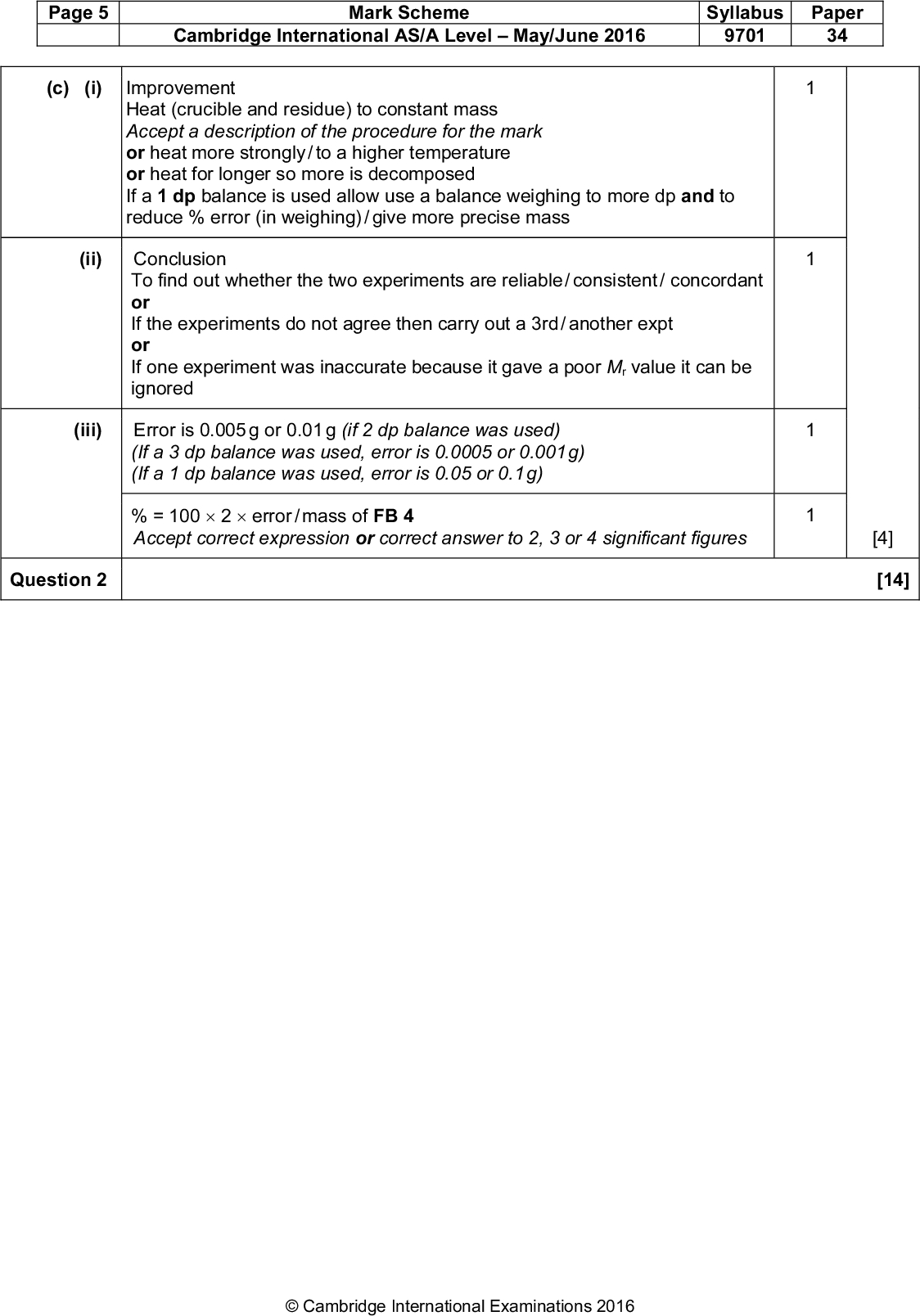
Page 5 (c) (i) Cambridge International AS/A LevelMay/June 2016 9701 34 Mark Scheme Syllabus Paper [4] [14] Improvement Heat (crucible and residue) to constant mass Accept a description of the procedure for the mark or heat more strongly / to a higher temperature or heat for longer so more is decomposed If a 1 dp balance is used allow use a balance weighing to more dp and to reduce % error (in weighing) / give more precise mass (ii) Conclusion To find out whether the two experiments are reliable / consistent / concordant or If the experiments do not agree then carry out a 3rd / another expt or If one experiment was inaccurate because it gave a poor Mr value it can be ignored (iii) Error is 0.005 g or 0.01 g (if 2 dp balance was used) (If a 3 dp balance was used, error is 0.0005 or 0.001 g) (If a 1 dp balance was used, error is 0.05 or 0.1 g) % = 1002error / mass of FB 4 Accept correct expression or correct answer to 2, 3 or 4 significant figures Question 2Cambridge International Examinations 2016<br />](https://learnah.org/wp-content/uploads/2018/08/June_2016_v4_MS_-_Paper_3_CIE_Chemistry_A-level_2-0.jpg)