Skip to content
CIE Jun 2016 v2 Paper 4 Q8
Answers available below
Show answer
Question
1
2
3
4
5
6
7
8
9
10

![PMT (a) Describe and explain the trend in the solubility of the hydroxides down Group 2. 16[3] (b) Calcium reacts vigorously with HCl (aq) producing H2(g). Ca(s) + 2HCl (aq)CaCl 2(aq) + H2(g) (i) How would you expect the enthalpy change for this reaction to compare with the enthalpy change for the reaction where HNO3(aq) is used in place of HCl but all other conditions are the same? Explain your answer.[1]UCLES 2016 9701/42/M/J/16<br />
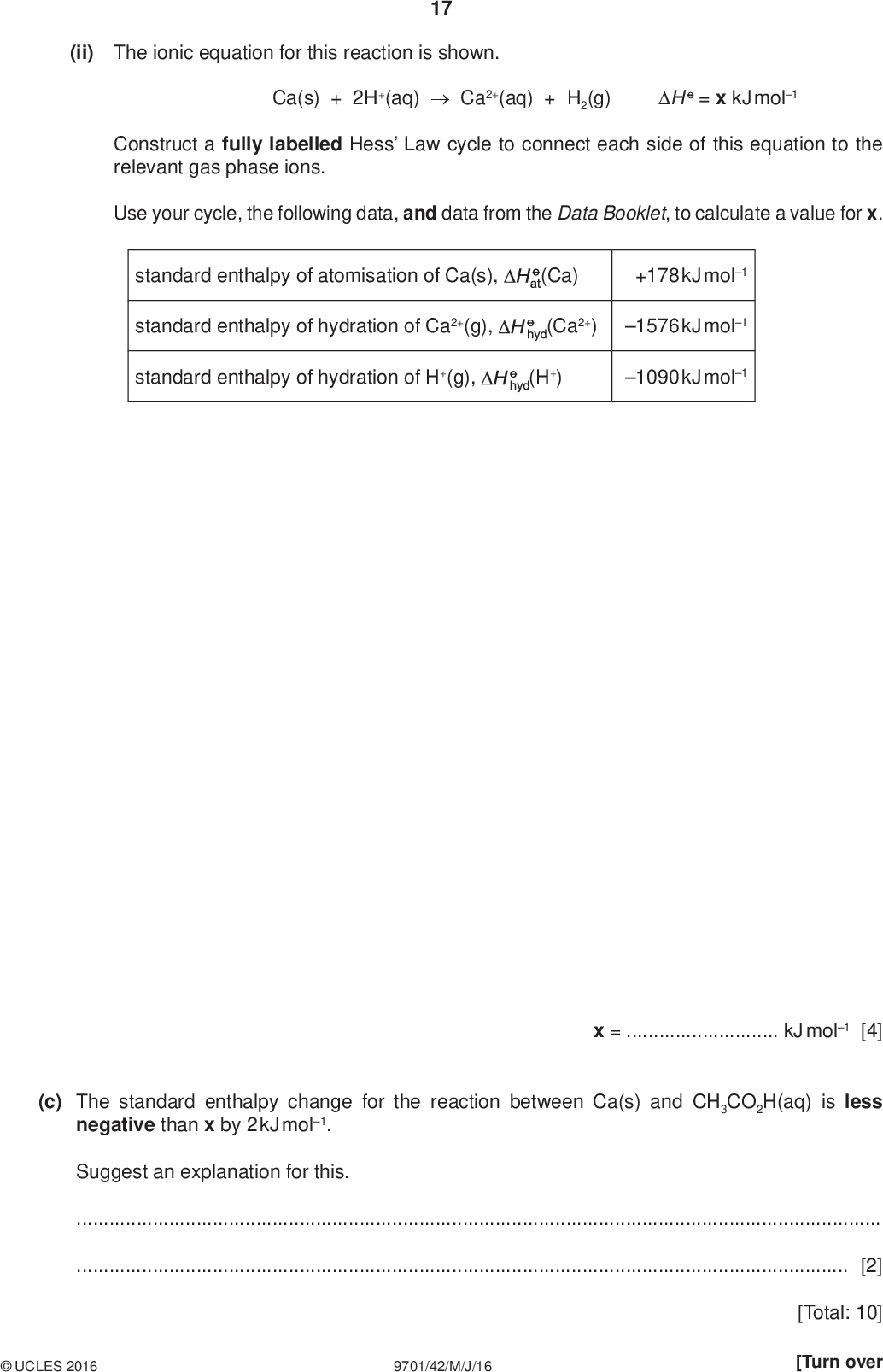
PMT (ii) The ionic equation for this reaction is shown. 17 Ca(s) + 2H+(aq)Ca2+(aq) + H2(g) H o = x kJ mol1 Construct a fully labelled Hess Law cycle to connect each side of this equation to the relevant gas phase ions. Use your cycle, the following data, and data from the Data Booklet, to calculate a value for x. standard enthalpy of atomisation of Ca(s), (Ca) +178 kJ mol1 standard enthalpy of hydration of Ca2+(g), (Ca2+) 1576 kJ mol1 standard enthalpy of hydration of H+(g), (H+) 1090 kJ mol1 x =kJ mol1 [4] (c) The standard enthalpy change for the reaction between Ca(s) and CH3CO2H(aq) is less negative than x by 2 kJ mol1. Suggest an explanation for this.[2]UCLES 2016 9701/42/M/J/16 [Total: 10] [Turn over<br />](https://learnah.org/wp-content/uploads/2018/08/June_2016_v2_QP_-_Paper_4_CIE_Chemistry_A-level_8-0.jpg)
![Page 9 Mark Scheme Syllabus Paper Cambridge International AS/A LevelMay/June 2016 9701 42 Question Answer Marks PMT (iii) Tyr + Phe: pH 12 because Tyr will be C6H5CH2O (R-group) moves further / more / faster (to positive electrode than Phe) or pH12 because Tyr has a charge of 2 but Phe has a charge of 1 (c) (i) CH OH CH CH CO M1: for CONH as shown above M2: for rest of molecule and correct connectivity of the bonds (ii) from the IR spectrum E is O-H or N-H (allow NH2) F is C=OG is C-O [Total: 12] (a) M1: solubility increases (down the group) M2: because lattice energy decreases faster than does Hhyd M3:Hsol / enthalpy of solution becomes more exothermic / less endothermic (b) (i) Should be the same / similar (enthalpy change), as (both acids) are fully ionised / strong acidsCambridge International Examinations 2016<br />
Page 10 Mark Scheme Syllabus Paper Cambridge International AS/A LevelMay/June 2016 9701 42 Question (ii) x = Hat(Ca) + IE(1) + IE(2)2Hhyd(H Answer ) + Hhyd(Ca 2+ )2IE(H)E(H-H) x = 178 + 590 + 1150 + 2(1090)15762(1310)436 x = 534 kJ mol 1 (c) CH3CO2H is incompletely ionised / weak acid / weaker acid enthalpy change of ionisation (of CH3COOH) is +2 kJ mol 1 or energy needed to ionise / dissociate (CH3COOH) (a) OH CN COCambridge International Examinations 2016 PMT Marks [Total: 10]<br />](https://learnah.org/wp-content/uploads/2018/08/June_2016_v2_MS_-_Paper_4_CIE_Chemistry_A-level_8-0.jpg)
