Skip to content
CIE Jun 2014 v2 Paper 4 Q1
Answers available below
Show answer
Question
1
2
3
4
5
6
7
8

![Section A Answer all the questions in the spaces provided. PMT (a) (i) On the diagrams below, show the outer electron arrangements of the atoms and ions indicated. (Use the symbolto represent a pair of electrons in an orbital.) 4s 3d 4s 3d 4s 3d Fe Fe2+(aq) Zn2+(aq) (ii) Use the above diagrams to explain why Fe2+(aq) ions are coloured, whereas Zn2+(aq) ions are colourless.[4] (b) When concentrated HCl is added to a solution of Cu2+(aq) ions, the solution turns yellow. (i) State the formula of the species responsible for the yellow colour and name the type of reaction that has occurred.(ii) Ammonia can react as a base or as a ligand. Describe the colour changes that occur when NH3(aq) is gradually added, with stirring, to the yellow solution, until the NH3(aq) is in excess. Identify the three ions or compounds responsible for the new colours.[7]UCLES 2014 9701/42/M/J/14<br />
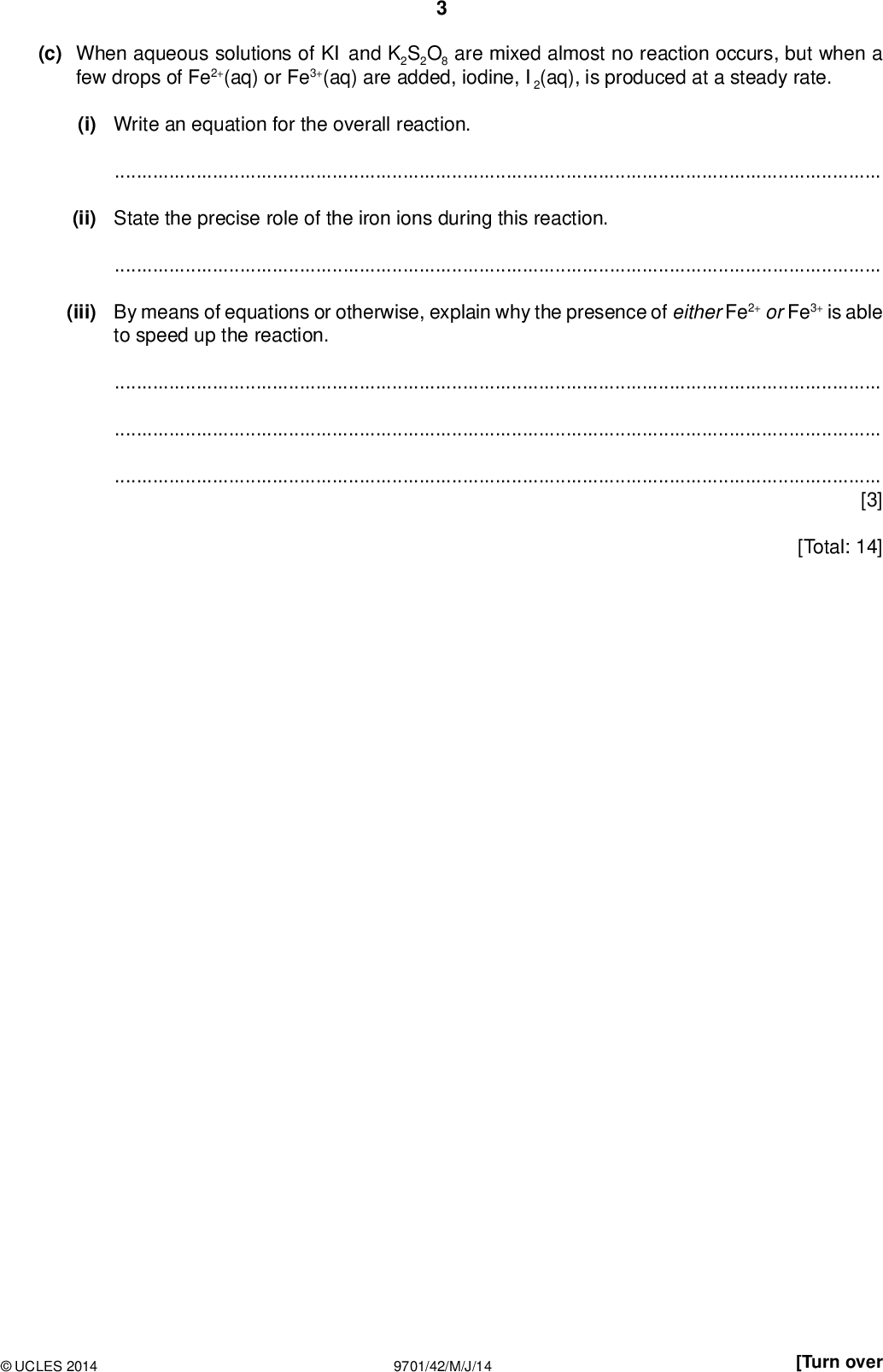
PMT (c) When aqueous solutions of KI and K2S2O8 are mixed almost no reaction occurs, but when a few drops of Fe2+(aq) or Fe3+(aq) are added, iodine, I2(aq), is produced at a steady rate. (i) Write an equation for the overall reaction.(ii) State the precise role of the iron ions during this reaction.(iii) By means of equations or otherwise, explain why the presence of either Fe2+ or Fe3+ is able to speed up the reaction.[3] [Total: 14]UCLES 2014 9701/42/M/J/14 [Turn over<br />](https://learnah.org/wp-content/uploads/2018/08/June_2014_v2_QP_-_Paper_4_CIE_Chemistry_A-level_1-0.jpg)
![Mark Scheme GCE A LEVELMay/June 2014 Syllabus 9701 Paper 42 Page 2 (a) (i) 4s 4s 4s or 3d 4s 3d Fe 3d 2+ Zn 2+ Fe (ii) (colour due to absorbance of visible light) due to electron promoted (from lower) to upper orbital / energy level there's no space in higher orbital for the electron to go or completely 2+ in Zn filled d-orbitals / shell (b) (i) yellow is due to [CuCl4] 2 reaction is ligand displacement / exchange (ii) (solution goes blue) due to [Cu(H2O)6] 2+ blue ppt. or (s) of Cu(OH)2 or [Cu(H2O)4(OH)2] etc. purple or deep / dark blue solution or (aq) due to [Cu(NH3)4] or [Cu(NH3)4(H2O)2] 2+ 2+ (c) (i) 2KI + K2S2O82K2SO4 + I2 or + I22SO4+ S2O8 ionic: 2I 2 2 (ii) Fe 2+ is a homogeneous catalyst (iii) equations: 2Fe 3+ + S2O8 + 2I2Fe 2Fe 2+ 22Fe 2+ + I2 3+ + 2SO4 2 or verbal equivalent, e.g. reactants are both negative ions, so repel each can be oxidised by S2O8 and Fe 2 3+ can be reduced by I 2+ other or FeCambridge International Examinations 2014 [2] [1] [1] [1] [1] [1] [1] [1] [1] [1] [1] [1] [1] [Total: 14]<br />](https://learnah.org/wp-content/uploads/2018/08/June_2014_v2_MS_-_Paper_4_CIE_Chemistry_A-level_1.jpg)