Skip to content
CIE Jun 2013 v3 Paper 3 Q3
Answers available below
Show answer
Question
1
2
3

![Examiners For Use Qualitative Analysis At each stage of any test you are to record details of the following.colour changes seen the formation of any precipitate the solubility of such precipitates in an excess of the reagent added Where gases are released they should be identi ed by a test, described in the appropriate place in your observations. You should indicate clearly at what stage in a test a change occurs. Marks are not given for chemical equations. No additional tests for ions present should be attempted. If any solution is warmed, a boiling tube MUST be used. Rinse and reuse test-tubes and boiling tubes where possible. Where reagents are selected for use in a test, the name or correct formula of the element or compound must be given. (a) You are provided with a solid, FA 5. FA 5 is a mixture that contains two anions and two cations. To all your sample of FA 5 in a boiling tube add 3 cm depth of distilled water. Shake the tube andlter the contents. Keep the solid residue for tests in (b) and theltered solution for tests in (c). (b) (i) Open up thelter paper and scrape the residue into a boiling tube. Add dilute nitric acid, HNO3, using a dropping pipette until the solid just disappears. Record your observations and keep the solution for tests in (ii). observations(ii) Divide the solution from test (i) equally into three test-tubes. To therst test-tube add aqueous sodium hydroxide, NaOH, until in excess. Record your observations. observationsWhich cations, from those listed in the Qualitative Analysis Notes on page 12, would give these observations?UCLES 2013 9701/33/M/J/13<br />
Examiners For Use (iii) You are to devise tests that will positively identify which one of the cations you have suggested in (ii) is present. For each of the possible ions you should indicate the test and the expected result for each test in a suitable table in the space below. Use the solutions in the second and third test-tubes to carry out these tests and record your observations in the space below. Identify the cation present. The cation present is. [7]UCLES 2013 9701/33/M/J/13 [Turn over<br />
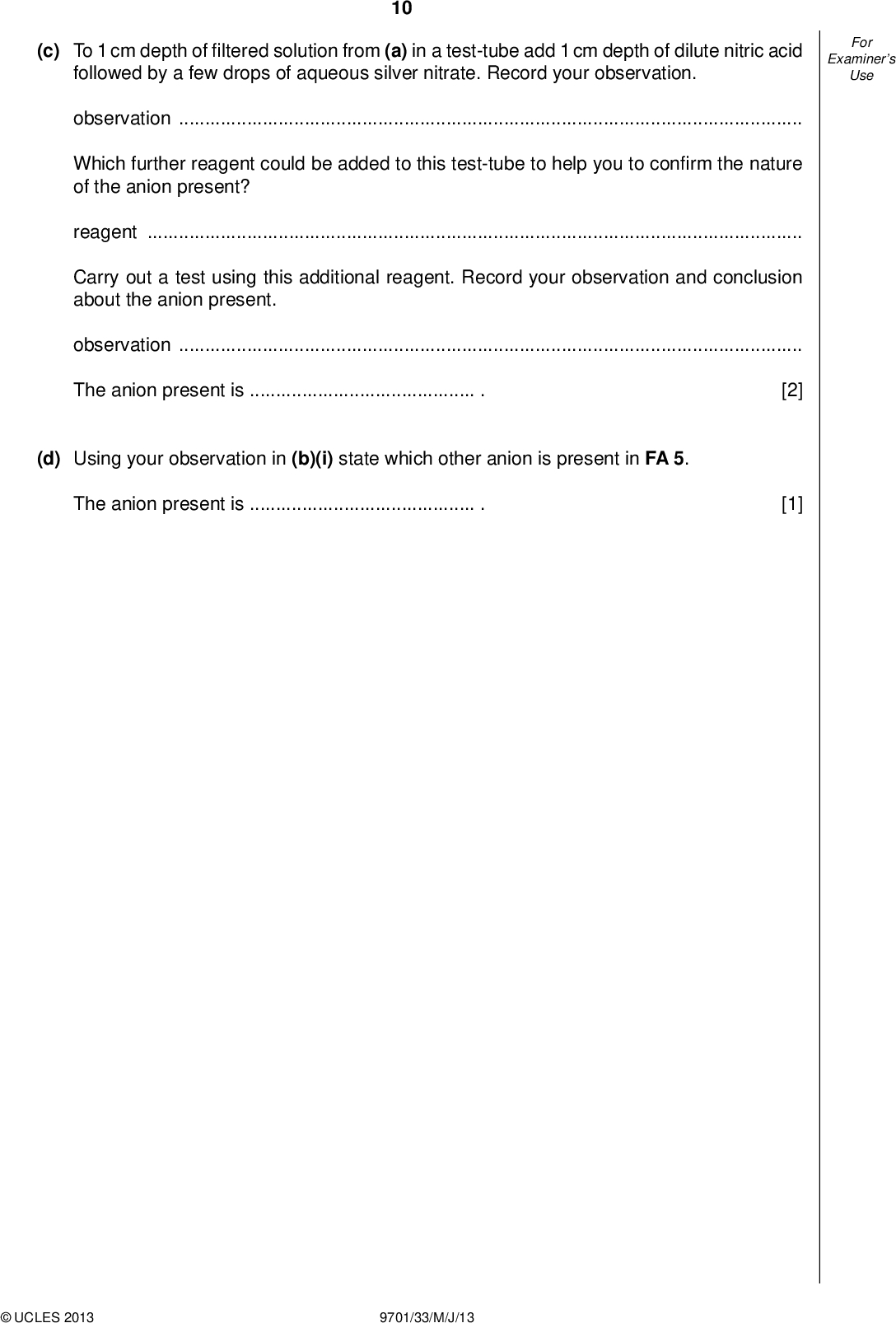
Examiners For Use 10 (c) To 1 cm depth ofltered solution from (a) in a test-tube add 1 cm depth of dilute nitric acid followed by a few drops of aqueous silver nitrate. Record your observation. observationWhich further reagent could be added to this test-tube to help you to con rm the nature of the anion present? reagentCarry out a test using this additional reagent. Record your observation and conclusion about the anion present. observationThe anion present is. (d) Using your observation in (b)(i) state which other anion is present in FA 5. The anion present is. [2] [1]UCLES 2013 9701/33/M/J/13<br />
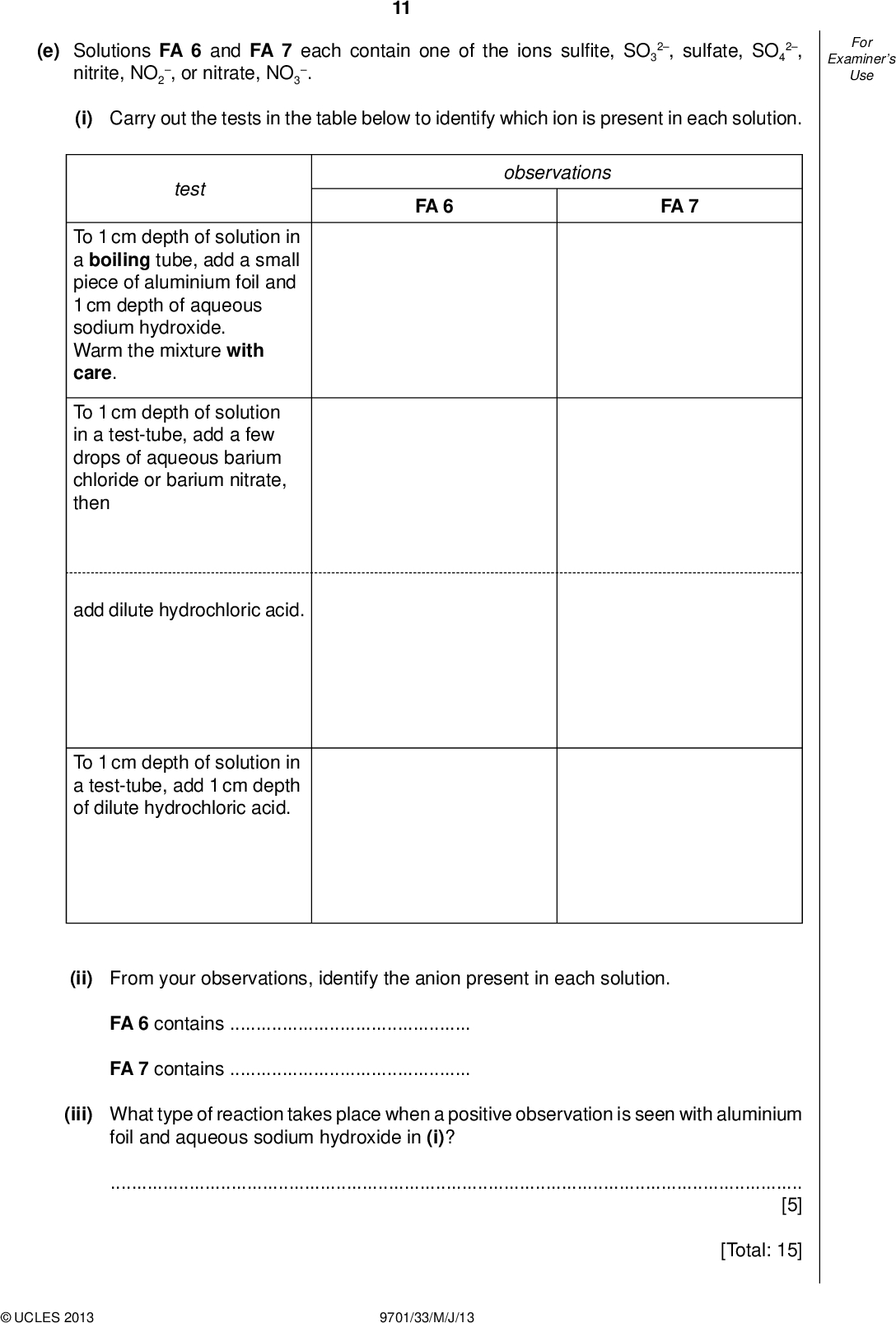
Examiners For Use (e) Solutions FA 6 and FA 7 each contain one of the ions sul te, SO3 2, sulfate, SO4 2, nitrite, NO2 , or nitrate, NO3 . 11 (i) Carry out the tests in the table below to identify which ion is present in each solution. observations FA 6 FA 7 test To 1 cm depth of solution in a boiling tube, add a small piece of aluminium foil and 1 cm depth of aqueous sodium hydroxide. Warm the mixture with care. To 1 cm depth of solution in a test-tube, add a few drops of aqueous barium chloride or barium nitrate, then add dilute hydrochloric acid. To 1 cm depth of solution in a test-tube, add 1 cm depth of dilute hydrochloric acid. (ii) From your observations, identify the anion present in each solution. FA 6 containsFA 7 contains(iii) What type of reaction takes place when a positive observation is seen with aluminium foil and aqueous sodium hydroxide in (i)?[5]UCLES 2013 9701/33/M/J/13 [Total: 15] [Turn over<br />](https://learnah.org/wp-content/uploads/2018/08/June_2013_v3_QP_-_Paper_3_CIE_Chemistry_A-level_3-0.jpg)

![PMT Page 5 Mark Scheme Syllabus Paper GCE AS/A LEVELMay/June 2013 9701 33 (d) (i) ACE (Titration more accurate) Interpret- because temperature rises are small or ation titration apparatus/burette/pipette is more accurately calibrated or more precise or lower % error or is more accurate than measuring cylinder (ora for measuring cylinder) or the indicator gives an exact/precise end point but measuring temperature rise does not. (ii) ACE use more volumes near the maximum T or Improve- use burette/pipette or ment better insulation/use of lid or use more accurately calibrated thermometer or increase concentration(s) or measuring initial T of solutions for each expt carried out [2] [Total: 15] FA 5 is ZnCO3 + NaBr; FA 6 is NaNO2; FA 7 is Na2SO4 (b) (i) MMO Effervescence / fizzing / bubbling or gas (evolved) which Collection turns limewater milky. (ii) MMO White precipitate, dissolves in excess sodium hydroxide. Collection ACE Zn , Al and Pb Allow zinc, aluminium, lead no ecf. 2+ 3+ 2+ Conclusion (iii) MMO Suitable pair of reagents chosen to distinguish between the Decisions 3 expected ions (NH3 + one other). PDO Six correct theoretical results for the three ions. Display Allow -- for no reaction Award one mark if one set of theoretical results match the given reagent (ie mark horizontally or vertically) ecf possible from observations in (ii) (for 1 mark) as pairs require a single reagent 2+ 2+ Mg and Ca if white ppt insoluble in excess in (ii); 2+ Ba and NH4 if no ppt obtained in (ii); two out of the correct three ions are chosenCambridge International Examinations 2013<br />
Page 6 Mark Scheme Syllabus Paper GCE AS/A LEVELMay/June 2013 9701 33 reagent 2+ Zn 3+ Al 2+ Pb aqueous NH3 white ppt white ppt white ppt soluble in excess insol in excess insol in excess aqueous KI no reaction/sol no reaction/sol yellow ppt/insol aq named sulfate no reaction/sol no reaction/sol white ppt/insol aq named chromate no reaction/sol no reaction/sol yellow ppt/insol aq named chloride no reaction/sol no reaction/sol white ppt/insol reagent 2+ Mg 2+ Ca aqueous NH3 white ppt no ppt insoluble in excess allow aq named SO4 2 no reaction white ppt reagent 2+ Ba NH4 aq NaOH + heat no reaction NH3 given off/gas turns red litmus blue or aq named SO4 2 white ppt no reaction (iii) MMO Practical results: (independent of earlier work) cont. Collection White ppt soluble in excess NH3 (ignore 2nd reagent) ACE cation is Zn /zinc 2+ Conclusion (allow from ppt soluble in excessno mention of white) PMT [7] [2] [1] (c) MMO Cream ppt with silver nitrate and Collection ppt partially dissolves with ammonia/ insoluble in ammonia/ soluble in conc. NH3. ACE bromide/Br ecf from off-white or qualified cream ppt with Conclusion AgNO3 (d) ACE carbonate/CO3 (candidate must have gas in (b)(i)) 2 Conclusion (e) (i) MMO 1 for each correct horizontal row or vertical column CollectionCambridge International Examinations 2013<br />
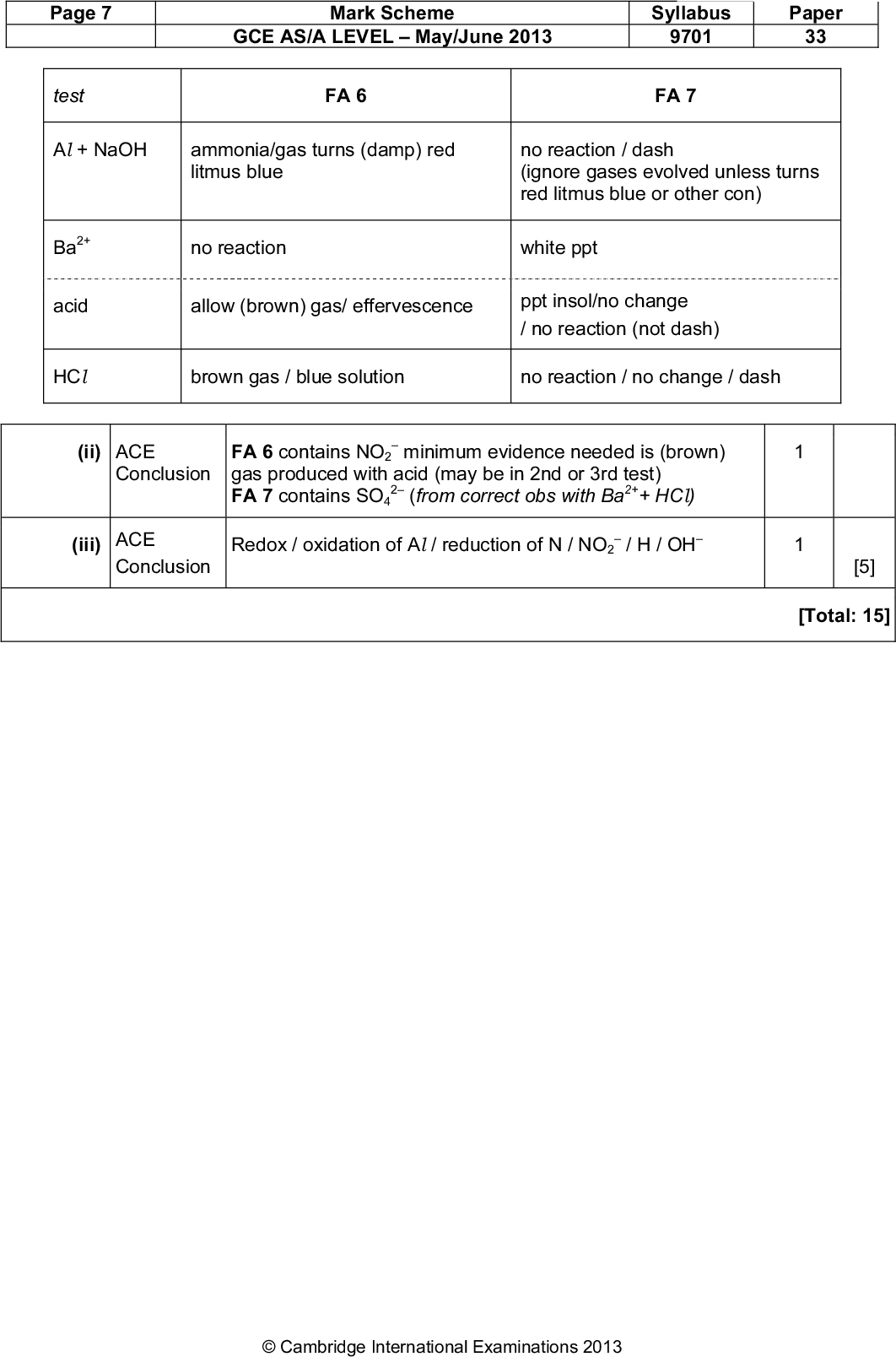
PMT Page 7 Mark Scheme Syllabus Paper GCE AS/A LEVELMay/June 2013 9701 33 test FA 6 FA 7 Al + NaOH ammonia/gas turns (damp) red no reaction / dash litmus blue (ignore gases evolved unless turns red litmus blue or other con) 2+ Ba no reaction white ppt acid allow (brown) gas/ effervescence ppt insol/no change / no reaction (not dash) HCl brown gas / blue solution no reaction / no change / dash (ii) ACE FA 6 contains NO2 minimum evidence needed is (brown) Conclusion gas produced with acid (may be in 2nd or 3rd test) FA 7 contains SO4 (from correct obs with Ba + HCl) 2 2+ (iii) ACE Redox / oxidation of Al / reduction of N / NO2 / H / OH Conclusion [5] [Total: 15]Cambridge International Examinations 2013<br />](https://learnah.org/wp-content/uploads/2018/08/June_2013_v3_MS_-_Paper_3_CIE_Chemistry_A-level_3-0.jpg)