Skip to content
CIE Jun 2013 v3 Paper 2 Q3
Answers available below
Show answer
Question
1
2
3
4
5

![Examiners For Use This question refers to the elements in the section of the Periodic Table shown below. Be Li Na Mg K Ca N Ptransition elementsGa Ge As B Al C Si He Ne Ar Kr O S Se F Cl Br (a) From this list of elements, identify in each case one element that has the property described. Give the symbol of the element. (i) An element that has molecules which consist of single atoms.(ii) An element that has a molecule which contains exactly four atoms.(iii) The element that is a liquid at room temperature and pressure.(iv) The element in Period 3 (Na to Ar) that has the largest atomic radius.(v) The element in Period 3 (Na to Ar) that has the highest melting point.(vi) The element in Period 3 (Na to Ar) that forms the largest anion.(vii) An element that reacts with water to give a solution that can behave as an oxidising agent.[7]UCLES 2013 9701/23/M/J/13<br />
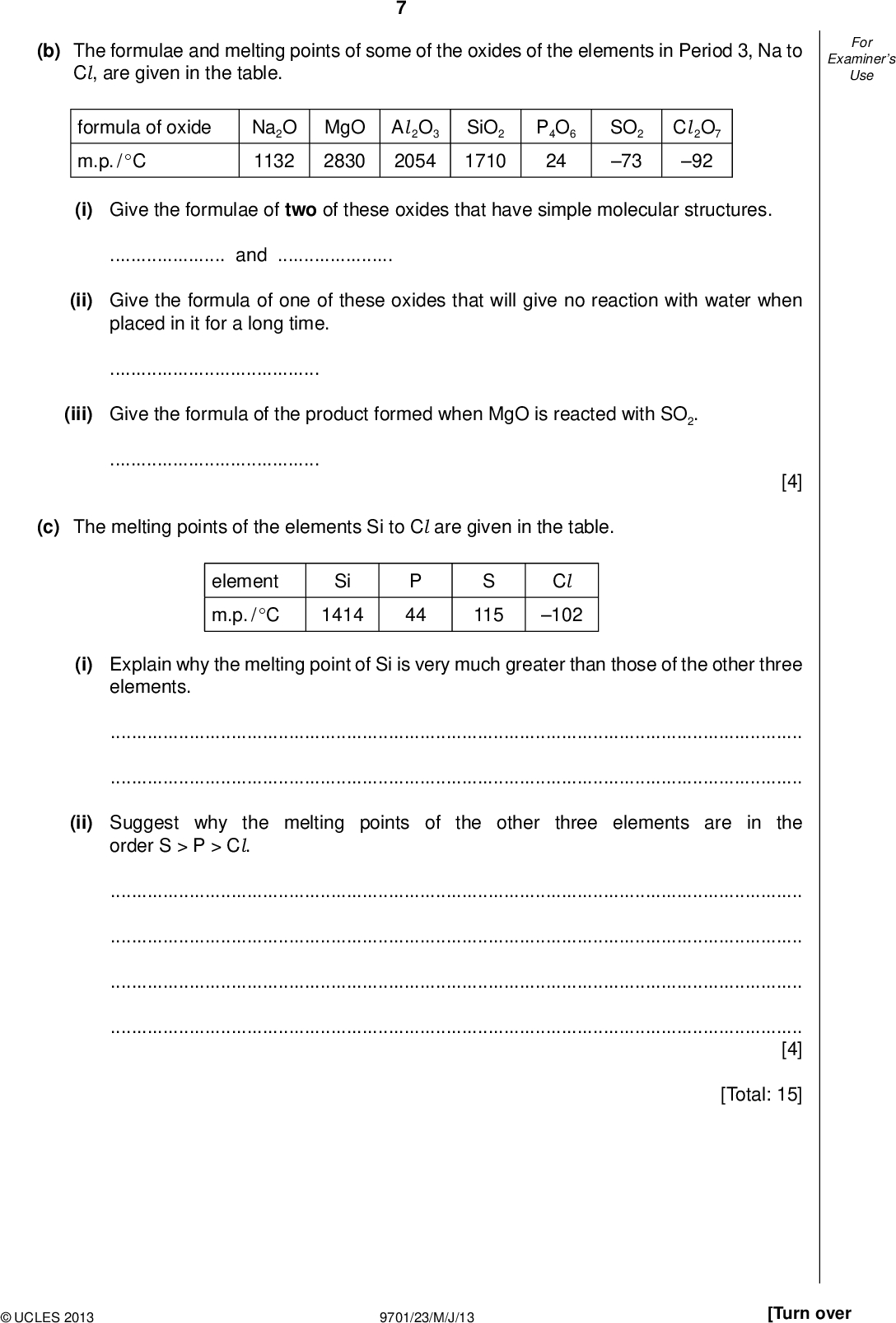
Examiners For Use (b) The formulae and melting points of some of the oxides of the elements in Period 3, Na to Cl, are given in the table. formula of oxide m.p. / C Na2O MgO Al 2O3 1132 2054 2830 SiO2 1710 P4O6 24 SO2 73 Cl 2O7 92 (i) Give the formulae of two of these oxides that have simple molecular structures.and(ii) Give the formula of one of these oxides that will give no reaction with water when placed in it for a long time.(iii) Give the formula of the product formed when MgO is reacted with SO2.[4] (c) The melting points of the elements Si to Cl are given in the table. element m.p. / C Si 1414 P 44 S 115 Cl 102 (i) Explain why the melting point of Si is very much greater than those of the other three elements.(ii) Suggest why the melting points of the other three elements are in the order S > P > Cl.[4] [Total: 15]UCLES 2013 9701/23/M/J/13 [Turn over<br />](https://learnah.org/wp-content/uploads/2018/08/June_2013_v3_QP_-_Paper_2_CIE_Chemistry_A-level_3-0.jpg)
![Page 4 Mark Scheme Syllabus Paper GCE AS/A LEVELMay/June 2013 9701 (a) (i) He or Ne or Ar or Kr (ii) P or As (iii) Br (iv) Na allow Ar (v) Si (vi) P allow Si (vii) Cl or F or Br (ii) Al2O3 or SiO2 (iii) MgSO3 (b) (i) any two from P4O6, SO2 and Cl2O7 23 (1) (1) (1) (1) (1) (1) (1) [7] (1+1) (1) (1) [4] (1) (1) (1) (1) [4] [Total: 15] (c) (i) Si is giant molecular/giant covalent or P, S, and Cl are simple molecular (ii) the molecules are S8, P4, Cl2 larger molecules have more electrons and hence greater van der Waals' forcesCambridge International Examinations 2013<br />](https://learnah.org/wp-content/uploads/2018/08/June_2013_v3_MS_-_Paper_2_CIE_Chemistry_A-level_3.jpg)