Skip to content
CIE Nov 2016 v4 Paper 3 Q1
Answers available below
Show answer
Question
1
2
3

![You will find the relative atomic mass, Ar, of magnesium by measuring the volume of hydrogen produced when a known mass of metal reacts with an excess of acid. PMT Mg(s) + 2HCl (aq)MgCl 2(aq) + H2(g) FB 1 is 1.00 mol dm3 hydrochloric acid, HCl. FB 2 is magnesium, Mg. (a) Method Read through the whole method before starting any practical work.Fill the tub with water to a depth of about 5 cm. Weigh the magnesium, FB 2, and note its mass below. If you are using a balance reading to 1 decimal place and the reading with the magnesium is zero, you should record this value. Fill the burette to about the 20 cm3 mark with hydrochloric acid, FB 1. Add distilled water to reach the 0 cm3 mark on the burette. Bend the magnesium strip into a U-shape. Place the magnesium in the burette so that it is above the liquid and friction holds it in position. Use a glass rod to push the magnesium about 2 cm into the burette. Hold a piece of paper towel over the open end of the burette, invert the burette and immediately place it in the tub of water. Remove the paper towel and clamp the burette as shown in the diagram. The liquid level should now be on the scale of the burette. If it is not, open the tap for a moment to allow the level to drop.magnesium ribbon burette burette clamp hydrochloric acid tub magnesium ribbon waterRecord the initial reading on the burette. Remember that the scale is now upside down. Leave the apparatus so that the acid from the burette diffuses around the magnesium and reacts. You should start Question 2 or Question 3 while waiting for the reaction to complete. When all the magnesium has reacted, note and record the final reading on the burette. Calculate the volume of hydrogen produced. ResultsUCLES 2016 9701/34/O/N/16 [3]<br />
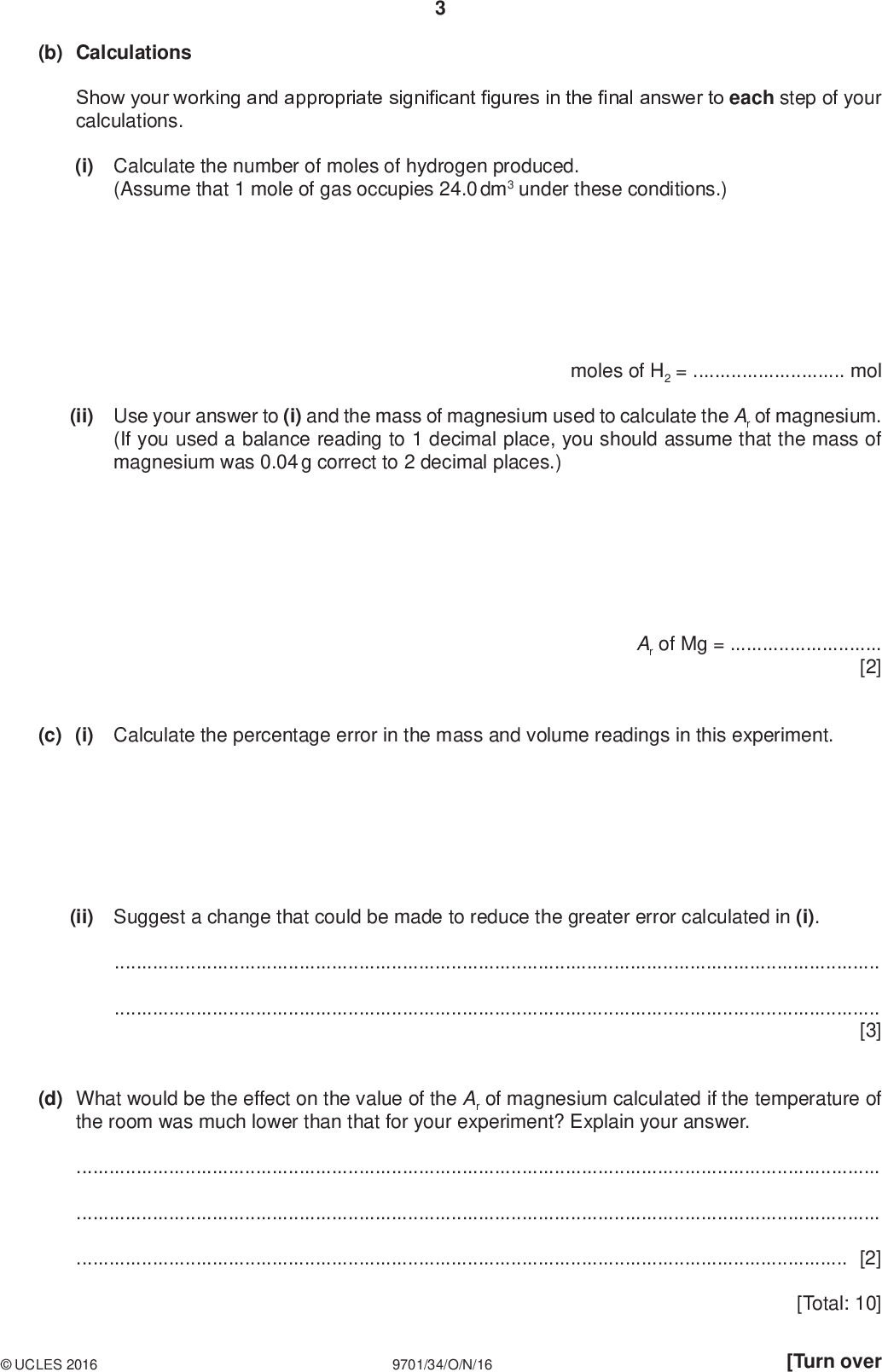
PMT (b) Calculations Show your working and appropriate significant figures in the final answer to each step of your calculations. (i) Calculate the number of moles of hydrogen produced. (Assume that 1 mole of gas occupies 24.0 dm3 under these conditions.) (ii) Use your answer to (i) and the mass of magnesium used to calculate the Ar of magnesium. (If you used a balance reading to 1 decimal place, you should assume that the mass of magnesium was 0.04 g correct to 2 decimal places.) moles of H2 =mol (c) (i) Calculate the percentage error in the mass and volume readings in this experiment. Ar of Mg =[2] (ii) Suggest a change that could be made to reduce the greater error calculated in (i).[3] (d) What would be the effect on the value of the Ar of magnesium calculated if the temperature of the room was much lower than that for your experiment? Explain your answer.[2]UCLES 2016 9701/34/O/N/16 [Total: 10] [Turn over<br />](https://learnah.org/wp-content/uploads/2018/08/November_2016_v4_QP_-_Paper_3_CIE_Chemistry_A-level_1-0.jpg)