Skip to content
CIE Nov 2016 v3 Paper 5 Q1
Answers available below
Show answer
Question
1
2

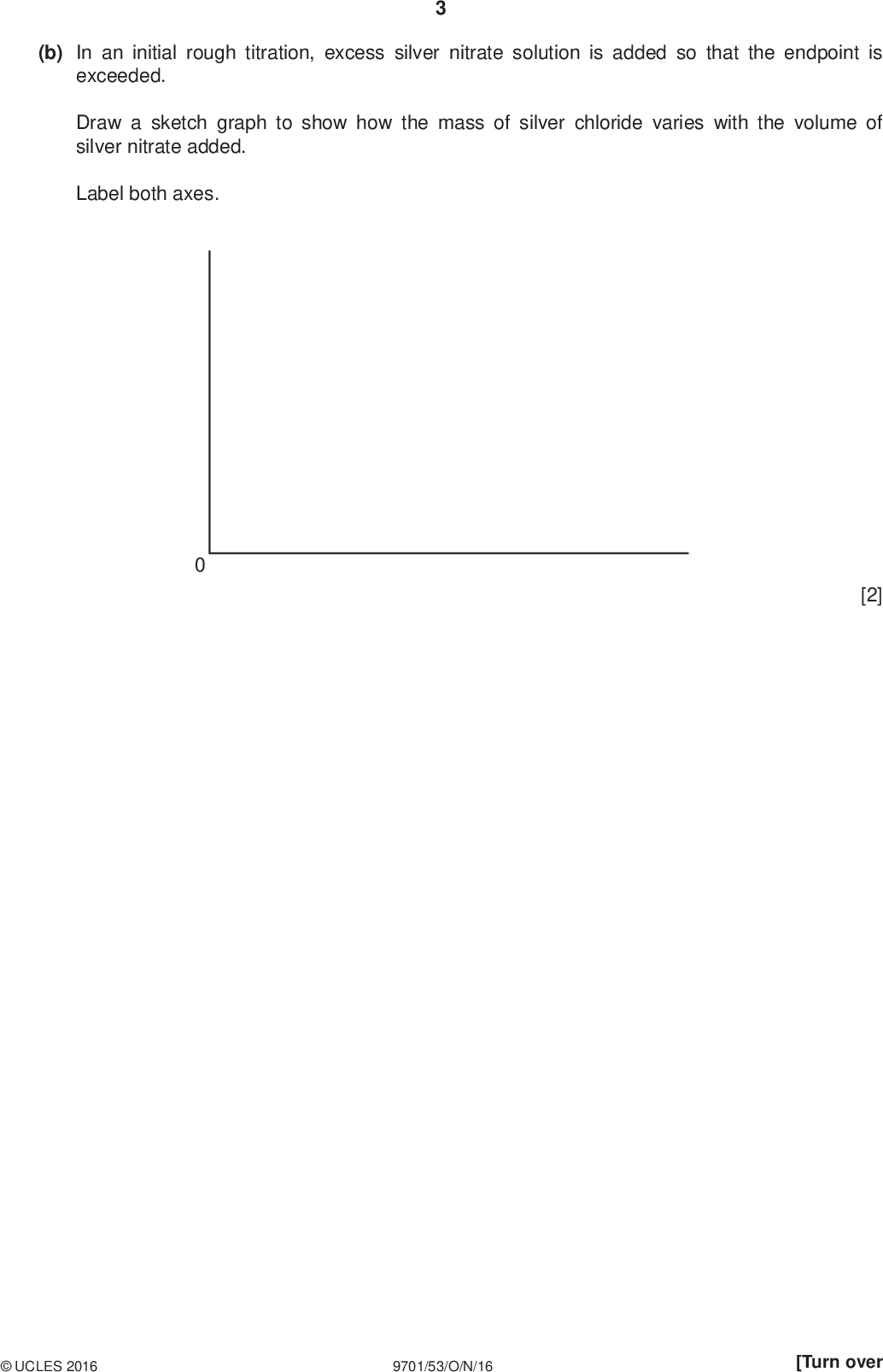
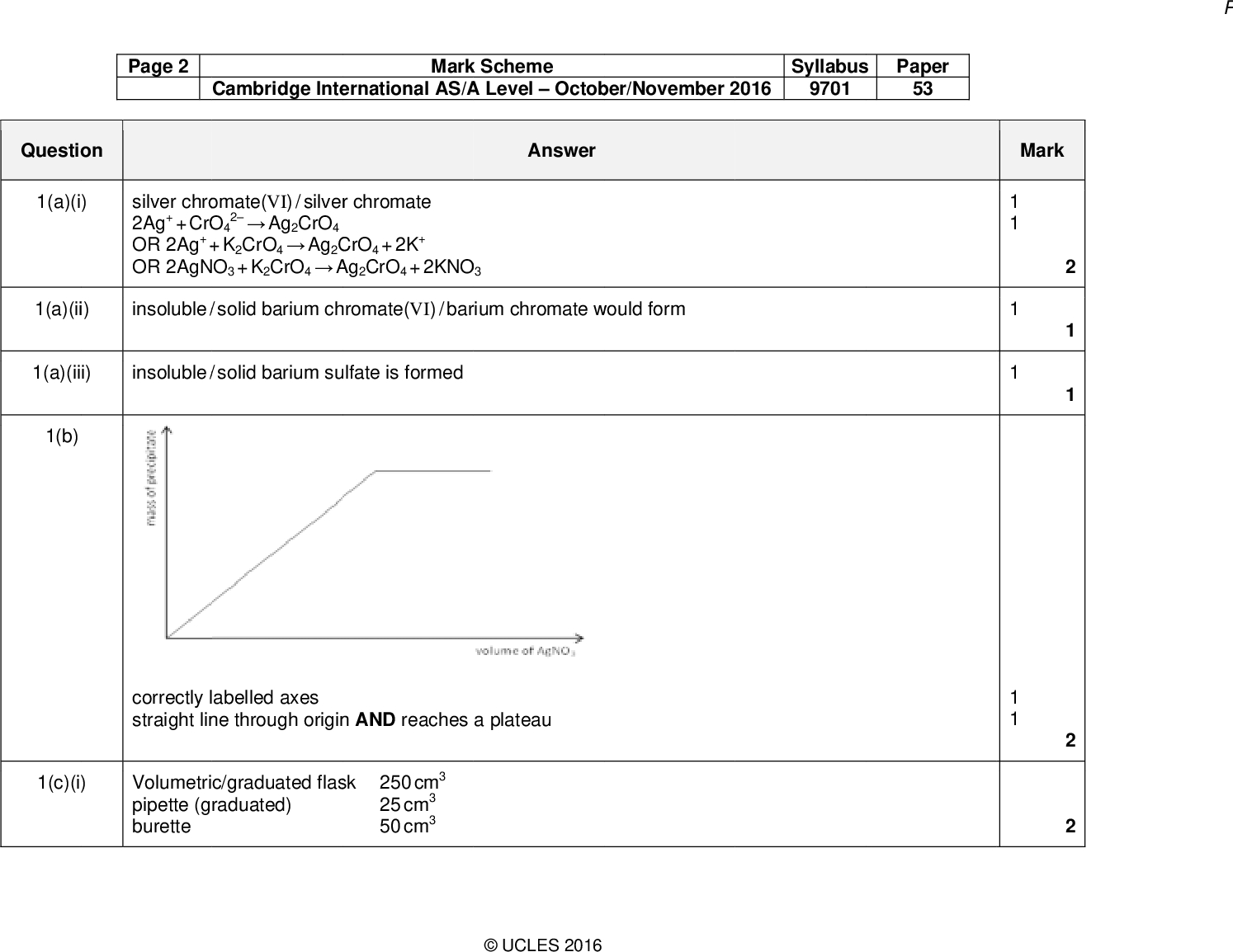
![When hydrated barium chloride, BaCl 2.xH2O, dissolves in water, Ba2+(aq) and Cl (aq) ions are formed. PMT The concentration of chloride ions in solution can be determined by titration with aqueous silver nitrate of known concentration. Ag+(aq) + Cl (aq)AgCl (s) The indicator for the reaction is aqueous potassium chromate(VI), K2CrO4(aq). At the endpoint of the titration, it forms a red precipitate in the presence of excess silver ions. (a) The solubilities, in g dm3, of different ionic compounds at 20 C are given in the table below. cation Ag+ Ba2+ Cl0.0019 358 anion CrO4 2 0.022 0.0028 2 SO4 293 0.00245 With reference to these data, where relevant, answer the following questions. (i) Name the red precipitate and give an equation for its formation. name:equation:[2] Sulfuric acid must be added to the solution to prevent the Ba2+(aq) ions from interfering with the action of the potassium chromate(VI) indicator. (ii) How would Ba2+(aq) ions interfere with the action of this indicator?[1] (iii) How does the addition of sulfuric acid prevent Ba2+(aq) ions from interfering with the action of this indicator?[1]UCLES 2016 9701/53/O/N/16<br />
(b) In an initial rough titration, excess silver nitrate solution is added so that the endpoint is exceeded. Draw a sketch graph to show how the mass of silver chloride varies with the volume of silver nitrate added. Label both axes. PMT [2]UCLES 2016 9701/53/O/N/16 [Turn over<br />
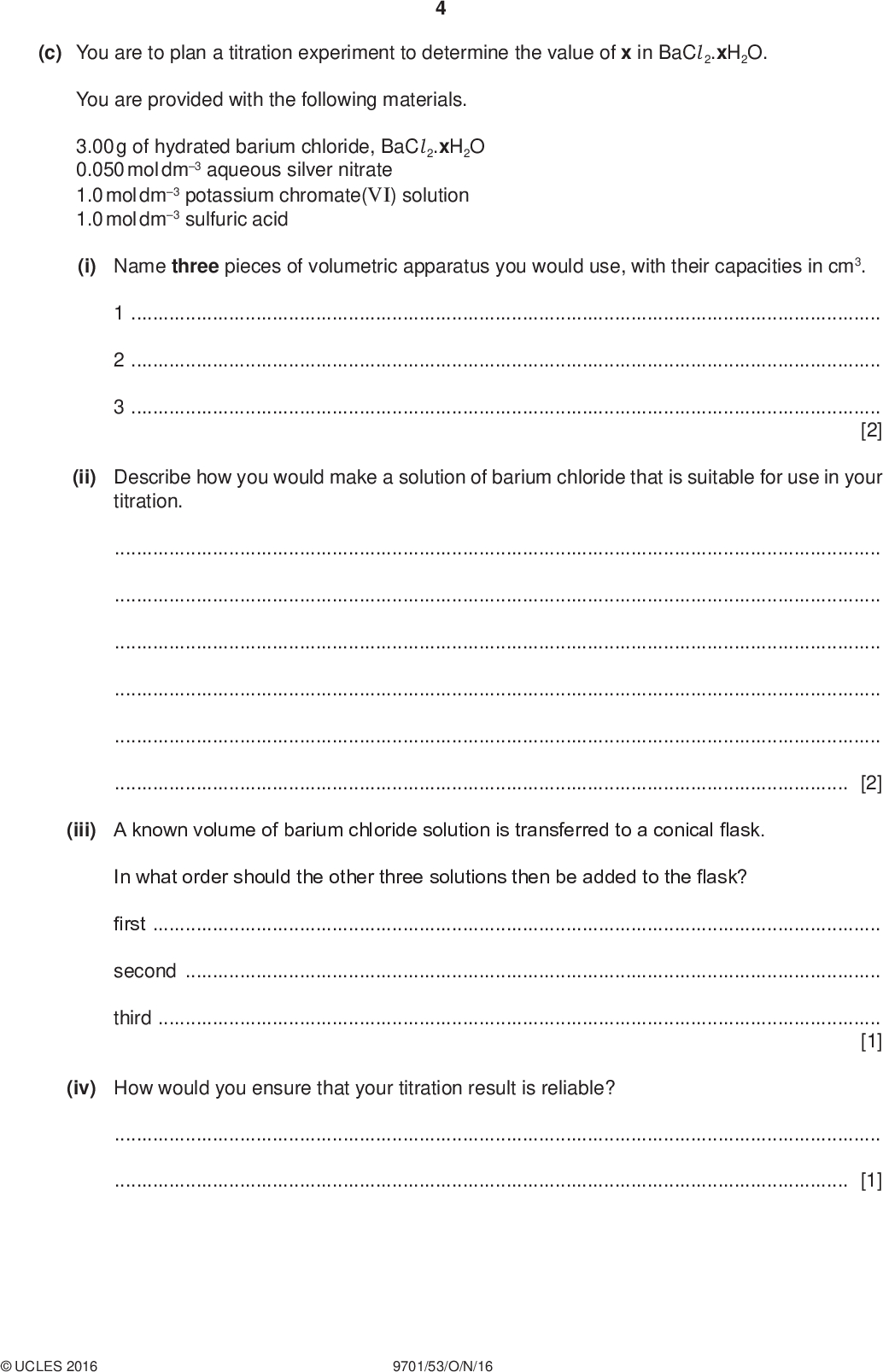
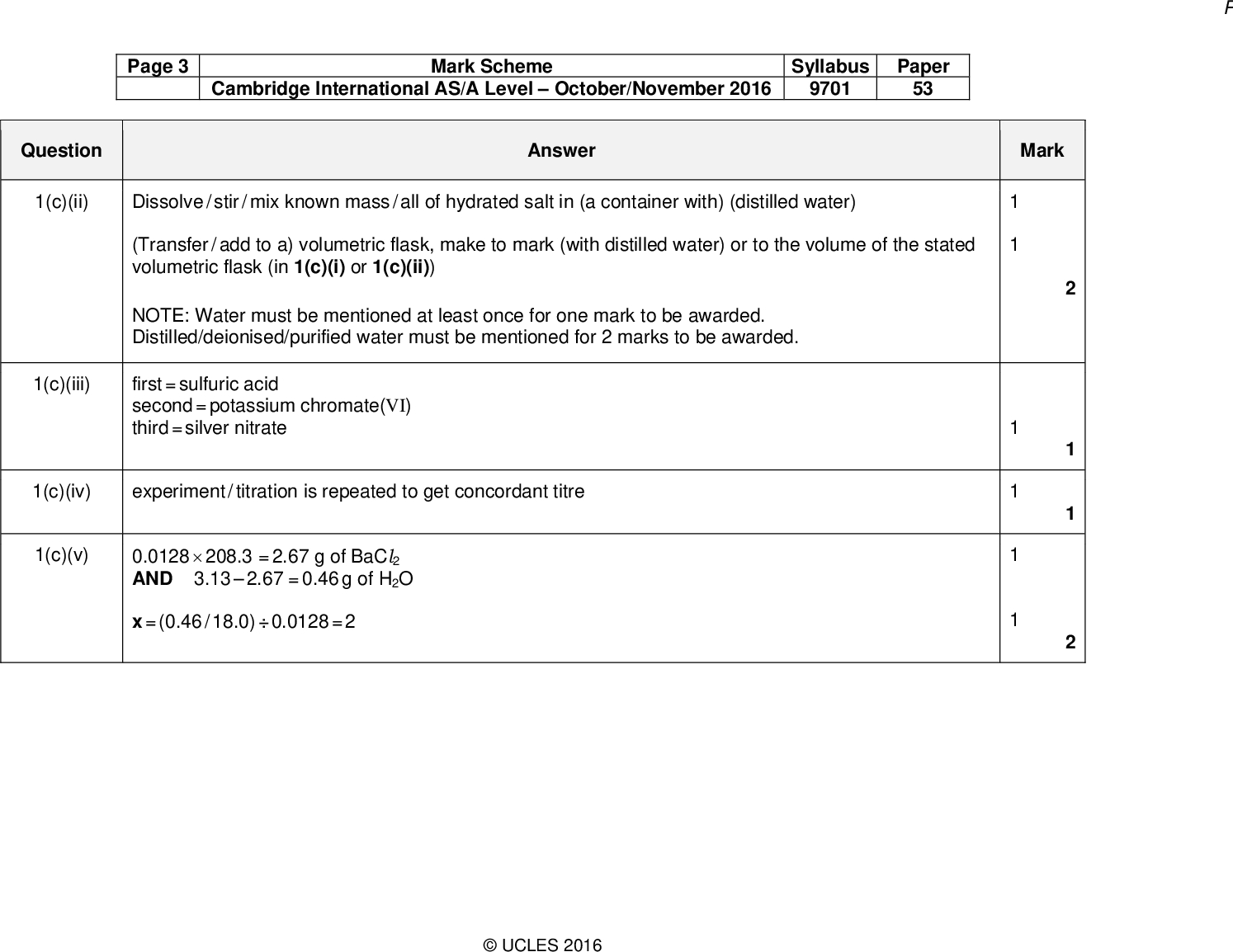
PMT (c) You are to plan a titration experiment to determine the value of x in BaCl 2.xH2O. You are provided with the following materials. 3.00 g of hydrated barium chloride, BaCl 2.xH2O 0.050 mol dm3 aqueous silver nitrate 1.0 mol dm3 potassium chromate(VI) solution 1.0 mol dm3 sulfuric acid (i) Name three pieces of volumetric apparatus you would use, with their capacities in cm3. 123[2] (ii) Describe how you would make a solution of barium chloride that is suitable for use in your titration.[2] (iii) A known volume of barium chloride solution is transferred to a conical flask. In what order should the other three solutions then be added to the flask? firstsecondthird[1] (iv) How would you ensure that your titration result is reliable?[1]UCLES 2016 9701/53/O/N/16<br />
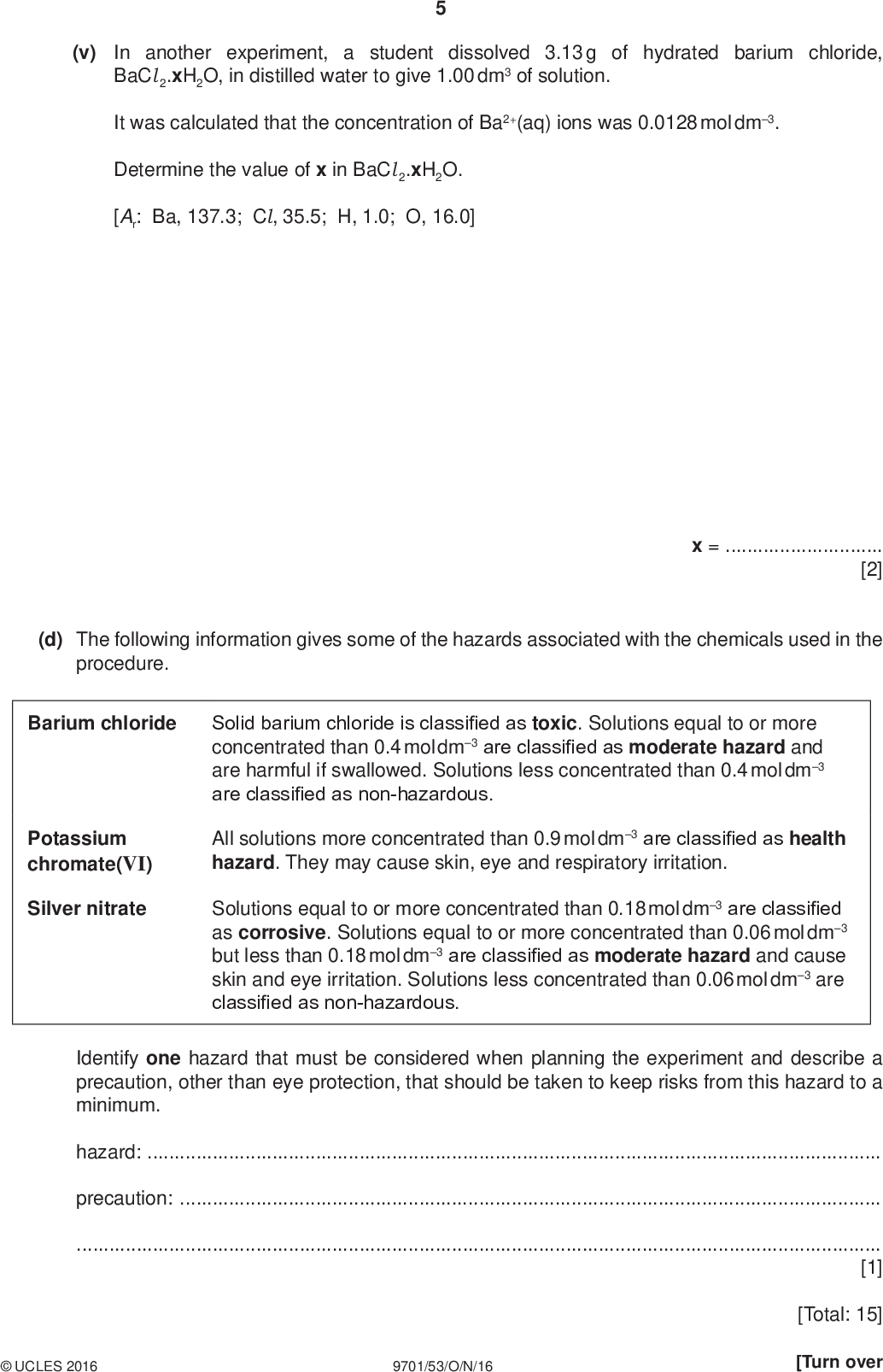
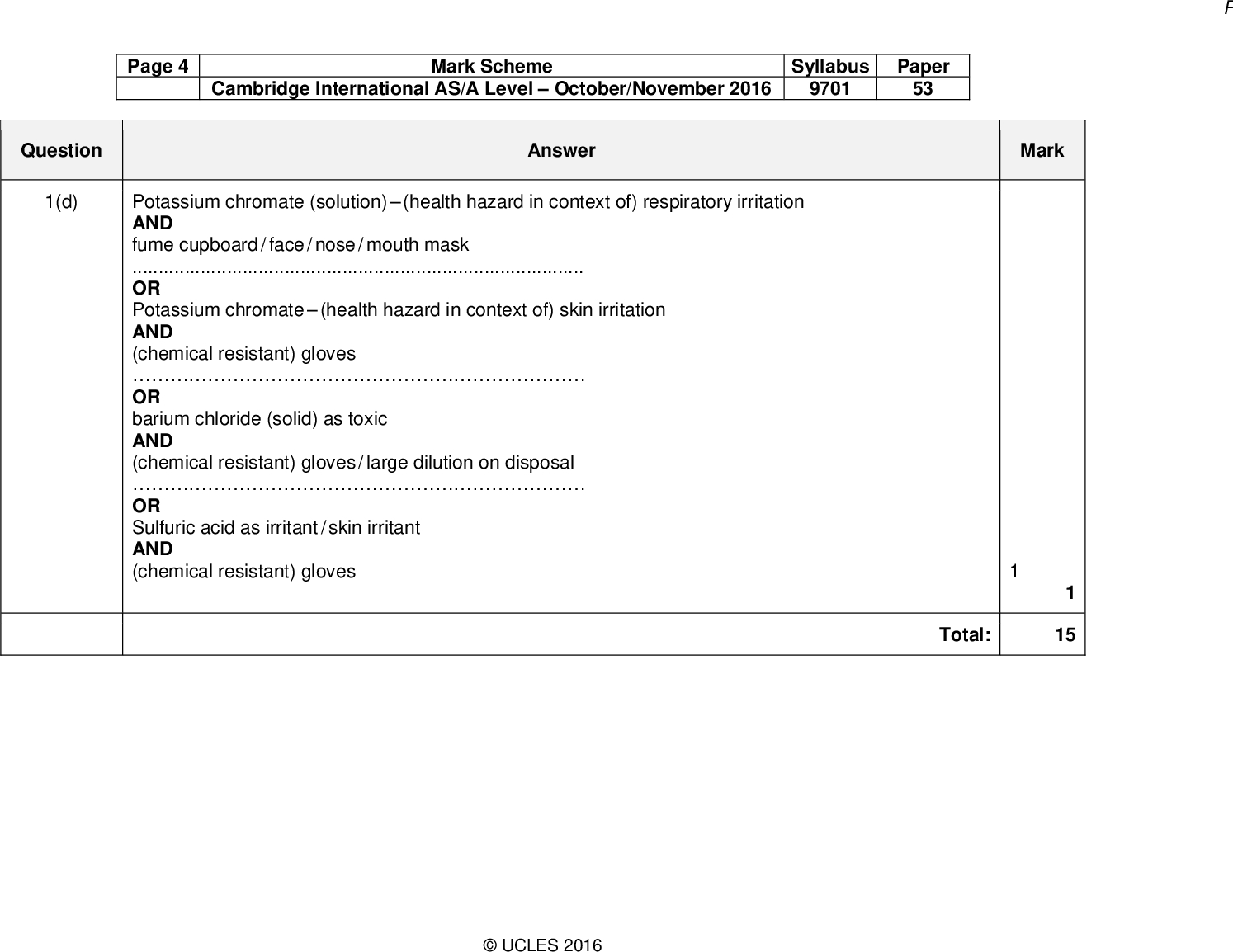
PMT (v) In another experiment, a student dissolved 3.13 g of hydrated barium chloride, BaCl 2.xH2O, in distilled water to give 1.00 dm3 of solution. It was calculated that the concentration of Ba2+(aq) ions was 0.0128 mol dm3. Determine the value of x in BaCl 2.xH2O. [Ar: Ba, 137.3; Cl, 35.5; H, 1.0; O, 16.0] x =[2] (d) The following information gives some of the hazards associated with the chemicals used in the procedure. Barium chloride Solid barium chloride is classified as toxic. Solutions equal to or more concentrated than 0.4 mol dm3 are classified as moderate hazard and are harmful if swallowed. Solutions less concentrated than 0.4 mol dm3 are classified as non-hazardous. Potassium chromate(VI) Silver nitrate All solutions more concentrated than 0.9 mol dm3 are classified as health hazard. They may cause skin, eye and respiratory irritation. Solutions equal to or more concentrated than 0.18 mol dm3 are classified as corrosive. Solutions equal to or more concentrated than 0.06 mol dm3 but less than 0.18 mol dm3 are classified as moderate hazard and cause skin and eye irritation. Solutions less concentrated than 0.06 mol dm3 are classified as non-hazardous. Identify one hazard that must be considered when planning the experiment and describe a precaution, other than eye protection, that should be taken to keep risks from this hazard to a minimum. hazard:precaution:[1]UCLES 2016 9701/53/O/N/16 [Total: 15] [Turn over<br />
BLANK PAGE PMTUCLES 2016 9701/53/O/N/16<br />](https://learnah.org/wp-content/uploads/2018/08/November_2016_v3_QP_-_Paper_5_CIE_Chemistry_A-level_1-0.jpg)