Skip to content
CIE Nov 2016 v2 Paper 5 Q2
Answers available below
Show answer
Question
1
2

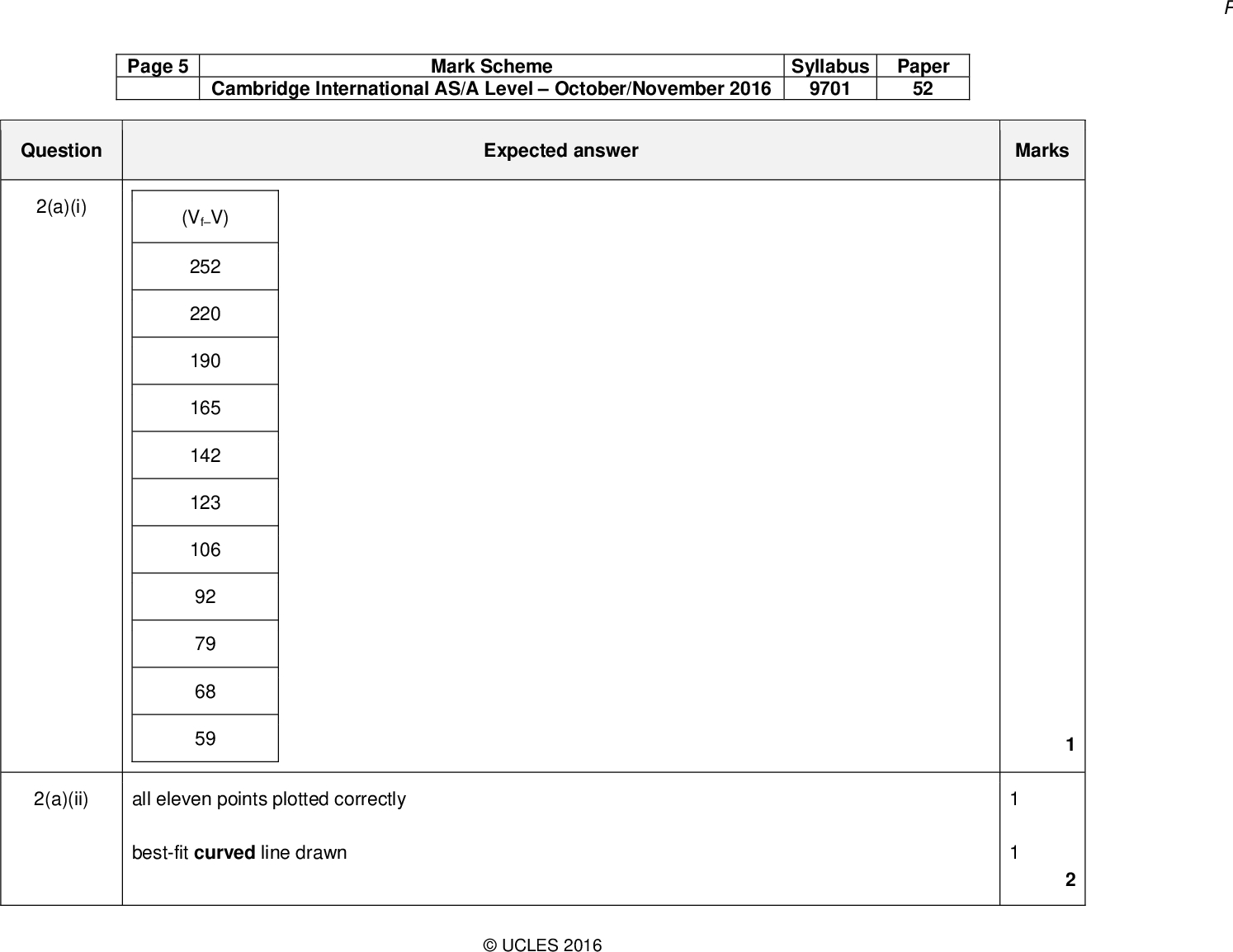
![Benzenediazonium chloride, C6H5N2Cl, is readily hydrolysed at temperatures above 5 C, forming phenol, nitrogen gas and hydrochloric acid. PMT C6H5N2Cl (aq) + H2O(l)C6H5OH(aq) + N2(g) + HCl (aq) The progress of the reaction can be monitored by measuring the volume of gas produced over time. The volume of gas produced, V, after time, t, is proportional to the amount of benzenediazonium chloride that has been hydrolysed. Thenal volume of gas produced, V nal, is proportional to the original concentration of benzenediazonium chloride. The order of reaction can be determined from these results. (a) (i) The experimentally determined volumes of gas produced during the hydrolysis of benzenediazonium chloride at 50 C are recorded below. Process the results to allow you to plot a graph of (V nalV ) against time, t. V nal = 252 cm3 time / s 0 150 300 450 600 750 900 1050 1200 1350 1500 volume, V / cm3 (V nalV ) / cm3 0 32 62 87 110 129 146 160 173 184 193 [1]UCLES 2016 9701/52/O/N/16<br />
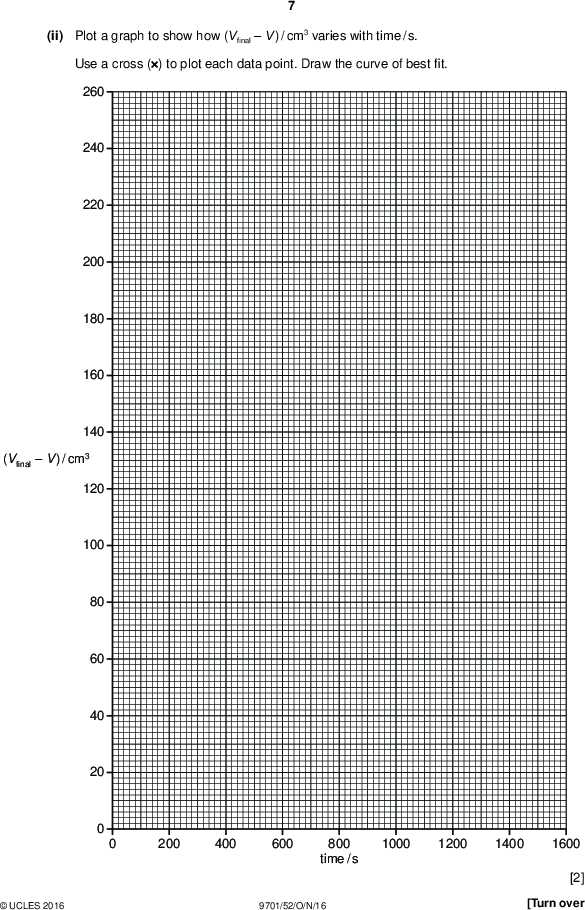
(ii) Plot a graph to show how (V nalV ) / cm3 varies with time / s. Use a cross () to plot each data point. Draw the curve of bestt. PMT 260 240 220 200 180 160 140 (VfinalV ) / cm3 120 100 80 60 40 20 200 400 600 800 time / s 1000 1200 1400 1600UCLES 2016 9701/52/O/N/16 [2] [Turn over<br />
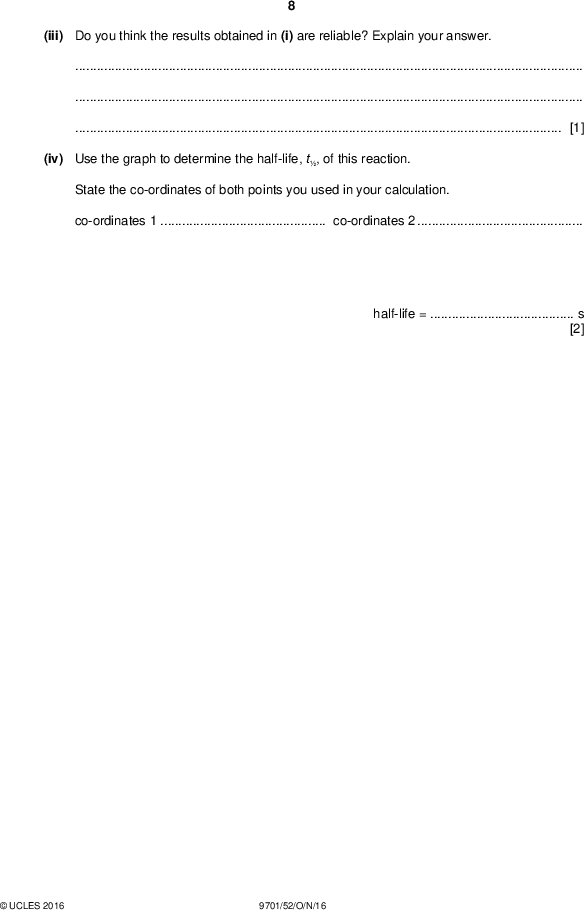
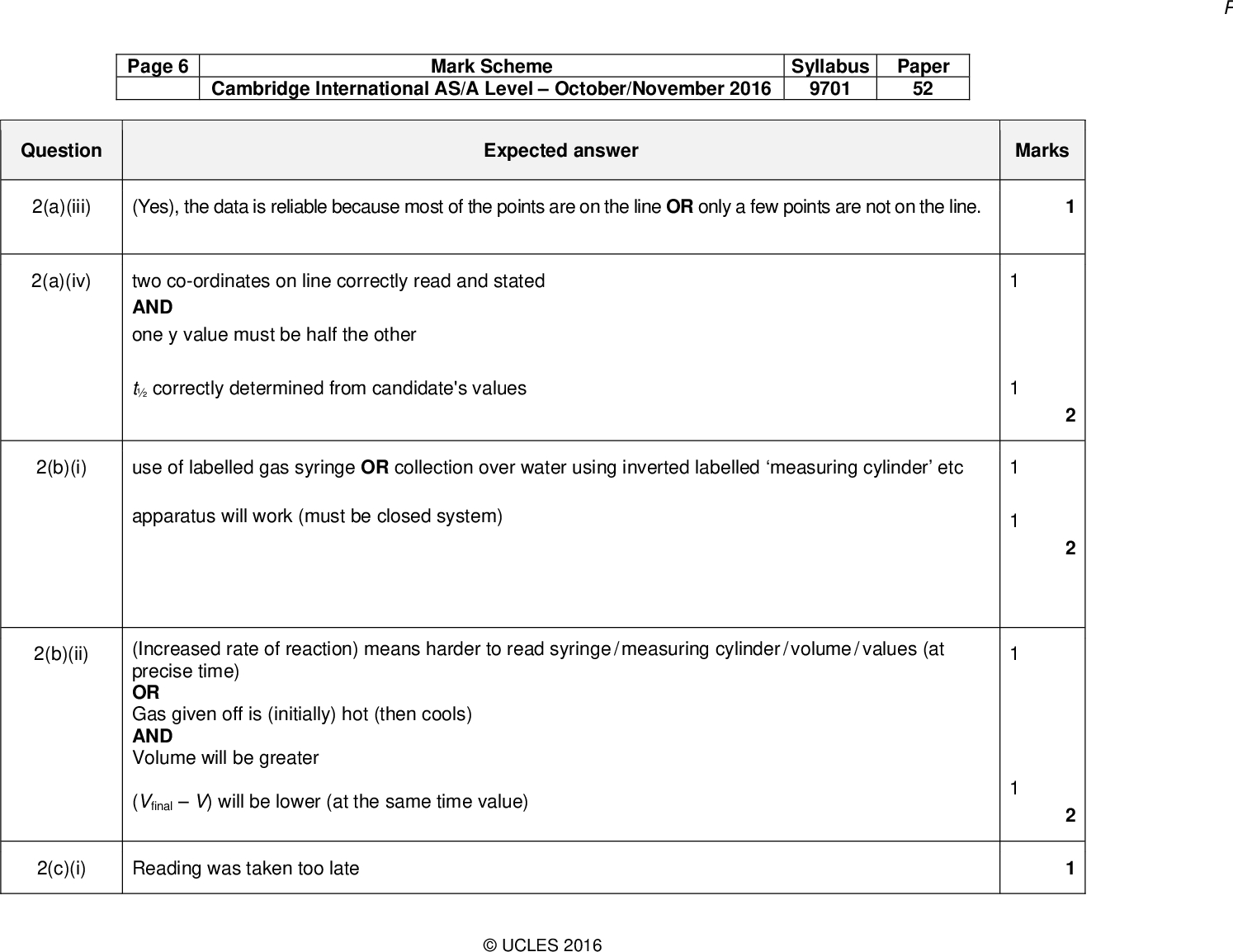
PMT (iii) Do you think the results obtained in (i) are reliable? Explain your answer.[1] (iv) Use the graph to determine the half-life, t, of this reaction. State the co-ordinates of both points you used in your calculation. co-ordinates 1co-ordinates 2half-life =s [2]UCLES 2016 9701/52/O/N/16<br />
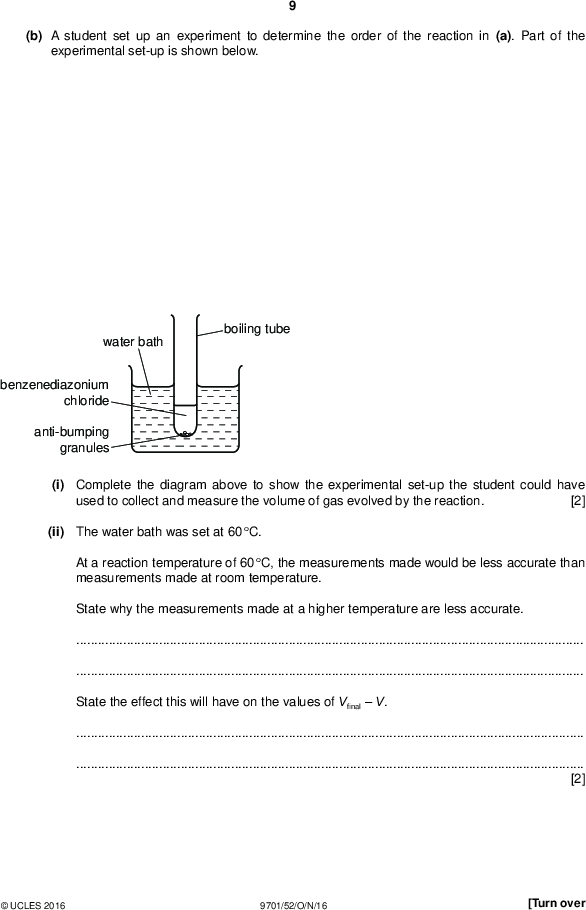
(b) A student set up an experiment to determine the order of the reaction in (a). Part of the experimental set-up is shown below. PMT water bath boiling tube benzenediazonium chloride anti-bumping granules (i) Complete the diagram above to show the experimental set-up the student could have used to collect and measure the volume of gas evolved by the reaction. [2] (ii) The water bath was set at 60 C. At a reaction temperature of 60 C, the measurements made would be less accurate than measurements made at room temperature. State why the measurements made at a higher temperature are less accurate.State the effect this will have on the values of V nalV.[2]UCLES 2016 9701/52/O/N/16 [Turn over<br />
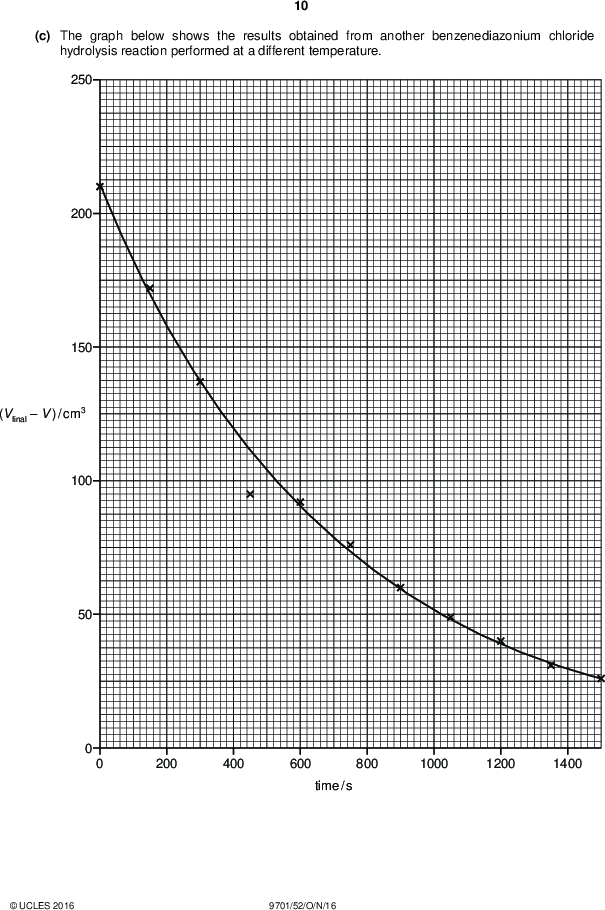
(c) The graph below shows the results obtained from another benzenediazonium chloride hydrolysis reaction performed at a different temperature. 10 PMT 250 200 150 (VfinalV ) / cm3 100 50 200 400 600 800 1000 1200 1400 time / sUCLES 2016 9701/52/O/N/16<br />
PMT 11 (i) The point at time = 450 s is considered to be anomalous. Suggest what caused the anomaly.[1] Question 2 continues on page 12.UCLES 2016 9701/52/O/N/16 [Turn over<br />
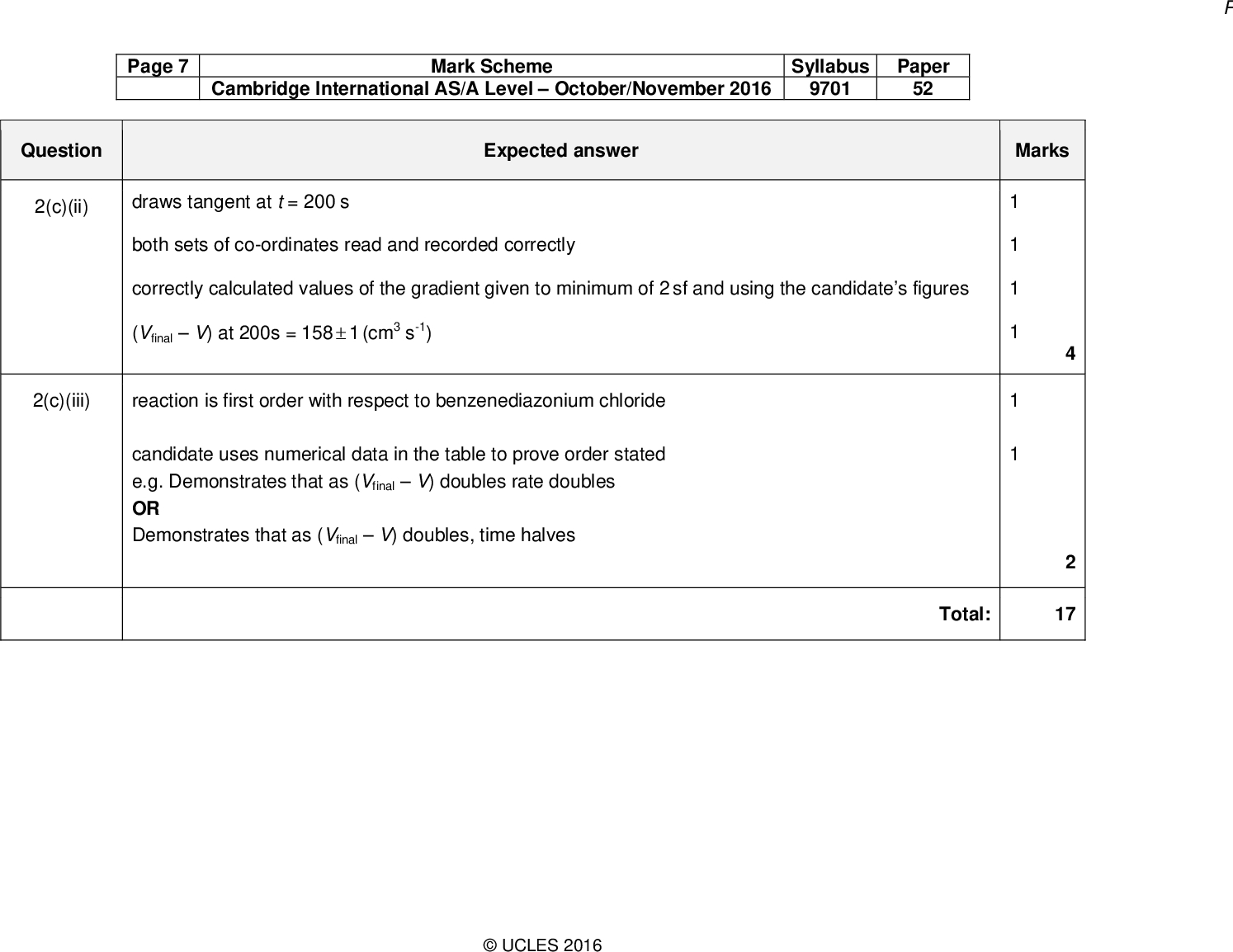
PMT 12 (ii) The rate of reaction at different times can be calculated by drawing tangents to the best- t line. The gradient of the tangent is equal to the rate of reaction, in cm3 s1. Use the graph in (c) to read the value of (V nalV ) at time t = 200 s and write this value in the table below. Draw a tangent to the curve at time t = 200 s. Use the tangent to determine the gradient at time t = 200 s. State the co-ordinates of both points you used in your calculation. co-ordinates 1co-ordinates 2Use your gradient to complete the table. gradient at 200 s =cm3 s1 time / s 200 500 600 900 1000 1400 (V nalV ) / cm3 rate of reaction / cm3 s1 104 91 59 52 30 0.143 0.127 0.0867 0.0720 0.0417 (iii) The concentration of benzenediazonium chloride is directly proportional to (V nalV ). Use the data in the table in (ii) to calculate the order of reaction with respect to benzenediazonium chloride. You must show your working. [4] [2] [Total: 17] Permission to reproduce items where third-party owned material protected by copyright is included has been sought and cleared where possible. Every reasonable effort has been made by the publisher (UCLES) to trace copyright holders, but if any items requiring clearance have unwittingly been included, the publisher will be pleased to make amends at the earliest possible opportunity. To avoid the issue of disclosure of answer-related information to candidates, all copyright acknowledgements are reproduced online in the Cambridge International Examinations Copyright Acknowledgements Booklet. This is produced for each series of examinations and is freely available to download at www.cie.org.uk after the live examination series. Cambridge International Examinations is part of the Cambridge Assessment Group. Cambridge Assessment is the brand name of University of Cambridge Local Examinations Syndicate (UCLES), which is itself a department of the University of Cambridge.UCLES 2016 9701/52/O/N/16<br />](https://learnah.org/wp-content/uploads/2018/08/November_2016_v2_QP_-_Paper_5_CIE_Chemistry_A-level_2-0.jpg)