Skip to content
CIE Nov 2015 v3 Paper 5 Q1
Answers available below
Show answer
Question
1
2

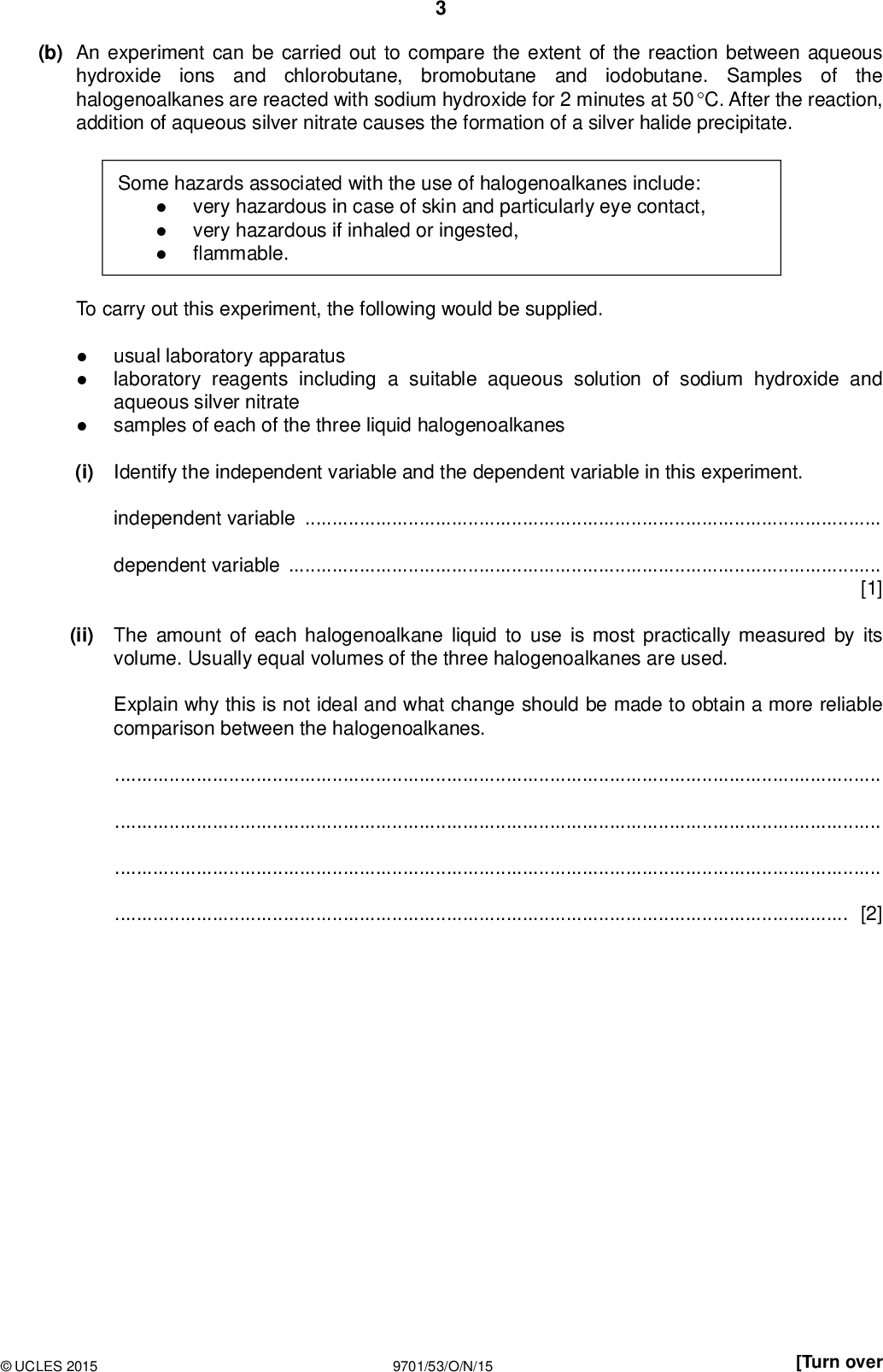
![PMT The halogenoalkanes can react with hydroxide ions to form an alcohol and a halide ion. (a) The rate at which the reaction occurs depends on which of the halogenoalkanes is chosen. The reaction is a nucleophilic attack by the hydroxide ion and the rate might depend on: the polarity of the carbon-halogen bond, the bond strength of the carbon-halogen bond. For (i) and (ii), chlorobutane, bromobutane and iodobutane should be considered. (i) If the rate of reaction was only controlled by the polarity of the carbon-halogen bond, the order of reactivity (most reactive to least reactive) would be. Explain the variation in the polarity of the carbon-halogen bonds.[2] (ii) If the rate of reaction was only controlled by the bond strength of the carbon-halogen bond, the order of reactivity (most reactive to least reactive) would be. Explain the variation in the bond strength of the carbon-halogen bonds.[2]UCLES 2015 9701/53/O/N/15<br />
PMT (b) An experiment can be carried out to compare the extent of the reaction between aqueous hydroxide the halogenoalkanes are reacted with sodium hydroxide for 2 minutes at 50 C. After the reaction, addition of aqueous silver nitrate causes the formation of a silver halide precipitate. ions and chlorobutane, bromobutane and iodobutane. Samples of Some hazards associated with the use of halogenoalkanes include: very hazardous in case of skin and particularly eye contact, very hazardous if inhaled or ingested,ammable.To carry out this experiment, the following would be supplied.(i) usual laboratory apparatus laboratory reagents including a suitable aqueous solution of sodium hydroxide and aqueous silver nitrate samples of each of the three liquid halogenoalkanes Identify the independent variable and the dependent variable in this experiment. independent variabledependent variable[1] (ii) The amount of each halogenoalkane liquid to use is most practically measured by its volume. Usually equal volumes of the three halogenoalkanes are used. Explain why this is not ideal and what change should be made to obtain a more reliable comparison between the halogenoalkanes.[2]UCLES 2015 9701/53/O/N/15 [Turn over<br />
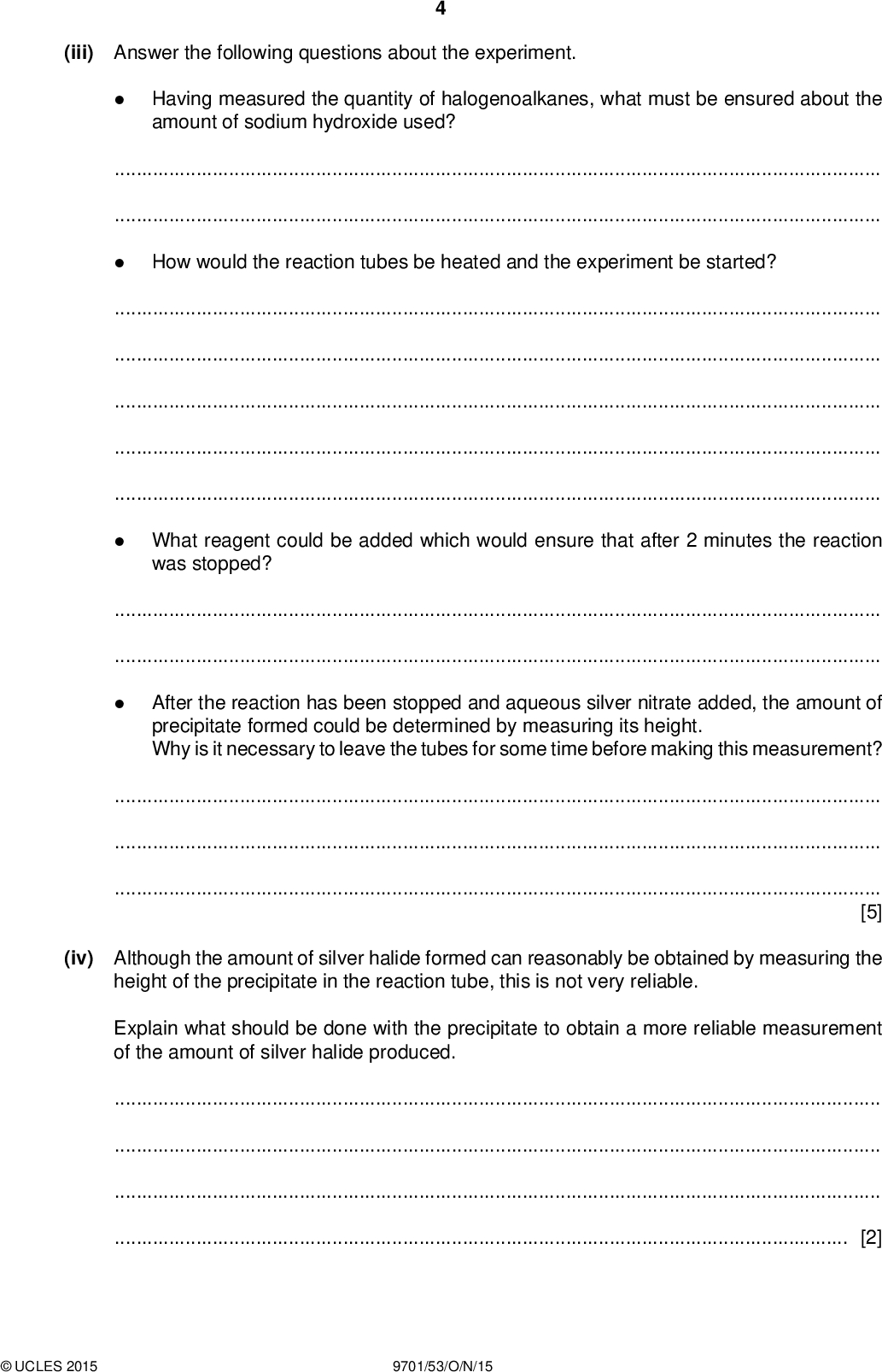
PMT (iii) Answer the following questions about the experiment. Having measured the quantity of halogenoalkanes, what must be ensured about the amount of sodium hydroxide used?How would the reaction tubes be heated and the experiment be started?What reagent could be added which would ensure that after 2 minutes the reaction was stopped?After the reaction has been stopped and aqueous silver nitrate added, the amount of precipitate formed could be determined by measuring its height. Why is it necessary to leave the tubes for some time before making this measurement?[5] (iv) Although the amount of silver halide formed can reasonably be obtained by measuring the height of the precipitate in the reaction tube, this is not very reliable. Explain what should be done with the precipitate to obtain a more reliable measurement of the amount of silver halide produced.[2]UCLES 2015 9701/53/O/N/15<br />
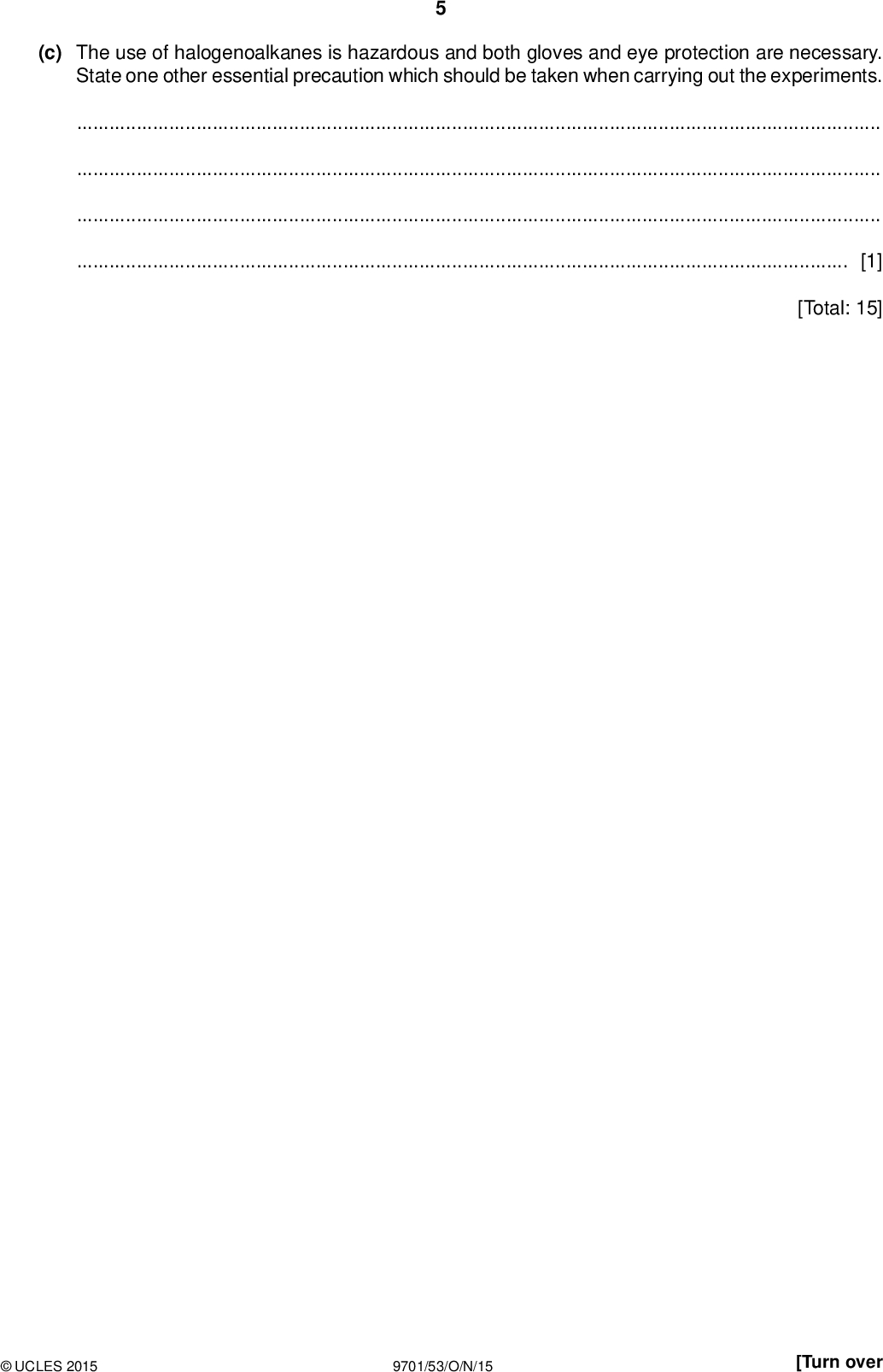
PMT (c) The use of halogenoalkanes is hazardous and both gloves and eye protection are necessary. State one other essential precaution which should be taken when carrying out the experiments.[1] [Total: 15]UCLES 2015 9701/53/O/N/15 [Turn over<br />](https://learnah.org/wp-content/uploads/2018/08/November_2015_v3_QP_-_Paper_5_CIE_Chemistry_A-level_1-0.jpg)
![chlorobutane, bromobutane, iodobutane decreasing electronegativity of chlorine, bromine and iodine (ii) iodobutane, bromobutane, chlorobutane decreasing size of atoms of iodine, bromine and chlorine/decreasing bond length of the C-Hal bond (b) (i) The halogenoalkane(s) AND the amount of precipitate (ii) Equal moles / amounts are not being used Use same number of moles / amounts of halogenoalkane (iii) (cid:127) Use the same amount of sodium hydroxide each time (cid:127) (cid:127) mix reagents / mix halogenoalkane and hydroxide and immediately heat water / oil bath / heating mantle (to 50 C) start timer add nitric acid allow precipitate to settle (cid:127) (cid:127) (iv) The precipitates should be filtered and dried The precipitates should be weighed (c) Avoid the use of flames / keep away from flames / use a fume cupboard/wear a face mask / well ventilated room [1] [1] [1] [1] [1] [1] [1] [1] [1] [1] [1] [1] [1] [1] [1] Page 2 Mark Scheme Syllabus Paper Cambridge International A LevelOctober/November 2015 9701 53 Expected Answer Mark Question (a) (i) [15]Cambridge International Examinations 2015<br />](https://learnah.org/wp-content/uploads/2018/08/November_2015_v3_MS_-_Paper_5_CIE_Chemistry_A-level_1.jpg)