Skip to content
CIE Mar 2017 v3 Paper 3 Q1
Answers available below
Show answer
Question
1
2
3

![PMT The concentration of hydrogen peroxide may be given in mol dm3 or as volume strength. You will determine the concentration of hydrogen peroxide in mol dm3 and in volume strength by a gas collection method. Hydrogen peroxide decomposes to form water and oxygen. The reaction is much faster in the presence of a catalyst such as manganese(IV) oxide. 2H2O2(aq) 2H2O(l) + O2(g) Volume strength is defined as the volume of oxygen in cm3 produced from the decomposition of 1.0 cm3 of hydrogen peroxide at room temperature and pressure. For example, 1.0 cm3 of 100 volume hydrogen peroxide will produce 100 cm3 of oxygen. FA 1 is a solution of hydrogen peroxide, H2O2. FA 2 is manganese(IV) oxide, MnO2. (a) Method Read the whole method before starting any practical work. The diagram below may help you in setting up your apparatus. clamp clamp waterFill the tub with water to a depth of about 5 cm. Fill the 250 cm3 measuring cylinder completely with water. Hold a piece of paper towel firmly over the top, invert the measuring cylinder and place it in the water in the tub. Remove the paper towel and clamp the inverted measuring cylinder so that the open end is in the water just above the base of the tub. Rinse the 50 cm3 measuring cylinder with a little FA 1 then use it to transfer 150 cm3 of FA 1 into the reaction flask labelled X. Check that the bung fits tightly in the neck of flask X, clamp flask X and place the end of the delivery tube into the inverted 250 cm3 measuring cylinder. Remove the bung from the neck of the flask. Tip FA 2 into the hydrogen peroxide and replace the bung immediately. Remove the flask from the clamp and swirl it to mix the contents. Swirl the flask occasionally until no more gas is given off. Replace the flask in the clamp. Measure and record the final volume of gas in the measuring cylinder in the space below. Keep FA 1 for use in Question 2. ResultUCLES 2017 9701/33/F/M/17 [2]<br />
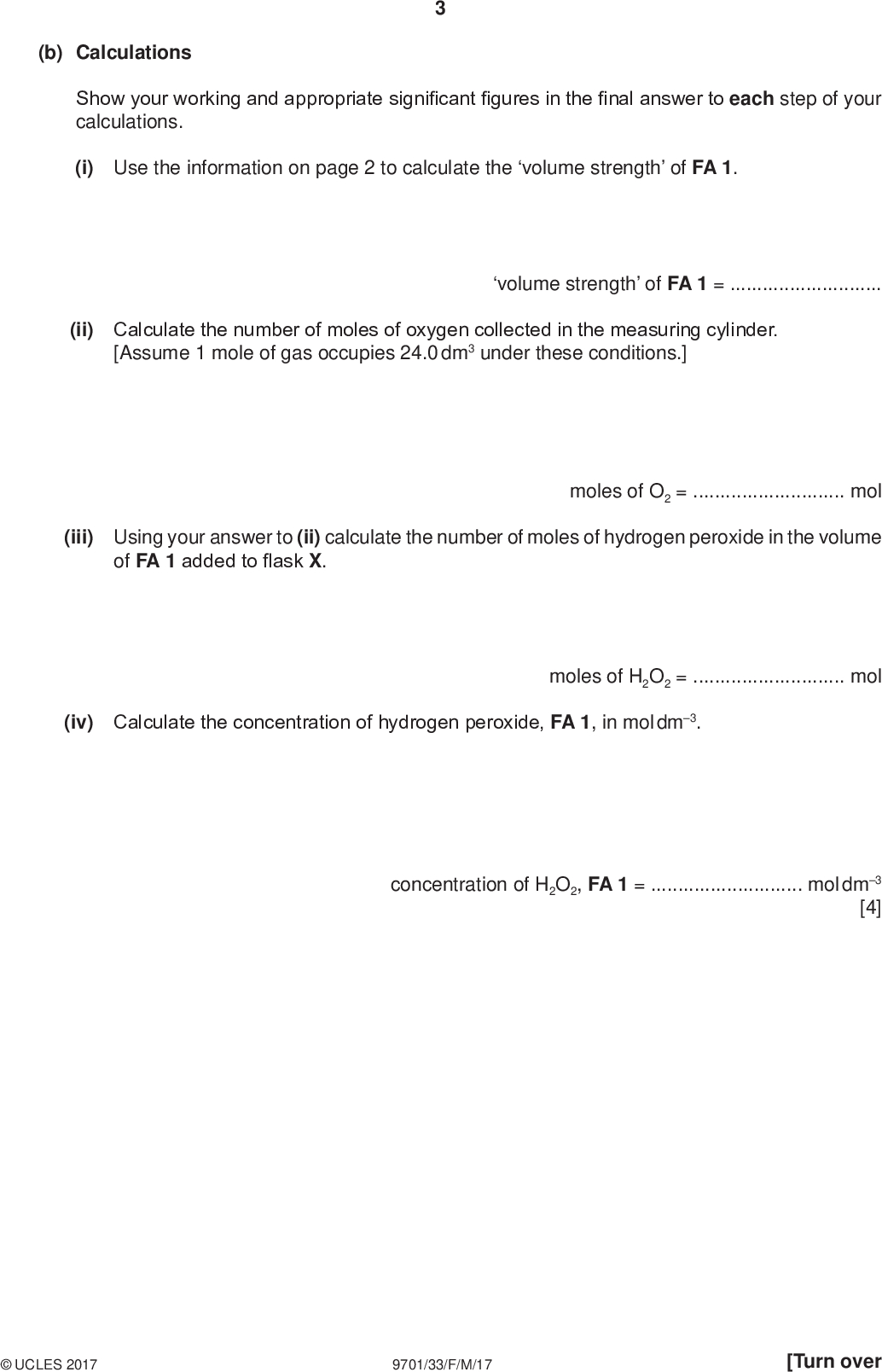
(b) Calculations Show your working and appropriate significant figures in the final answer to each step of your calculations. (i) Use the information on page 2 to calculate the volume strength of FA 1. PMT (ii) Calculate the number of moles of oxygen collected in the measuring cylinder. [Assume 1 mole of gas occupies 24.0 dm3 under these conditions.] volume strength of FA 1 =(iii) Using your answer to (ii) calculate the number of moles of hydrogen peroxide in the volume of FA 1 added to flask X. moles of O2 =mol (iv) Calculate the concentration of hydrogen peroxide, FA 1, in mol dm3. moles of H2O2 =mol concentration of H2O2, FA 1 =mol dm3 [4]UCLES 2017 9701/33/F/M/17 [Turn over<br />
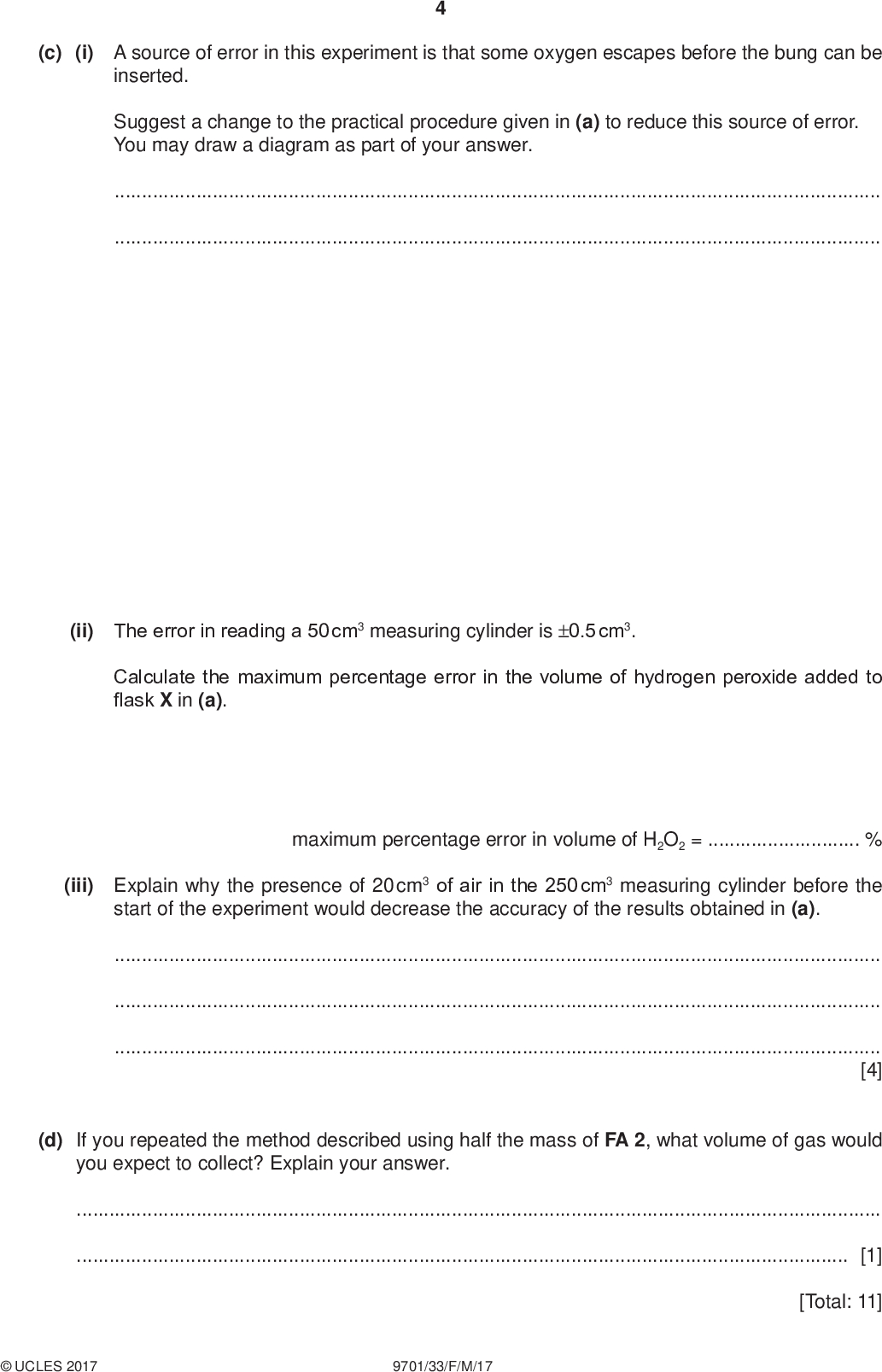
PMT (c) (i) A source of error in this experiment is that some oxygen escapes before the bung can be inserted. Suggest a change to the practical procedure given in (a) to reduce this source of error. You may draw a diagram as part of your answer.(ii) The error in reading a 50 cm3 measuring cylinder is 0.5 cm3. Calculate the maximum percentage error in the volume of hydrogen peroxide added to flask X in (a). maximum percentage error in volume of H2O2 =% (iii) Explain why the presence of 20 cm3 of air in the 250 cm3 measuring cylinder before the start of the experiment would decrease the accuracy of the results obtained in (a).[4] (d) If you repeated the method described using half the mass of FA 2, what volume of gas would you expect to collect? Explain your answer.[1] [Total: 11]UCLES 2017 9701/33/F/M/17<br />](https://learnah.org/wp-content/uploads/2018/08/March_2017_v3_QP_-_Paper_3_CIE_Chemistry_A-level_1-0.jpg)
![9701/33 Question Cambridge International AS/A LevelMark Scheme PUBLISHED Answer March 2017 Marks 1(a) M1 unambiguous recording of volume of oxygen gas with unit M2 volume of gas within 10% of the supervisors value 1(b)(i) correctly calculates V(a)150 to 24 sig. fig. 1(b)(ii) 1(b)(iii) 1(b)(iv) 1(c)(i) 1(c)(ii) correctly calculates ( V a24.0 1 000 to 24 sig. fig. correctly uses (ii)2 AND answer to 24 sig. fig. shows working ) 1 000 iii 150 AND answer to 24 sig. fig. MnO2 in (ignition) tube / floating in weighing boat OR use a dropping funnel / syringe for H2O2 AND subtract the liquid volume M1 0.5 1 00 = 1.0%50 M23 = 3.0% (3.0 with no working shown scores [2].) 1(c)(iii) (agree as) two readings to find volume of gas evolved are needed so there is twice the percentage error in the gas volume reading 1(d) no change because MnO2 / FA 2 / solid is a catalystUCLES 2017 Page 2 of 5<br />](https://learnah.org/wp-content/uploads/2018/08/March_2017_v3_MS_-_Paper_3_CIE_Chemistry_A-level_1.jpg)