Skip to content
CIE Mar 2017 v2 Paper 2 Q2
Answers available below
Show answer
Question
1
2
3

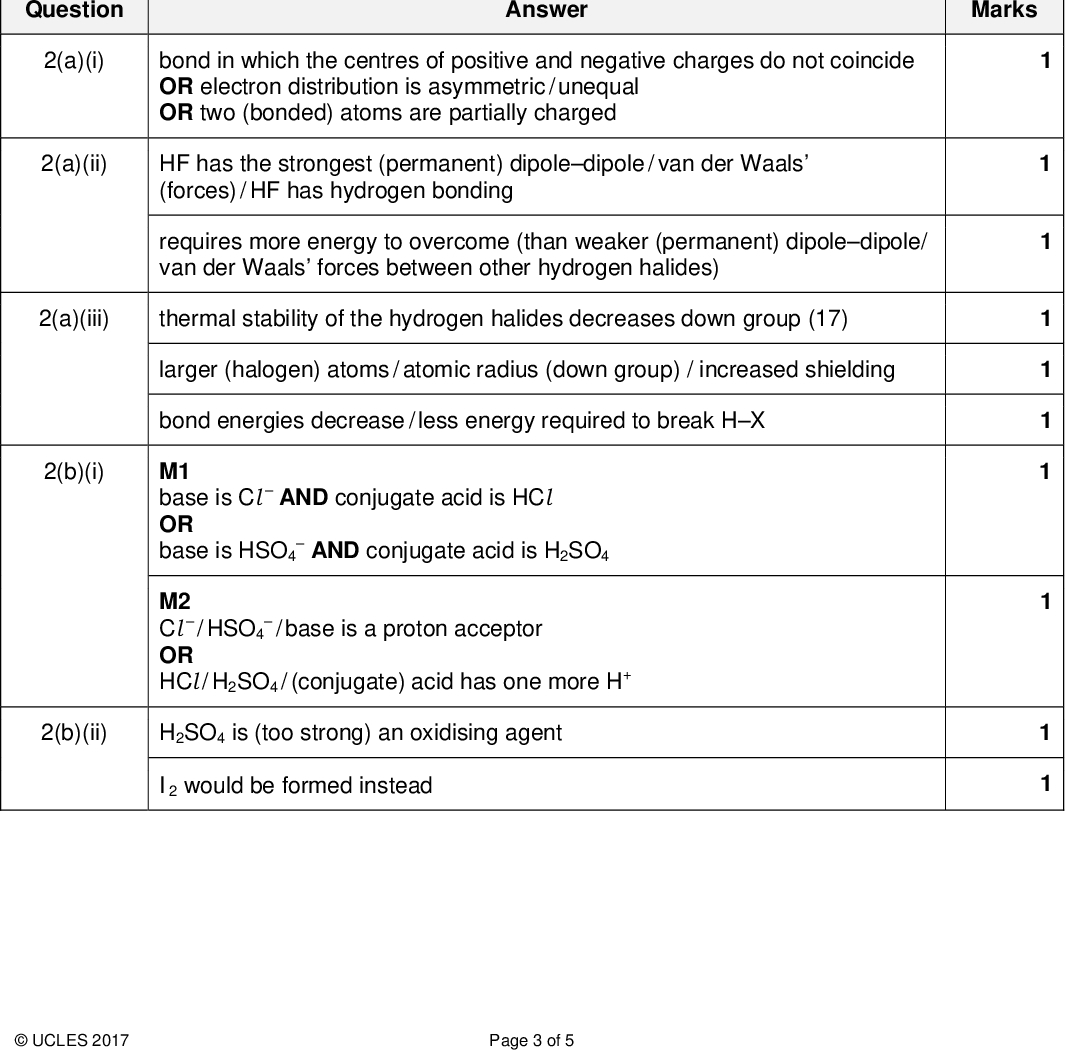
![Hydrogen halides are compounds formed when halogens (Group 17 elements) react with hydrogen. The bond polarity of the hydrogen halides decreases from HF to HI. PMT Some relevant data are shown in the table. hydrogen halide boiling point / C HX bond energy / kJ mol1 HF 19 562 HCl 85 431 HBr 67 366 HI 35 299 (a) (i) Explain the meaning of the term bond polarity.[1] (ii) Suggest why the boiling point of HF is much higher than the boiling points of the other hydrogen halides.[2] (iii) Describe and explain the relative thermal stabilities of the hydrogen halides.[3]UCLES 2017 9701/22/F/M/17<br />
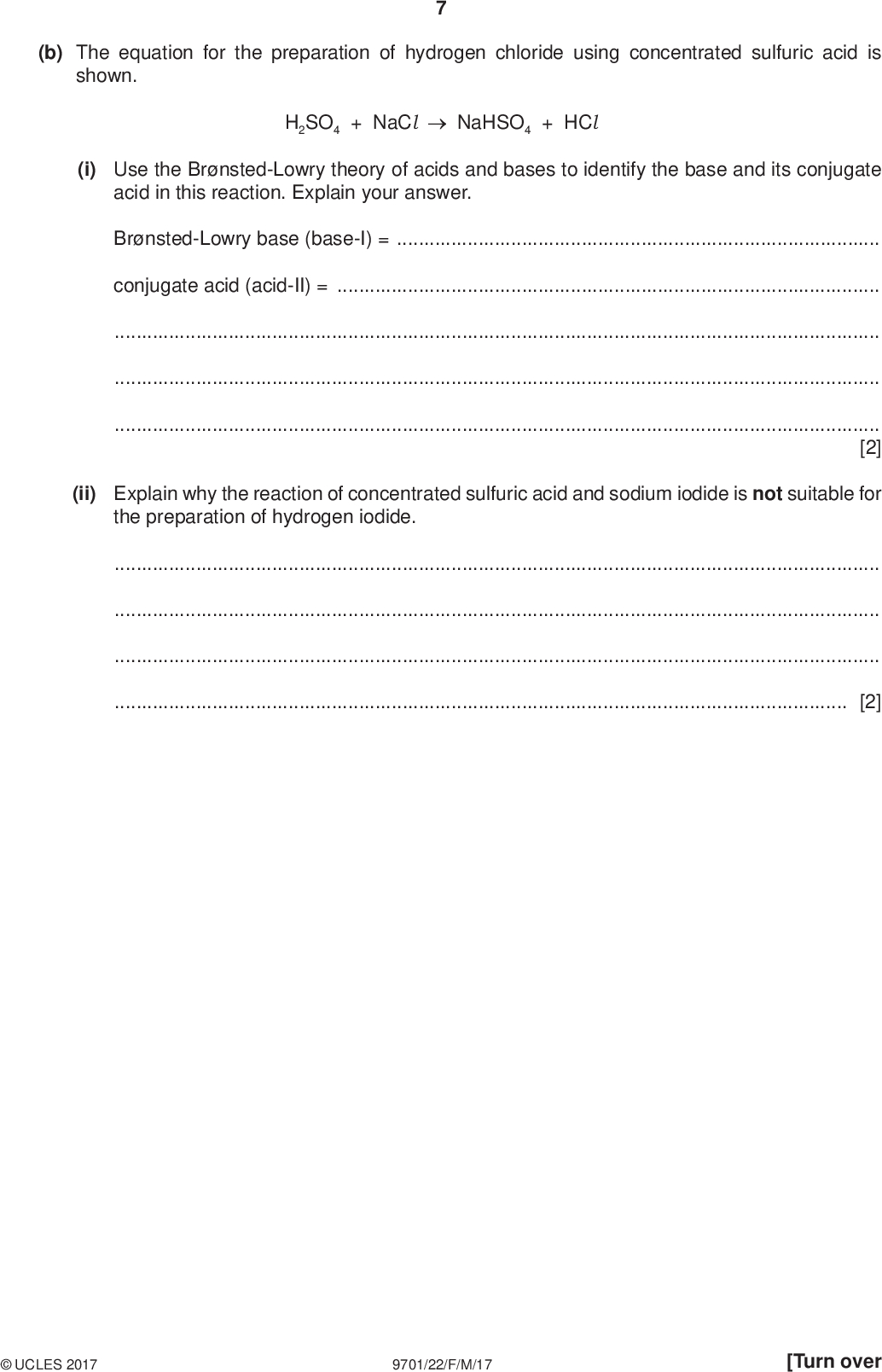
PMT (b) The equation for the preparation of hydrogen chloride using concentrated sulfuric acid is shown. H2SO4 + NaCl NaHSO4 + HCl (i) Use the Brnsted-Lowry theory of acids and bases to identify the base and its conjugate acid in this reaction. Explain your answer. Brnsted-Lowry base (base-I) =conjugate acid (acid-II) =[2] (ii) Explain why the reaction of concentrated sulfuric acid and sodium iodide is not suitable for the preparation of hydrogen iodide.[2]UCLES 2017 9701/22/F/M/17 [Turn over<br />
PMT (c) Hydrogen chloride undergoes a reversible reaction with oxygen. 4HCl (g) + O2(g) 2Cl 2(g) + 2H2O(g) The reaction is carried out at 400 C in the presence of a copper(II) chloride catalyst. (i) Use the data in the table to calculate the overall enthalpy change of reaction. compound enthalpy change of formation / kJ mol1 HCl (g) H2O(g) 92 242 enthalpy change of reaction =kJ mol1 [2] (ii) State the type of catalyst used in this reaction. Explain how a catalyst is able to increase the rate of a chemical reaction.[2] (iii) The reaction exists in dynamic equilibrium. The reaction was repeated at 1000 C and the same pressure. State and explain the effect on the composition of the equilibrium mixture of the change in temperature.[2]UCLES 2017 9701/22/F/M/17<br />
(iv) When 1.60 mol of HCl are mixed in a sealed container with 0.500 mol of O2 at 400 C, 0.600 mol of Cl 2 and 0.600 mol of H2O are formed. The total pressure inside the container is 1.50105 Pa. Calculate the amounts, in mol, of HCl and O2 in the equilibrium mixture. PMT Calculate the mole fraction of Cl 2 and hence the partial pressure of Cl 2 in the equilibrium mixture. HCl =mol O2 =mol mole fraction of Cl 2 =pCl 2 =Pa [3]UCLES 2017 9701/22/F/M/17 [Turn over<br />
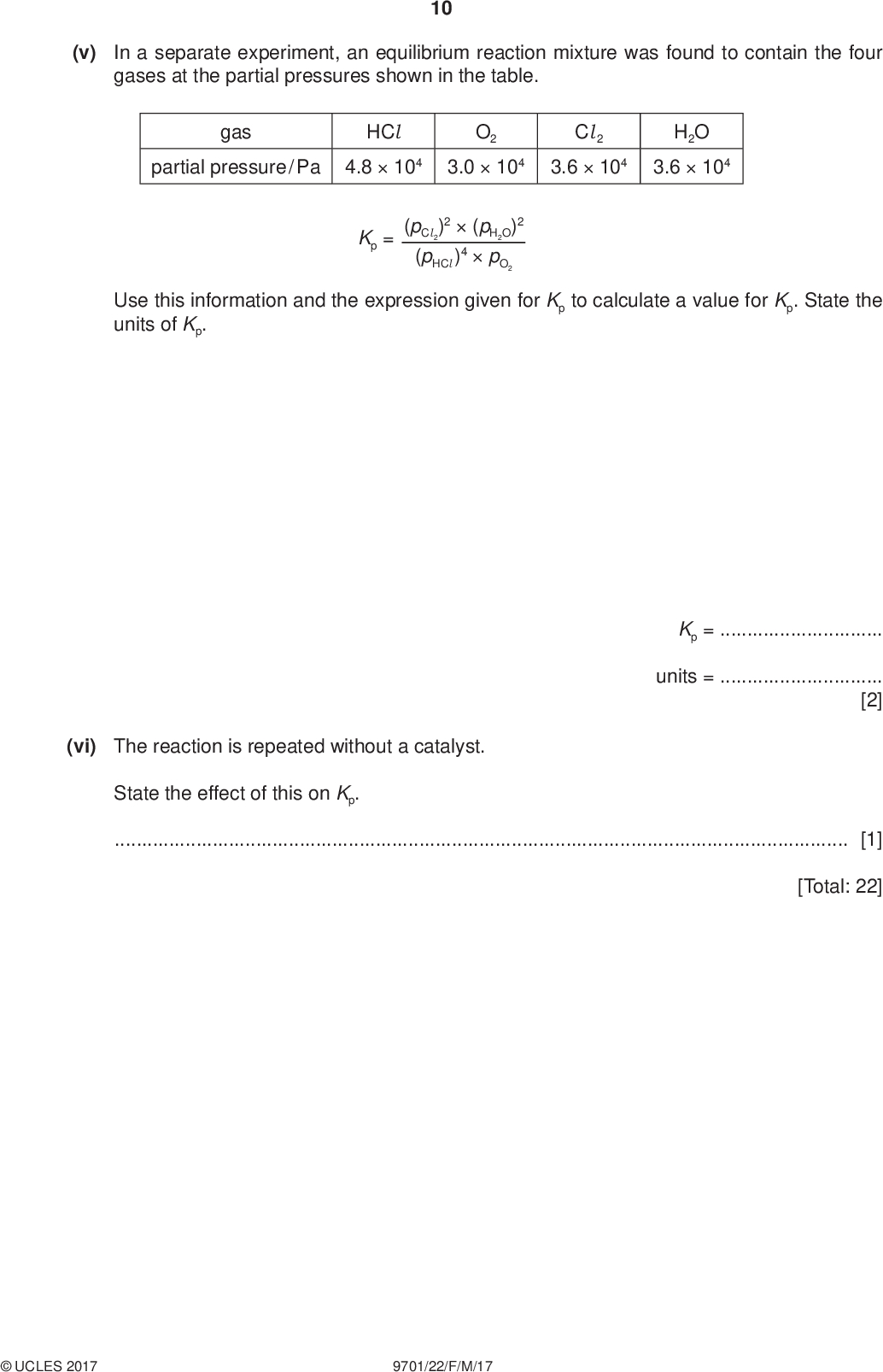
PMT (v) In a separate experiment, an equilibrium reaction mixture was found to contain the four gases at the partial pressures shown in the table. 10 gas HCl O2 Cl 2 H2O partial pressure / Pa 4.8104 3.0104 3.6104 3.6104 Kp = (pCl 2)2(pH2O)2 (pHCl )4pO2 Use this information and the expression given for Kp to calculate a value for Kp. State the units of Kp. Kp =units =[2] (vi) The reaction is repeated without a catalyst. State the effect of this on Kp.[1] [Total: 22]UCLES 2017 9701/22/F/M/17<br />](https://learnah.org/wp-content/uploads/2018/08/March_2017_v2_QP_-_Paper_2_CIE_Chemistry_A-level_2-0.jpg)