Skip to content
CIE Jun 2017 v4 Paper 3 Q1
Answers available below
Show answer
Question
1
2
3

![Strong acids, such as hydrochloric acid, HCl, are completely ionised in aqueous solution. Weak acids, such as ethanoic acid, CH3COOH, are partially ionised in aqueous solution. PMT You will investigate the enthalpy change for the reaction of an excess of each of these acids with magnesium and hence determine the energy needed to cause the weak acid to ionise completely. (a) Reaction 1 Enthalpy change of a weak acid FB 1 is ethanoic acid, CH3COOH. FB 2 is magnesium, Mg. Method 1Weigh the strip of magnesium and record the balance reading in the space below. Support the plastic cup in the 250 cm3 beaker. Coil the magnesium ribbon loosely so that it fits into the bottom of the plastic cup and then remove the ribbon. Use the measuring cylinder to transfer 25 cm3 of the acid, FB 1, into the plastic cup. Place the thermometer in the acid and read the initial temperature. This is the temperature at time zero (t = 0). Start timing and do not stop the clock until the whole experiment has been completed. Read the temperature of the acid every half minute for two minutes. At time t = 2 1 Measure and record, in the table below, the temperature of the mixture at t = 3 minutes and then every half minute until t = 10 minutes. Stir the mixture continuously between thermometer readings. Rinse the plastic cup for use in Method 2. Shake to remove excess water. 2 minutes drop the magnesium, FB 2, into the acid and stir the mixture. Results Mass of magnesium Temperature time / minutes temperature / C time / minutes 5 1 2 temperature / C 1 2 11 2 2 1 2 3 1 2 4 1 2 6 1 2 7 1 2 8 1 2 9 1 2 10 [4] II III IVUCLES 2017 9701/34/M/J/17<br />
PMT (b) Plot a graph of temperature on the y-axis against time on the x-axis on the grid below. The scale for temperature should extend 10 C above your highest recorded temperature. You will use this graph to determine the theoretical maximum temperature rise at 2 1 2 minutes. II III IV Draw two lines of best fit through the points on your graph. The first line should be for the temperature before adding FB 2 and the second for the cooling of the mixture once the reaction is complete. Extrapolate the two lines to 2 1 theoretical rise in temperature at this time. 2 minutes, draw a vertical line between the two and determine the theoretical rise in temperature at 2 1 2 minutes =C [5]UCLES 2017 9701/34/M/J/17 [Turn over<br />
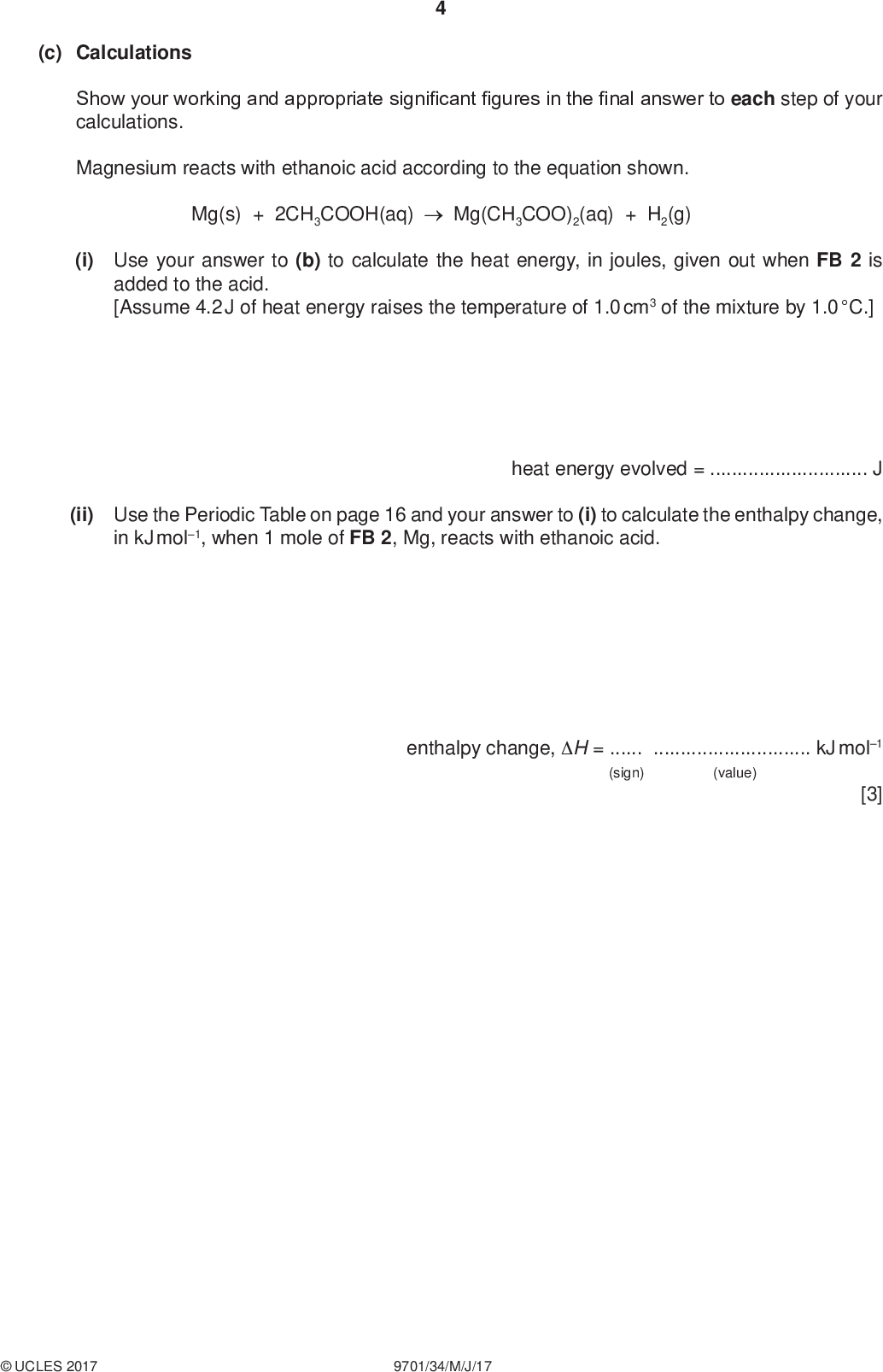
PMT (c) Calculations Show your working and appropriate significant figures in the final answer to each step of your calculations. Magnesium reacts with ethanoic acid according to the equation shown. Mg(s) + 2CH3COOH(aq) Mg(CH3COO)2(aq) + H2(g) (i) Use your answer to (b) to calculate the heat energy, in joules, given out when FB 2 is added to the acid. [Assume 4.2 J of heat energy raises the temperature of 1.0 cm3 of the mixture by 1.0 C.] (ii) Use the Periodic Table on page 16 and your answer to (i) to calculate the enthalpy change, in kJ mol1, when 1 mole of FB 2, Mg, reacts with ethanoic acid. heat energy evolved =J enthalpy change, H =kJ mol1 (sign) (value) [3]UCLES 2017 9701/34/M/J/17<br />
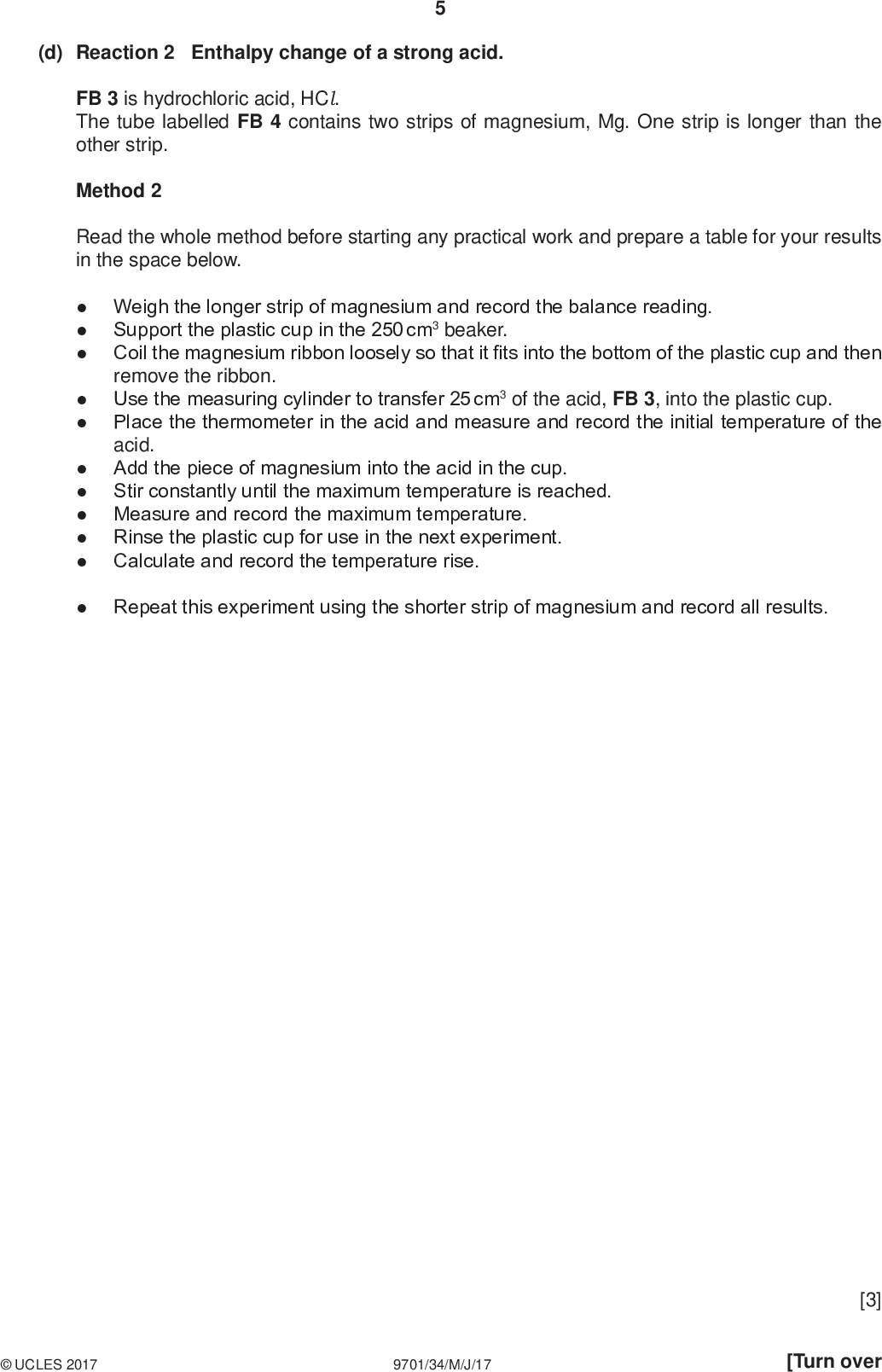
PMT (d) Reaction 2 Enthalpy change of a strong acid. FB 3 is hydrochloric acid, HCl. The tube labelled FB 4 contains two strips of magnesium, Mg. One strip is longer than the other strip. Method 2 Read the whole method before starting any practical work and prepare a table for your results in the space below.Weigh the longer strip of magnesium and record the balance reading. Support the plastic cup in the 250 cm3 beaker. Coil the magnesium ribbon loosely so that it fits into the bottom of the plastic cup and then remove the ribbon. Use the measuring cylinder to transfer 25 cm3 of the acid, FB 3, into the plastic cup. Place the thermometer in the acid and measure and record the initial temperature of the acid. Add the piece of magnesium into the acid in the cup. Stir constantly until the maximum temperature is reached. Measure and record the maximum temperature. Rinse the plastic cup for use in the next experiment. Calculate and record the temperature rise. Repeat this experiment using the shorter strip of magnesium and record all results.UCLES 2017 9701/34/M/J/17 [3] [Turn over<br />
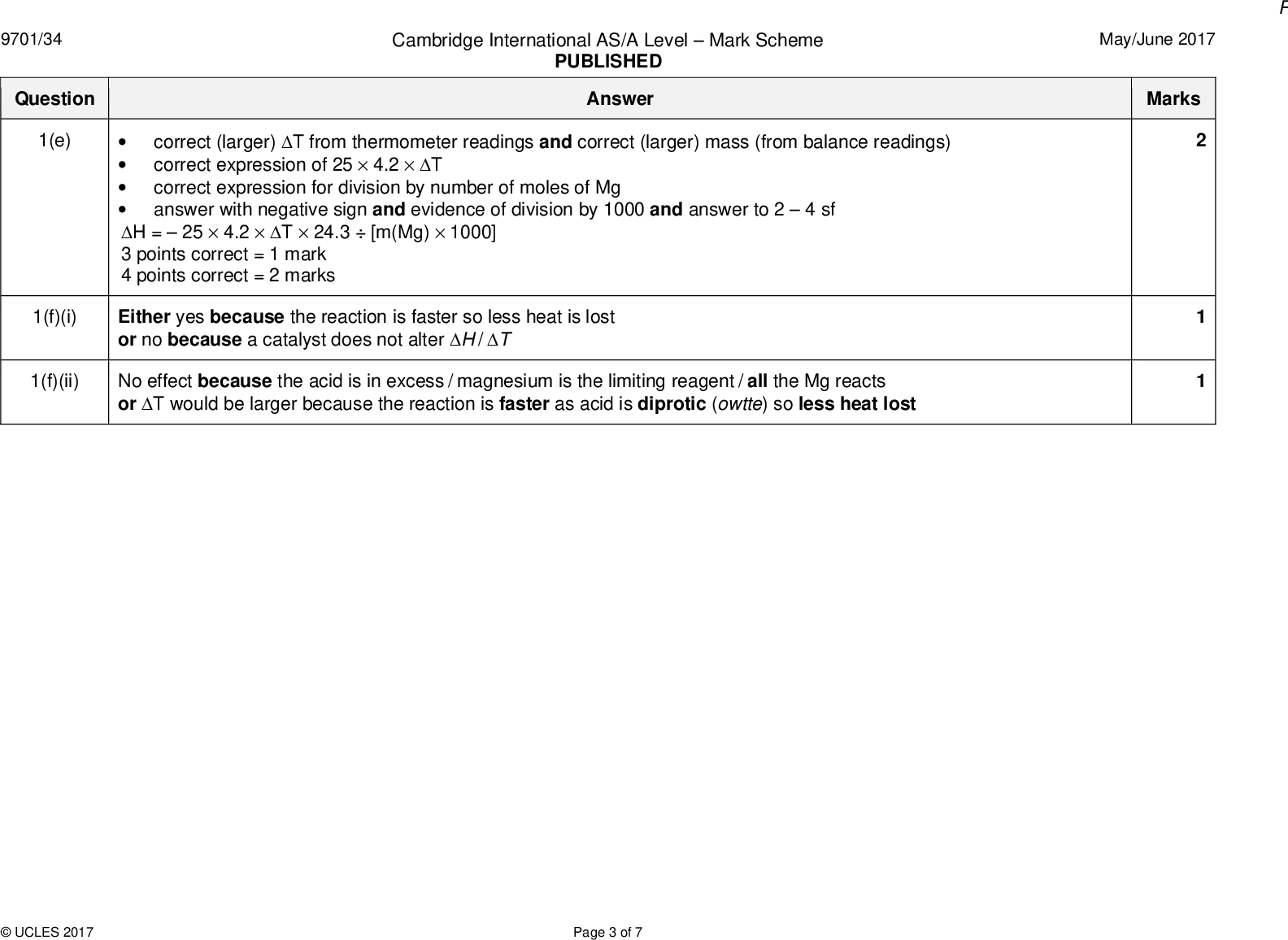
PMT (e) Calculations Show your working and appropriate significant figures in the final answer to each step of your calculations. Use your results from (d) for the longer strip of magnesium and the Periodic Table on page 16 to calculate the enthalpy change, in kJ mol1, when 1 mole of FB 4, Mg, reacts with hydrochloric acid. [Assume 4.2 J of heat energy changes the temperature of 1.0 cm3 of the mixture by 1.0 C.] enthalpy change, H =kJ mol1 (sign) (value) [2] (f) (i) A student suggested that the experiment carried out in (d) could be improved by using a catalyst. Would the use of a catalyst improve the accuracy of the results in this experiment? Give a reason for your answer.(ii) Another student could not find the hydrochloric acid, FB 3, so used sulfuric acid, H2SO4, instead. He used the same volume and the same concentration as the hydrochloric acid in FB 3. What effect would this change have on the temperature rise in the experiment? Give a reason for your answer.[2]UCLES 2017 9701/34/M/J/17<br />
PMT (g) Ethanoic acid is a weak acid. It is partially ionised in aqueous solution. CH3COOH(aq) CH3COO(aq) + H+(aq) You are to determine the energy needed to cause the molecules of ethanoic acid to ionise completely. CH3COOH(aq) CH3COO(aq) + H+(aq) Hydrochloric acid is a strong acid; it is fully ionised in aqueous solution. The values for the enthalpy changes you obtained in (c)(ii) and (e) could be used to calculate the energy change for the ionisation but more accurate experiments give the results in Table 1. reaction Table 1 equation H / kJ mol1 Mg(s) + 2CH3COOH(aq) Mg(s) + 2HCl (aq) Mg(CH3COO)2(aq) + H2(g) MgCl 2(aq) + H2(g)460.3464.1 (i) Write the ionic equation, including state symbols, for the reaction of magnesium with aqueous hydrochloric acid.(ii) Use the data in Table 1 to calculate the enthalpy change for the ionisation of ethanoic acid. CH3COOH(aq) CH3COO(aq) + H+(aq) Show clearly how you obtained your answer. H =kJ mol1 (sign) (value) [4]UCLES 2017 9701/34/M/J/17 [Turn over<br />
PMT (h) The experiment in (a) was repeated using trichloroethanoic acid instead of ethanoic acid. Mg(s) + 2CCl 3COOH(aq) Mg(CCl 3COO)2(aq) + H2(g) reaction 3 Trichloroethanoic acid, CCl 3COOH, is a weak acid that is however stronger than ethanoic acid. The enthalpy change for reaction 3 is between the two values given in Table 1. reaction Table 1 equation H / kJ mol1 Mg(s) + 2CH3COOH(aq) Mg(s) + 2HCl (aq) Mg(CH3COO)2(aq) + H2(g) MgCl 2(aq) + H2(g)460.3464.1 (i) Explain why the enthalpy change for reaction 3 is more exothermic than the enthalpy change for reaction 1.(ii) Explain why the enthalpy change for reaction 3 is less exothermic than the enthalpy change for reaction 2.[2] [Total: 25]UCLES 2017 9701/34/M/J/17<br />](https://learnah.org/wp-content/uploads/2018/08/June_2017_v4_QP_-_Paper_3_CIE_Chemistry_A-level_1-0.jpg)


![9701/34 Question Cambridge International AS/A LevelMark Scheme PUBLISHED Answer May/June 2017 Marks 1(a) I Mass (of Mg) with correctly displayed unit and all temperatures recorded Initial T must be between 1045 C II All temperature readings to .5 C with at least one ending in .0 C and at least one ending in .5 C Round any thermometer readings to the nearest .5 C Calculate T from T at 2 minutes to T max from the table. Compare with supervisor T. Award III if T within 2 C of supervisor Award III and IV if T within 1 C of supervisor 1(b) I Axes labelled (T on y-axis & t on x-axis). Scale chosen so that plotted points (and 10 C extra on y-axis) occupy more than half the available space in both directions. 1(c)(i) 1(c)(ii) II Points plotted to within half a small square. Points that should be on lines must be on the line and points that should not be on lines must not be on lines. III Two lines of best fit drawnone up to 2 minutes and the other after the reaction has occurred. IV Both lines extrapolated to 2 minutes and vertical line drawn at 2 minutes V Examiner to calculate T from candidate graph and award mark if within 0.5 C of candidates T Correctly calculates energy evolved = 254.2T and answer to 24 sf. Correct use of moles of magnesium = mass Mg from (a)/24.3 Correct use of H = ( ) i ( n Mg x 1000 and answer must be negative 1(d) 2 masses, 4 thermometer readings and 2 temperature rises with correct units and unambiguous headings shown Examiner to calculate T longer piece/ T shorter piece to 2 dp Award 2 marks if 1.80 to 2.20 Award 1 mark if 1.70 to 2.30UCLES 2017 Page 2 of 7<br />
9701/34 Question 1(e) 1(f)(i) 1(f)(ii) Cambridge International AS/A LevelMark Scheme PUBLISHED Answer May/June 2017 Marks correct (larger) T from thermometer readings and correct (larger) mass (from balance readings) correct expression of 254.2T correct expression for division by number of moles of Mg answer with negative sign and evidence of division by 1000 and answer to 24 sfH =254.2T24.3[m(Mg)1000] 3 points correct = 1 mark 4 points correct = 2 marks Either yes because the reaction is faster so less heat is lost or no because a catalyst does not alter H / T No effect because the acid is in excess / magnesium is the limiting reagent / all the Mg reacts or T would be larger because the reaction is faster as acid is diprotic (owtte) so less heat lostUCLES 2017 Page 3 of 7<br />
9701/34 Question 1(g)(i) 1(g)(ii) 1(h)(i) and 1(h)(ii) Cambridge International AS/A LevelMark Scheme PUBLISHED Answer Mg(s) + 2H+(aq)Mg2+(aq) + H2(g) Chemical symbols = 1 mark Correct balancing and state symbols = 1 mark Answer = + 1.9 = 2 marks Answer =1.9 / 1.9 / + 3.8 = 1 mark Some working must be shown to score both marks (i) & (ii) together Allow any two correct statementsa stronger acid or correct identification provides a greater concentration of H+ / more hydrogen ions (ora) (some) energy required to break OH bond (allow OH bond) I effect/increased electronegativity of Cl increases strength of (trichloroethanoic) acid / makes it easier to release H+ (compared to ethanoic acid) May/June 2017 Marks Total: 25UCLES 2017 Page 4 of 7<br />](https://learnah.org/wp-content/uploads/2018/08/June_2017_v4_MS_-_Paper_3_CIE_Chemistry_A-level_1-0.jpg)