Skip to content
CIE Jun 2014 v4 Paper 3 Q2
Answers available below
Show answer
Question
1
2
3

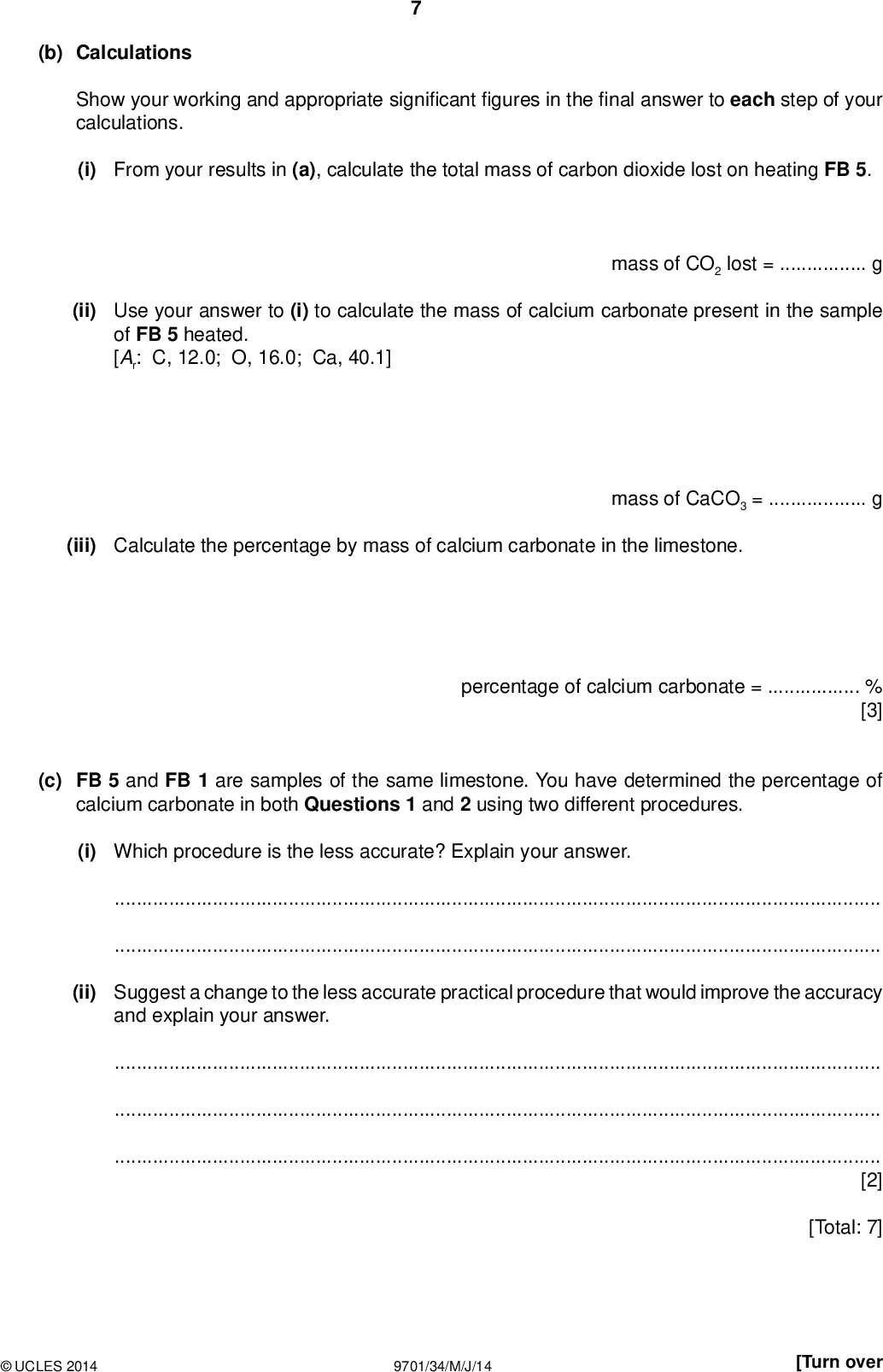
![You are to determine the percentage by mass of calcium carbonate in another sample of the limestone by thermal decomposition. You may assume that none of the other compounds in the limestone sample is affected by heating. The equation for the reaction that occurs is given below. PMT CaCO3(s)CaO(s) + CO2(g) FB 5 is crushed limestone, impure calcium carbonate. (a) Method Read through the method before starting any practical work and prepare a table for your results in the space below.Weigh the empty crucible and record the mass in your table. Transfer all the FB 5 into the crucible. Weigh the crucible with FB 5 and record the mass. Place the crucible on the pipe-clay triangle. Heat the crucible gently for about one minute and then strongly for three minutes. Remove the Bunsen burner and allow the crucible to cool. While the crucible is cooling start working on another question. Reweigh the cooled crucible with contents and record the mass. Reheat the crucible strongly for three minutes, cool and reweigh. Record the mass. Record the mass of FB 5 used and the mass of solid remaining after the second heating.UCLES 2014 9701/34/M/J/14 [2]<br />
PMT (b) Calculations Show your working and appropriate signi cantgures in thenal answer to each step of your calculations. (i) From your results in (a), calculate the total mass of carbon dioxide lost on heating FB 5. (ii) Use your answer to (i) to calculate the mass of calcium carbonate present in the sample of FB 5 heated. [Ar: C, 12.0; O, 16.0; Ca, 40.1] mass of CO2 lost =g (iii) Calculate the percentage by mass of calcium carbonate in the limestone. mass of CaCO3 =g percentage of calcium carbonate =% [3] (c) FB 5 and FB 1 are samples of the same limestone. You have determined the percentage of calcium carbonate in both Questions 1 and 2 using two different procedures. (i) Which procedure is the less accurate? Explain your answer.(ii) Suggest a change to the less accurate practical procedure that would improve the accuracy and explain your answer.[2]UCLES 2014 9701/34/M/J/14 [Total: 7] [Turn over<br />](https://learnah.org/wp-content/uploads/2018/08/June_2014_v4_QP_-_Paper_3_CIE_Chemistry_A-level_2-0.jpg)
![Page 4 Mark Scheme GCE AS/A LEVELMay/June 2014 Syllabus 9701 Paper 34 Question Sections Indicative material Mark Total [2] [3] [2] [7] (a) PDO Recording Headings with units for all four balance readings are tabulated clearly.mass of cruciblemass of crucible + FB 5mass of crucible + contents/residue/solid/FB5 after heating/coolingmass of crucible + contents/residue/solid/FB5 after re-heating/re-cooling/2nd heating/2nd cooling Mass /g, (g), in g, in grams If units are omitted from the headings then they must appear next to each entry in the table. Records all balance readings to a consistent number of dp (minimum 1 dp and minimum 3 balance readings ) and records mass of FB 5 (at start) and mass of solid remaining owtte Headings for unambiguous. two masses of solid must be the (b) (i) ACE Correct mass loss from results in (a) Interpretation (ii) PDO Display Shows correct use of 100.1 and 44: (i) 100.1 44 (iii) ACE Interpretation calculates ans (ii) mass 5 FB 100 (c) (i) ACE Conclusion Thermal decomposition is less accurate because not all carbonate has decomposed. Temperature used not high enough to decompose solid Percentage of CaCO3 is much less in Question 2 (ii) Improvement Heat to constant mass. Use a gas/Bunsen burner/furnace If candidates achieve constant mass and give titration less accurate as more steps then award 1 mark. Qn 2 TotalCambridge International Examinations 2014<br />](https://learnah.org/wp-content/uploads/2018/08/June_2014_v4_MS_-_Paper_3_CIE_Chemistry_A-level_2.jpg)