Skip to content
CIE Jun 2014 v4 Paper 3 Q1
Answers available below
Show answer
Question
1
2
3

![You are to determine the percentage of calcium carbonate in a sample of crushed limestone. You willrst react a known mass of the crushed limestone in a known amount of hydrochloric acid, HCl (aq), to make a solution. You may assume that only the calcium carbonate present in the sample will react with the acid. PMT CaCO3(s) + 2HCl (aq)CaCl 2(aq) + H2O(l) + CO2(g) The amount of acid that did not react with the carbonate is then found by a titration using sodium hydroxide. You may assume that no compounds present in the limestone will react with the sodium hydroxide. NaOH(aq) + HCl (aq)NaCl (aq) + H2O(l) FB 1 is crushed limestone, impure calcium carbonate. FB 2 is 2.0 mol dm3 hydrochloric acid, HCl. FB 4 is 0.20 mol dm3 sodium hydroxide, NaOH. methyl orange indicator (a) Method Read through the method before starting any practical work. Making the solutionWeigh the container with the limestone, FB 1, and record the mass below. Tip all the solid FB 1 into a 250 cm3 beaker. Reweigh the container and record the mass. Fill the burette with FB 2. Slowly run between 47.5 and 48.5 cm3 of FB 2 into the beaker containing FB 1. Record, in the space below, both your burette readings and the volume of FB 2 added. Stir the mixture carefully until all the solid has reacted. Transfer the contents of the beaker into the volumetric flask. Rinse the beaker with distilled water and add it to the volumetric flask. Make the solution up to 250 cm3 with distilled water and mix thoroughly. This is solution FB 3.UCLES 2014 9701/34/M/J/14<br />
Titration PMTEmpty and rinse the burette with distilled water. Fill the burette with FB 3 from the volumetric flask. Pipette 25.0 cm3 of FB 4 into a conical flask. Add a few drops of methyl orange indicator. Perform a rough titration and record your burette readings in the space below. The rough titre iscm3. Carry out as many accurate titrations as you think necessary to obtain consistent results. Make certain any recorded results show the precision of your practical work. Record, in a suitable form below, all of your burette readings and the volume of FB 3 added in each accurate titration. II III IV VI VII VIII IX [9] (b) From your accurate titration results, obtain a suitable value to be used in your calculations. Show clearly how you have obtained this value. 25.0 cm3 of FB 4 requiredcm3 of FB 3. [1]UCLES 2014 9701/34/M/J/14 [Turn over<br />
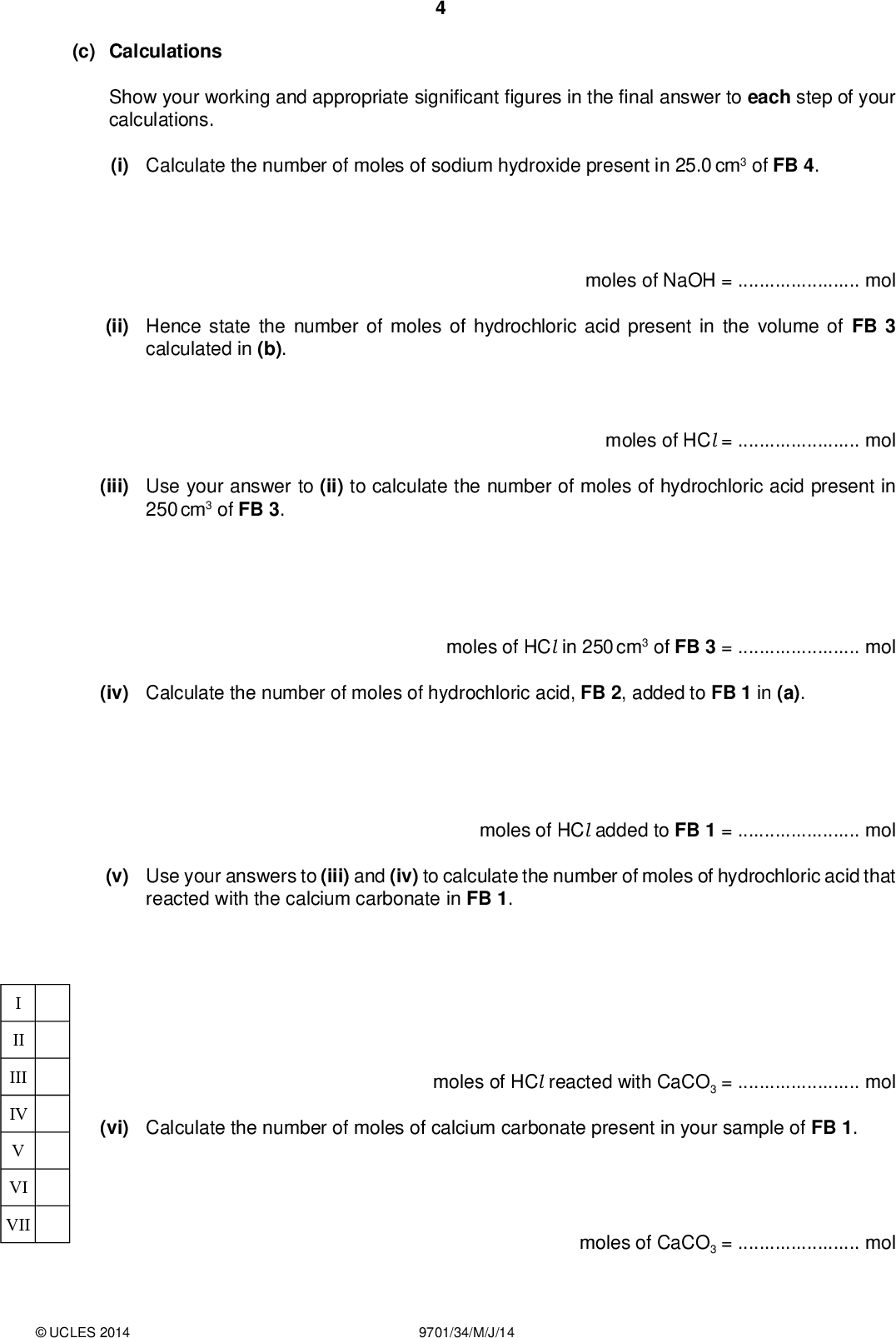
(c) Calculations Show your working and appropriate signi cantgures in thenal answer to each step of your calculations. (i) Calculate the number of moles of sodium hydroxide present in 25.0 cm3 of FB 4. PMT (ii) Hence state the number of moles of hydrochloric acid present in the volume of FB 3 calculated in (b). moles of NaOH =mol (iii) Use your answer to (ii) to calculate the number of moles of hydrochloric acid present in 250 cm3 of FB 3. moles of HCl =mol (iv) Calculate the number of moles of hydrochloric acid, FB 2, added to FB 1 in (a). moles of HCl in 250 cm3 of FB 3 =mol (v) Use your answers to (iii) and (iv) to calculate the number of moles of hydrochloric acid that reacted with the calcium carbonate in FB 1. moles of HCl added to FB 1 =mol (vi) Calculate the number of moles of calcium carbonate present in your sample of FB 1. moles of HCl reacted with CaCO3 =mol moles of CaCO3 =mol II III IV VI VIIUCLES 2014 9701/34/M/J/14<br />
(vii) From your answer to (vi) and the mass of FB 1 used in (a), calculate the percentage by mass of calcium carbonate in the limestone. [Ar: C, 12.0; O, 16.0; Ca, 40.1] PMT percentage of calcium carbonate =% [7] (d) (i) The maximum error in a single burette reading is 0.05 cm3. Student X, carrying out this experiment, recorded that 48.50 cm3 of FB 2 was added to FB 1. What are the smallest and largest possible volumes of FB 2 that were added? smallest volume used =cm3 largest volume used =cm3 (ii) Student Y used an identical mass of FB 1 but added 47.70 cm3 of FB 2. How would the value obtained in (b) by student X compare with the value obtained by student Y? Explain your answer.[3] [Total: 20]UCLES 2014 9701/34/M/J/14 [Turn over<br />](https://learnah.org/wp-content/uploads/2018/08/June_2014_v4_QP_-_Paper_3_CIE_Chemistry_A-level_1-0.jpg)


![Page 2 Mark Scheme GCE AS/A LEVELMay/June 2014 Syllabus 9701 Paper 34 Question Sections Indicative material Mark Total (a) PDO Layout MMO Collection PDO Recording MMO Decisions I Unambiguous headings for 2 balance readings and volume of FB 2 added between 47.5 and 48.5 cm3 II Initial and final readings and titre value given for rough titre and initial and final readings for two (or more) accurate titrations (minimum of 22 box) III Appropriate headings and units for all accurate data. and volume FB 3 added recorded for each accurate titre. Headings should match readings.unit: /cm3 or (cm3) or in cm3 or cm3 for each entry initial/start (burette) reading/volume final/end (burette) reading/volume titre or volume/FB 3 used/added (not difference) IV All accurate burette readings recorded to 0.05 cm3. The need to record to 0.05 applies only to the burette readings and not to the recorded titres. Do not award this mark if:more than one final burette reading is 50.(00)any burette reading is greater than 50.(00). 50(.00) is used as an initial burette reading V Has two uncorrected, accurate titres within 0.1 cm3 Do not include a reading labelled rough. Do not award this mark if, having performed two titres within 0.1 cm3, a further titration is performed that is more than 0.1 cm3 from the closer of the two initial titres unless further titrations within 0.1 cm3 of any other has also been carried out. Do not award the mark if any accurate burette readings (apart from initial 0) are given to zero dp. Round any burette readings to the nearest 0.05 cm3. Check and correct subtractions in the titre table. Examiner then selects the best titre using the hierarchy: two identical; titres within 0.05 cm3; titres within 0.1 cm3; etc. Candidate scaled titre calculated as: Scaled titre = Cand titre Cand {(V /500) 1.6mass/100.1 )} added Supervisor {(V added /500) 1.6mass/100.1 )} Examiner compares candidate scaled titre with Supervisors titre. (a) MMO Quality Award VI, VII, VIII and IX for0.40 cm3 Award VI, VII and VIII for 0.40 cm3 <0.80 cm3 Award VI and VII for 0.80 cm3 <1.20 cm3 Award VI only for 1.20 cm3 <2.00 cm3 If the best titres are0.50 cm3 apart cancel one of the Q marks. [9]Cambridge International Examinations 2014<br />
Page 3 Mark Scheme GCE AS/A LEVELMay/June 2014 Syllabus 9701 Paper 34 Question Sections Indicative material (b) ACE Interpretation Candidate must average two (or more) titres that are all within 0.20 cm3. Working must be shown or ticks must be put next to the two (or more) accurate readings selected. The mean should normally be quoted to 2 dp rounded to the nearest 0.01. Two special cases where the mean may not be to 2 dp: allow mean to 3 dp only for 0.025 or 0.075 e.g. 26.325; allow mean to 1 dp if all accurate burette readings were given to 1 dp and the mean is exactly correct. e.g. 26.0 and 26.2 = 26.1 is correct but 26.0 and 26.1 = 26.1 is incorrect. Note: the candidates mean will sometimes be marked as correct even if it is different from the mean calculated by the Examiner for the purpose of assessing accuracy. (c) (i)&(ii) ACE Interpretation I Correctly calculates 0.20025 1000 = 5103 in (i) (iii) (iv) (v)&(vi) and gives 5103 in (ii) II Uses (ii)250 (b) in (iii) III Correct expression 2.00diluted 1000 in (iv) IV Correct expressions (iv)(iii) in (v) and (v)2 in (vi) V (vi)100.1 (allow100) in (vii) VI (answercorrect mass FB 1)100 in (vii) (vii) (2 marks) PDO Display VII Answers to steps (iii) to (vii) given to 3 or 4 sf minimum number of steps attempted = 4 to access this mark (d) (i) ACE smallest = 48.40, largest = 48.60 Interpretation (ii) Conclusion Correct link between volume of FB 2 used/in excess/ concentration of remaining FB 2 and titre or between concentration/volume FB 3/HCl remaining/in excess and titre. (higher volume/concentration gives smaller titre ora) Correct reference to student(s) X and/or Y Qn 1 TotalCambridge International Examinations 2014 Mark Total 1 1 [1] [7] [3] [20]<br />](https://learnah.org/wp-content/uploads/2018/08/June_2014_v4_MS_-_Paper_3_CIE_Chemistry_A-level_1-0.jpg)
