Skip to content
CIE Jun 2013 v2 Paper 3 Q1
Answers available below
Show answer
Question
1
2
3

![Examiners For Use You will determine the enthalpy change, H, for the reaction of sodium carbonate, Na2CO3, with water and carbon dioxide to form sodium hydrogencarbonate, NaHCO3. In step 1 you will react a known mass of sodium hydrogencarbonate with a known volume of dilute hydrochloric acid andnd the temperature change. In step 2 you willnd the temperature change on adding a known mass of sodium carbonate to a known volume of acid. You will then use your results to calculate the enthalpy change for the reaction. Na2CO3(s) + H2O(l) + CO2(g)2NaHCO3(s) FB 1 is sodium hydrogencarbonate, NaHCO3. FB 2 is sodium carbonate, Na2CO3. FB 3 is 2.0 mol dm3 hydrochloric acid, HCl. (a) Method Step 1 NaHCO3(s) + HCl (aq)NaCl (aq) + H2O(l) + CO2(g)Place the plastic cup in the 250 cm3 beaker. Use the measuring cylinder to transfer 25 cm3 of the acid, FB 3, into the plastic cup. The acid is in excess. Weigh the container with FB 1 and record the balance reading in a suitable form below. Place the thermometer in the acid and record the initial temperature in the table of results. Tilt the cup if necessary so that the bulb of the thermometer is fully covered. This is the temperature at time zero. Start timing. Record the temperature of the acid at 1 minute and at 2 minutes. At 2 minutes carefully tip all the FB 1, in small portions to avoid spray, into the acid and stir to dissolve it. Record the temperature of the solution at 3, 4, 5, 6, 7 and 8 minutes. Reweigh the container with any residual FB 1 and record the balance reading and the mass of FB 1 used. Rinse out the plastic cup and shake it to remove excess water. Results Mass Temperature Time in minutes Temperature / CUCLES 2013 9701/32/M/J/13 II III IV [5]<br />
(b) Plot temperature on the y-axis against time on the x-axis on the grid below. You will use the graph to determine the theoretical temperature change at 2 minutes. The scale for temperature should extend at least 1 C below your lowest recorded temperature. Examiners For Use Draw two straight lines of bestt on your graph, one for the temperature of the acid before adding FB 1 and the other for the warming of the solution once the reaction is complete. Extrapolate the two lines to 2 minutes and determine the change in temperature at this time. temperature change at 2 minutes =C [4] II III IVUCLES 2013 9701/32/M/J/13 [Turn over<br />
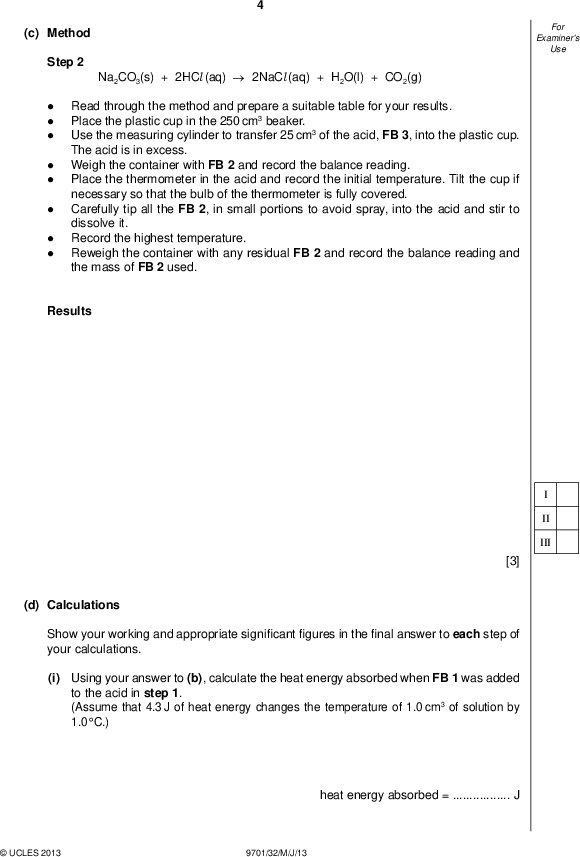
Examiners For Use (c) Method Step 2 Na2CO3(s) + 2HCl (aq)2NaCl (aq) + H2O(l) + CO2(g)Read through the method and prepare a suitable table for your results. Place the plastic cup in the 250 cm3 beaker. Use the measuring cylinder to transfer 25 cm3 of the acid, FB 3, into the plastic cup. The acid is in excess. Weigh the container with FB 2 and record the balance reading. Place the thermometer in the acid and record the initial temperature. Tilt the cup if necessary so that the bulb of the thermometer is fully covered. Carefully tip all the FB 2, in small portions to avoid spray, into the acid and stir to dissolve it. Record the highest temperature. Reweigh the container with any residual FB 2 and record the balance reading and the mass of FB 2 used. Results II III [3] (d) Calculations Show your working and appropriate signi cantgures in thenal answer to each step of your calculations. (i) Using your answer to (b), calculate the heat energy absorbed when FB 1 was added to the acid in step 1. (Assume that 4.3 J of heat energy changes the temperature of 1.0 cm3 of solution by 1.0 C.) heat energy absorbed =JUCLES 2013 9701/32/M/J/13<br />
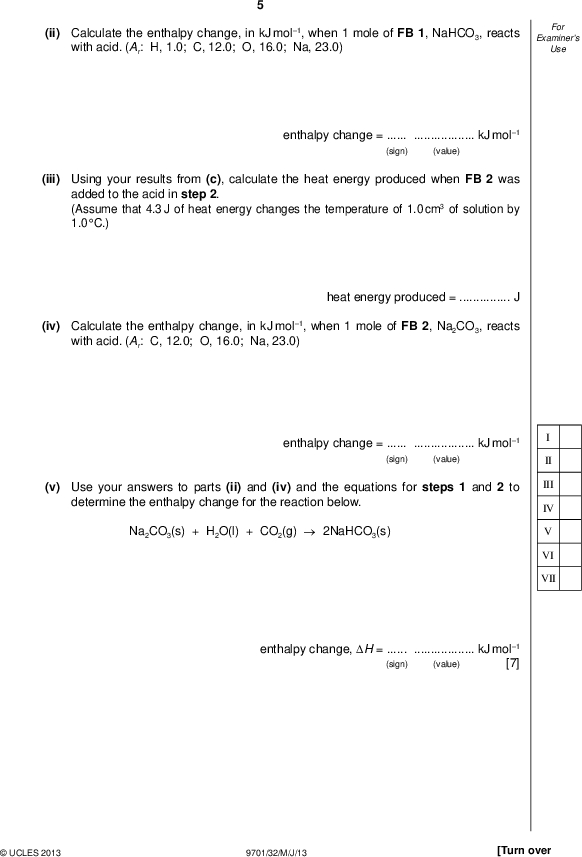
Examiners For Use (ii) Calculate the enthalpy change, in kJ mol1, when 1 mole of FB 1, NaHCO3, reacts with acid. (Ar: H, 1.0; C, 12.0; O, 16.0; Na, 23.0) enthalpy change =kJ mol1 (sign) (value) (iii) Using your results from (c), calculate the heat energy produced when FB 2 was added to the acid in step 2. (Assume that 4.3 J of heat energy changes the temperature of 1.0 cm3 of solution by 1.0 C.) (iv) Calculate the enthalpy change, in kJ mol1, when 1 mole of FB 2, Na2CO3, reacts with acid. (Ar: C, 12.0; O, 16.0; Na, 23.0) heat energy produced =J enthalpy change =kJ mol1 (sign) (value) (v) Use your answers to parts (ii) and (iv) and the equations for steps 1 and 2 to determine the enthalpy change for the reaction below. Na2CO3(s) + H2O(l) + CO2(g)2NaHCO3(s) II III IV VI VII enthalpy change, H =kJ mol1 [7] (value) (sign)UCLES 2013 9701/32/M/J/13 [Turn over<br />
Examiners For Use (e) (i) Complete the following table. The balance used in the experiment reads todecimal place(s). The maximum error in a single balance reading isg. The maximum error in measuring the recorded mass of FB 2 in (c) would beg. (ii) Calculate the maximum percentage error in the mass of FB 2 in step 2. maximum percentage error in the mass of FB 2 in step 2 =% [2] (f) (i) A student stated that the experiment could be made more accurate by using twice the volume of acid in step 1 and step 2. Suggest whether the student is correct or incorrect and justify your answer. The student isbecause[1] (ii) Another student carried out step 2 twice using the carbonate of a different metal and obtained the following results. First result: mass used = 2.96 g; increase in temperature = 4.0 C Second result: mass used = 3.65 g; increase in temperature = 5.0 C The student then used the mean mass and the mean temperature increase when calculating the enthalpy change for the reaction. Explain whether or not the student was justi ed in using the results in this way, by showing appropriate calculations.[2] [Total: 24]UCLES 2013 9701/32/M/J/13<br />](https://learnah.org/wp-content/uploads/2018/08/June_2013_v2_QP_-_Paper_3_CIE_Chemistry_A-level_1-0.jpg)


![Page 2 Mark Scheme GCE AS/A LEVELMay/June 2013 Syllabus 9701 Paper 32 Question Sections Indicative material (a) MMO Collection All thermometer readings and two weighings + correct mass of FB 1 recorded. Mark PDO Recording II Correct headings and units in table (lines not needed). Weighings and mass to same no. dp. Must use solidus, brackets or describe unit fully in words. If units not included in column headings, every entry must have the correct unit shown. III Temperature recorded to 0.5 C (must have at least one ending in .5 C and one ending in .0 C). Award IV and V if0.30 Award IV if 0.30 <0.60 C g1 C g1 1 1 [5] I Uniform scales chosen to use more than half of each axis. At least 5 large squares on y-axis. Axes labelled, units not needed. Scale extends at least 1 point. C below lowest recorded II All points correctly plotted to withinsmall square and in correct small square. (b) MMO Quality PDO Layout 1 1 [4] [3] III Appropriate lines of best fit drawn. ACE Interpretation IV Lines extrapolated and correct value (within 0 .5 oC) of T from graph (ignore sf and sign). (c) PDO Recording Table drawn to include weighings, correct mass of FB 2, initial and final thermometer readings (ignore units), headings must be unambiguous. MMO Quality Award II and III if0.30 Award II if 0.30 <0.60 C g1 C g1Cambridge International Examinations 2013<br />
Page 3 Mark Scheme GCE AS/A LEVELMay/June 2013 Syllabus 9701 Paper 32 (d) (i) (iii) (ii) PDO Display (iv) (v) ACE Conclusions Shows 25 x 4.3T for step 1 and for step 2 (no need to check calculation)..II Should be III Calculates.Award IV and V if correctly calculates H from answers to (ii) and (iv) with correct sign (answer to (iv)2answer to (ii) scores 2 (iv)(ii) scores 1 2(ii)(iv) scores 1) PDO Display VI Signs in (ii) (+ve) and (iv) (ve). VII All final answers given to 2 or 4 sf (minimum of 3 [7] answers attempted). (e) (i) ACE Interpretation Single balance reading0.005 or 0.01 g for 2dp balance. m0.01 or 0.02 g for 2 dp balance. 0.05 or 0.1 g for 1 dp balance / 0.0005 or 0.001 for 3 dp. (ii) Number of dps must correspond to candidates own readings. Calculates max m error / mass FB 2 in Step 2 to 2 or more sf (2 minimum for 1 dp balance and up to 4 for 3 dp balance). Allow ecf. [2] (f) (i) ACE Improvements Student incorrect as acid already in excess/ greater volume gives smaller T/greater volume needs more heat energy and/or greater % error. [1] (ii) MMO Interpretation Attempts to calculate T / m or m / T for each result or ratios of m1/m2 and T1 / T2 or similar (not averages of two). MMO Decisions Correct calculation (1.35 / 1.37 or 0.74 / 0.73). Conclusionyes, values concordant / consistent or no, values differ. [2] [Total: 24]Cambridge International Examinations 2013<br />](https://learnah.org/wp-content/uploads/2018/08/June_2013_v2_MS_-_Paper_3_CIE_Chemistry_A-level_1-0.jpg)
