Skip to content
AQA Specimen Paper 1 Q3
Answers available below
Show answer
Question
1
2
3
4
5
6
7
8
9
10

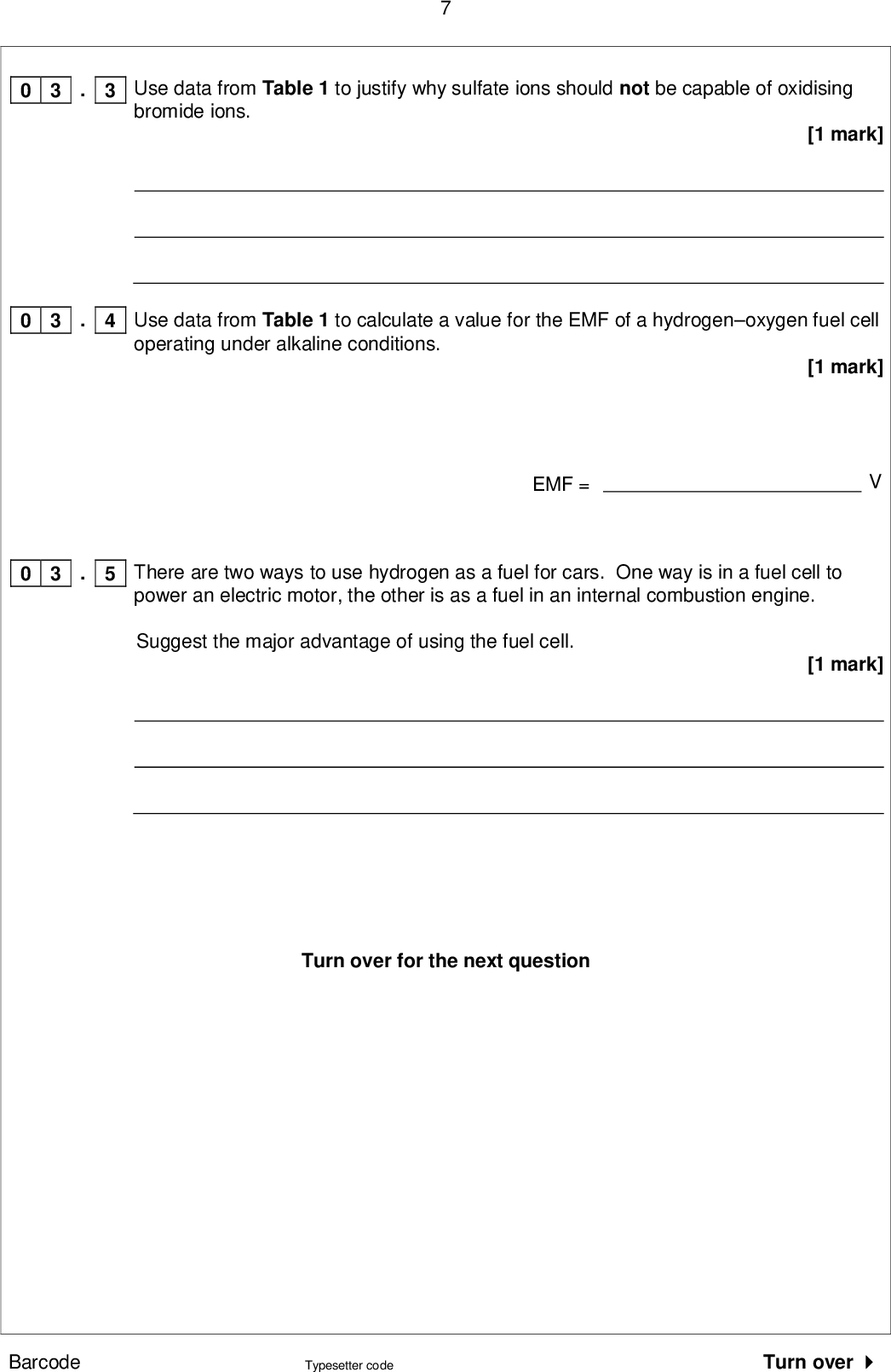
![Fuel cells are an increasingly important energy source for vehicles. Standard electrode potentials are used in understanding some familiar chemical reactions including those in fuel cells. Table 1 contains some standard electrode potential data. Table 1 Electrode half-equation F2 + 2e 2F 2Cl Cl2 + 2e O2 + 4H+ + 4e 2H2O Br2 + 2e 2Br I2 + 2e 2I O2 + 2H2O + 4e 4OH 2 + 4H+ + 2e SO2 + 2H2O SO4 2H+ + 2e H2 4OH + 2H2 4H2O + 4e 0 3 . 1 A salt bridge was used in a cell to measure electrode potential. Explain the function of the salt bridge. E/ V +2.87 +1.36 +1.23 +1.07 +0.54 +0.40 +0.17 0.00 0.83 [2 marks] . 2 0 3 Use data from Table 1 to deduce the halide ion that is the weakest reducing agent. [1 mark] Barcode Typesetter code<br />
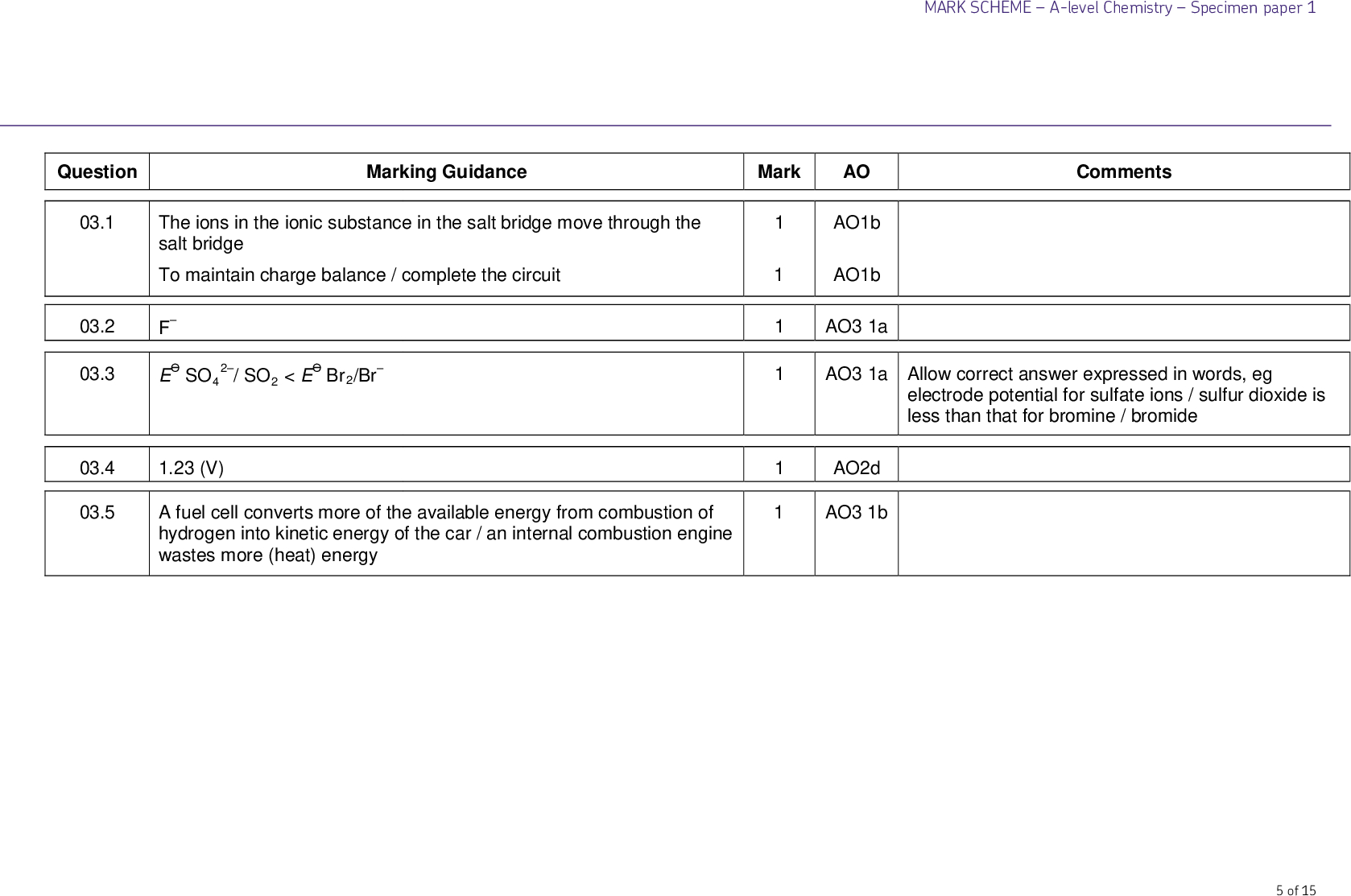
. 3 0 3 Use data from Table 1 to justify why sulfate ions should not be capable of oxidising bromide ions. [1 mark] . 4 0 3 Use data from Table 1 to calculate a value for the EMF of a hydrogenoxygen fuel cell operating under alkaline conditions. [1 mark] EMF = 0 3 . 5 There are two ways to use hydrogen as a fuel for cars. One way is in a fuel cell to power an electric motor, the other is as a fuel in an internal combustion engine. Suggest the major advantage of using the fuel cell. Turn over for the next question [1 mark] Barcode Typesetter code Turn over <br />](https://learnah.org/wp-content/uploads/2018/08/Specimen_QP_-_Paper_1_AQA_Chemistry_A-Level_3-0.jpg)