Skip to content
AQA Jun 2017 Paper 3 Q1
Answers available below
Show answer
Question
1
2
3
4

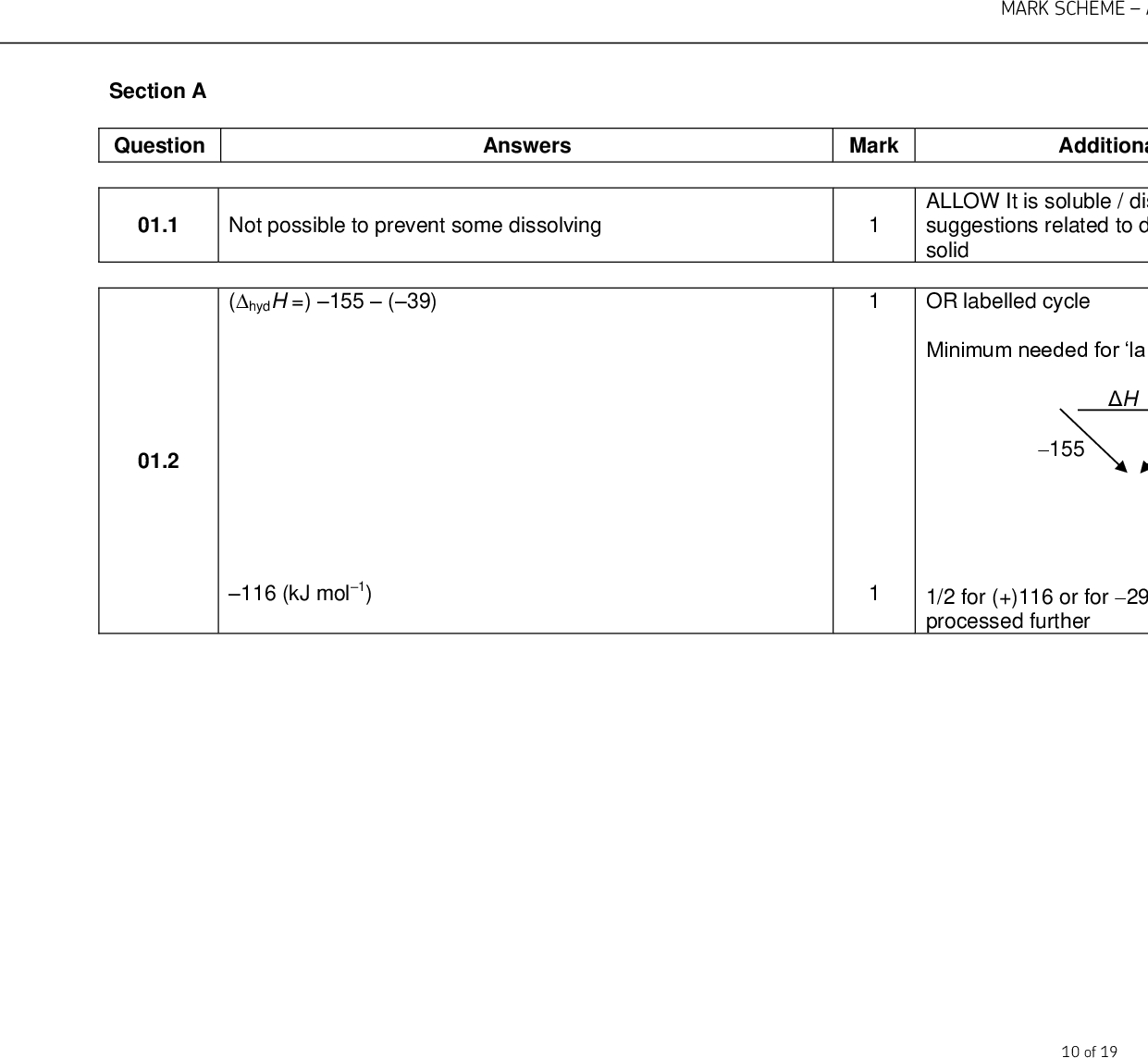
![Section A Answer all questions in the spaces provided Anhydrous magnesium chloride, MgCl2, can absorb water to form the hydrated salt MgCl2.4H2O MgCl2(s) + 4H2O(l)MgCl2.4H2O(s) 0 1 . 1 Suggest one reason why the enthalpy change for this reaction cannot be determined directly by calorimetry. [1 mark] 0 1 . 2 Some enthalpies of solution are shown in Table 1. Table 1 Salt MgCl2(s) MgCl2.4H2O(s) Enthalpy of solution / kJ mol1 155 39 Calculate the enthalpy change for the absorption of water by MgCl2(s) to form MgCl2.4H2O(s). [2 marks] 0 1 Enthalpy change kJ mol1 *02* IB/M/Jun17/7405/3<br />
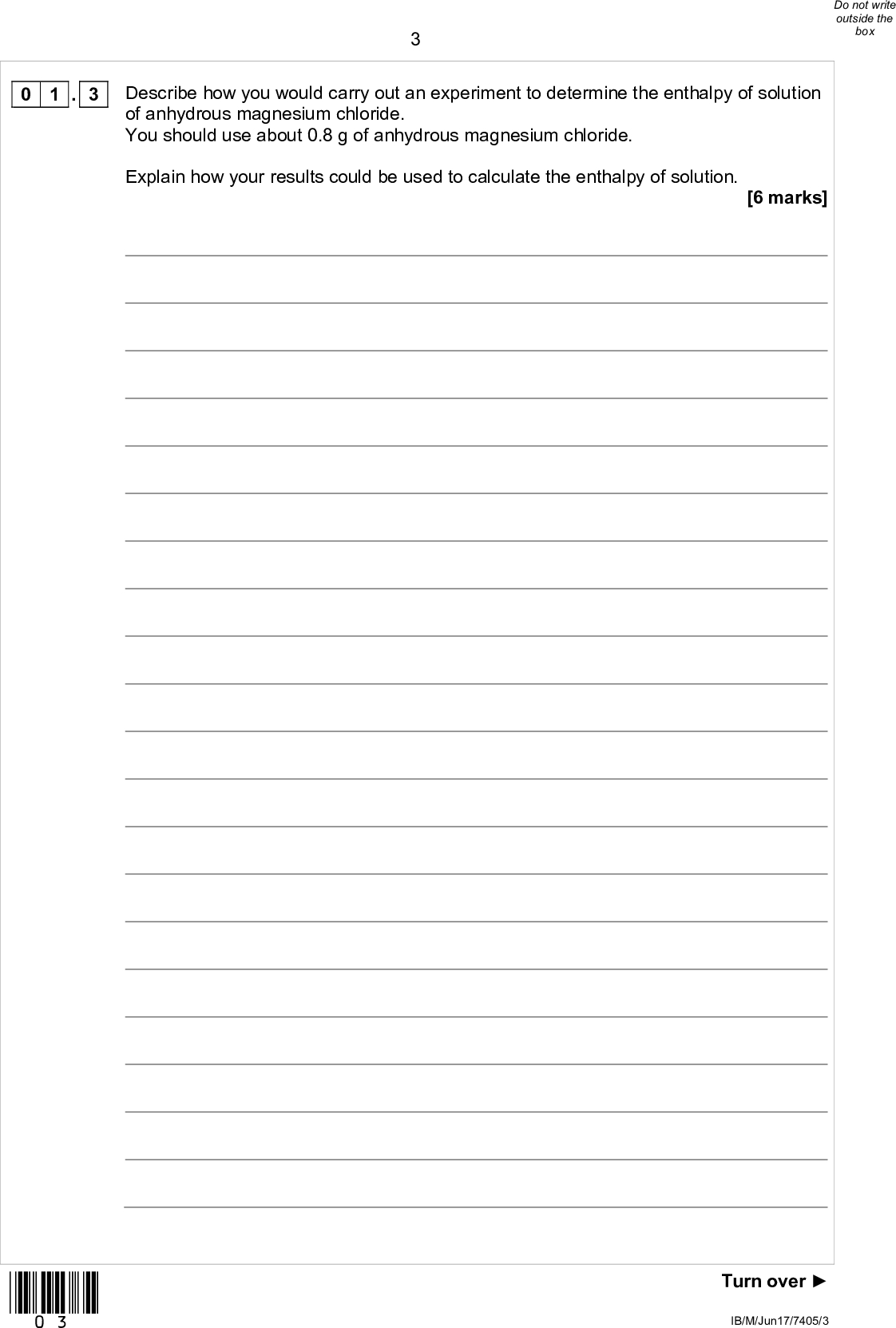
0 1 . 3 Describe how you would carry out an experiment to determine the enthalpy of solution of anhydrous magnesium chloride. You should use about 0.8 g of anhydrous magnesium chloride. Explain how your results could be used to calculate the enthalpy of solution. [6 marks] *03* Turn overIB/M/Jun17/7405/3<br />
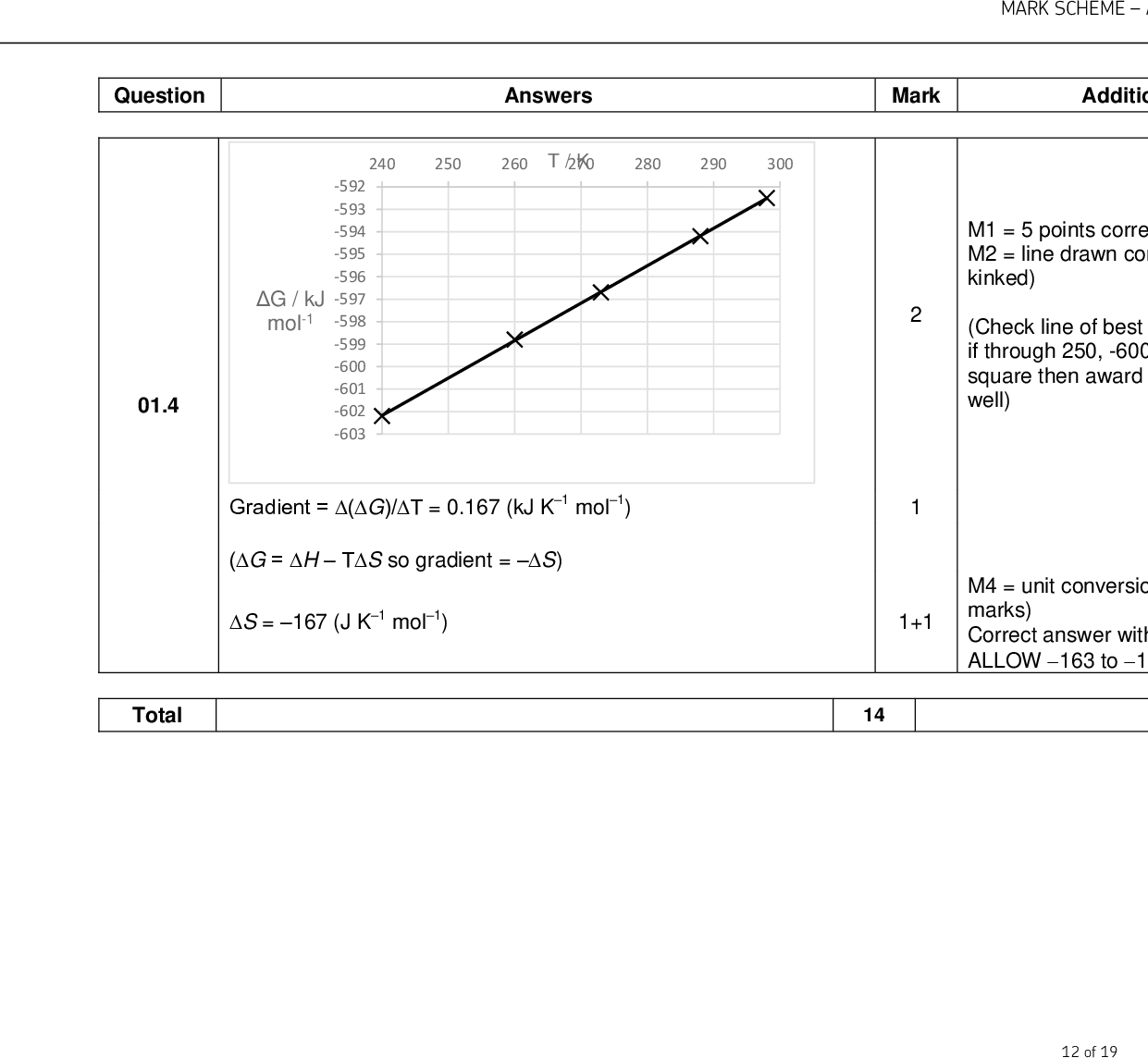
0 1 . 4 Anhydrous magnesium chloride can be formed by direct reaction between its elements. Mg(s) + Cl2(g)MgCl2(s) The free-energy change, G, for this reaction varies with temperature as shown in Table 2.T / K 298 288 273 260 240 Table 2 G / kJ mol1 592.5 594.2 596.7 598.8 602.2 Use these data to plot a graph of free-energy change against temperature on the grid opposite. Calculate the gradient of the line on your graph and hence calculate the entropy change, S, in J K1 mol1, for the formation of anhydrous magnesium chloride from its elements. Show your working. [5 marks] *04* IB/M/Jun17/7405/3<br />
S *05* J K1 mol1 14 Turn overIB/M/Jun17/7405/3<br />](https://learnah.org/wp-content/uploads/2018/08/June_2017_QP_-_Paper_3_AQA_Chemistry_A-Level_1-0.jpg)