Skip to content
OCR A AS Specimen Paper 1 Q21
Answers available below
Show answer
Question
16
17
18
19
20
21
22
23
24

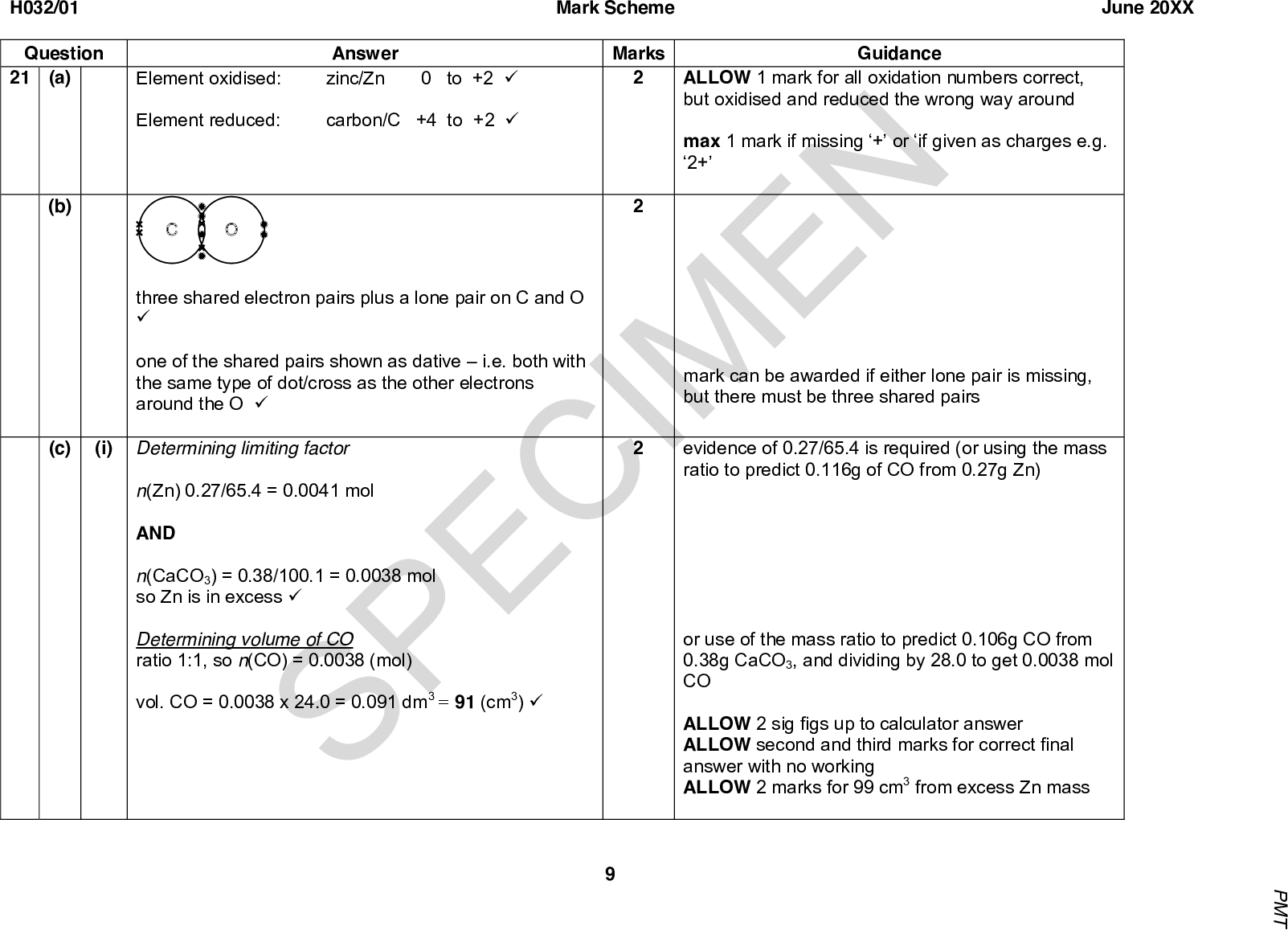
![14 21 Carbon monoxide can be made in the laboratory by heating a mixture of zinc metal and calcium carbonate. An equation for this reaction is shown below. Zn(s) + CaCO3(s) (cid:111) ZnO(s) + CaO(s) + CO(g) oxidation number change: fromto(a) (b) oxidation number change: fromtoThis reaction is a redox reaction. Deduce which element has been oxidised and which has been reduced, and state the change in oxidation number in each case. element oxidisedelement reduced . Carbon monoxide contains a triple bond, and includes a dative covalent bond. Construct a dot-and-cross diagram to show the outer electron pairs in a molecule of carbon monoxide. SPECIMEN [2] [2]OCR 2014 H032/01<br />
(c) A student carried out the reaction of zinc (Zn) and calcium carbonate (CaCO3) in a fume cupboard. The student measured the volume of gas produced. 15 A mixture containing 0.27 g of powdered zinc and 0.38 g of powdered CaCO3 was heated strongly for two minutes. The volume of gas collected in the 100 cm3 syringe was then measured. The experiment was then repeated. (i) Calculate the maximum volume of carbon monoxide, measured at room temperature and pressure, that could be produced by heating this mixture of Zn and CaCO3. Show all your working. SPECIMEN The student did not obtain the volume of gas predicted in (i) using this procedure. Apart from further repeats, suggest two improvements to the practical procedure that would allow the student to obtain a more accurate result. volume of carbon monoxide =cm3 [2][2] (ii)OCR 2014 H032/01 Turn over<br />
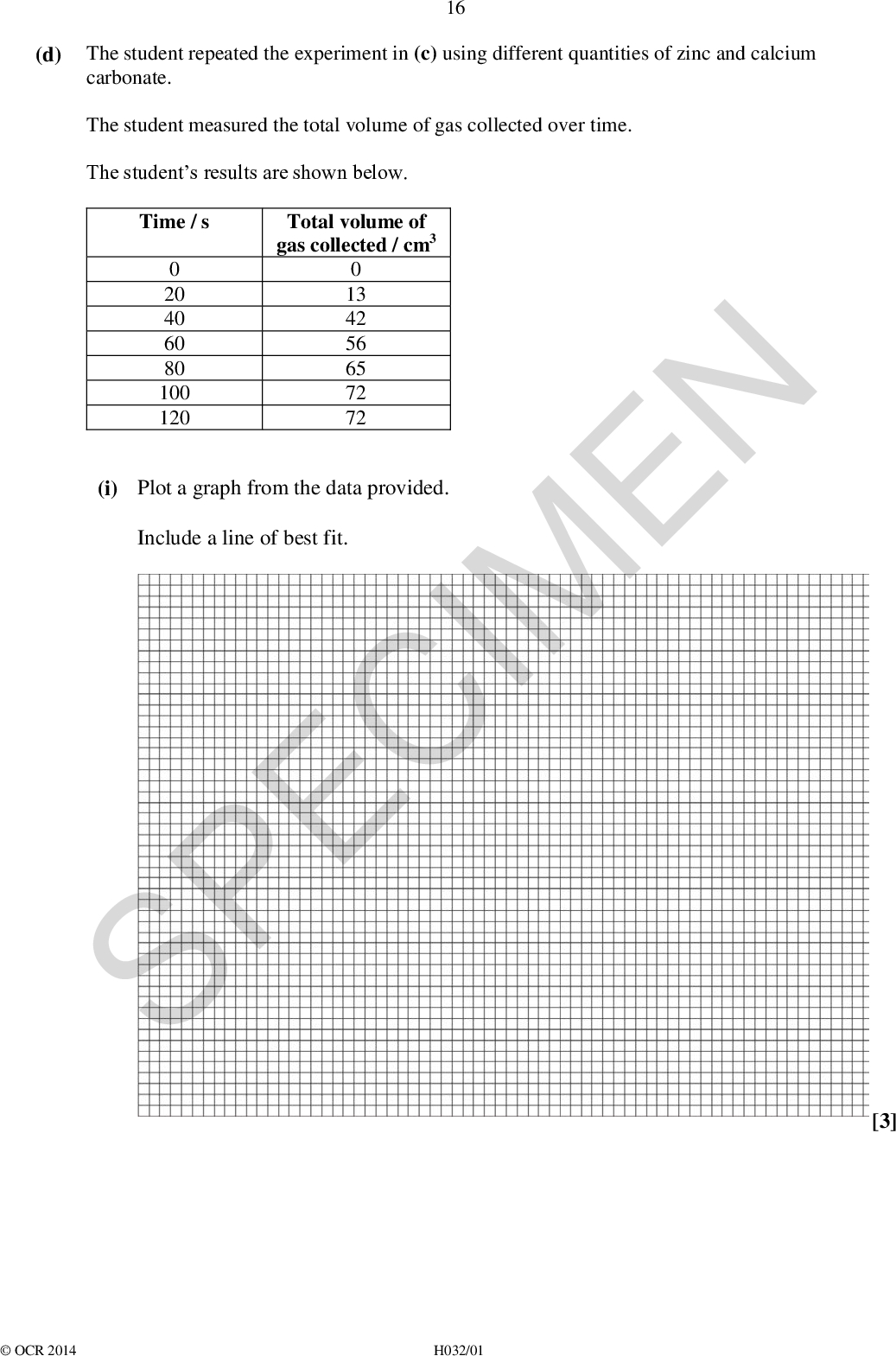
(d) The student repeated the experiment in (c) using different quantities of zinc and calcium 16 (i) Plot a graph from the data provided. carbonate. The student measured the total volume of gas collected over time. The students results are shown below. Time / s Total volume of gas collected / cm3 0 13 42 56 65 72 72 0 20 40 60 80 100 120 Include a line of best fit. SPECIMENOCR 2014 H032/01 [3]<br />
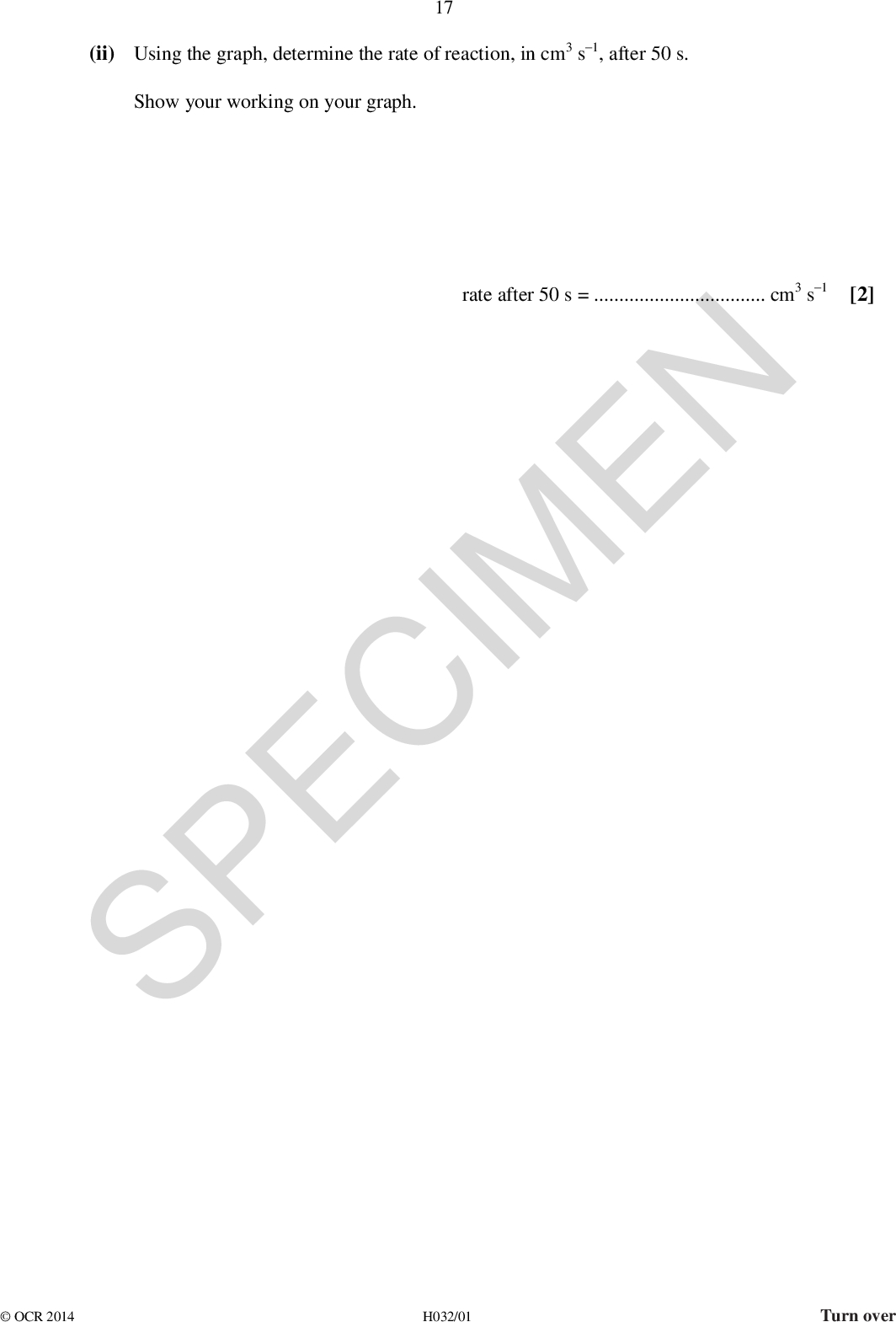
(ii) Using the graph, determine the rate of reaction, in cm3 s1, after 50 s. 17 Show your working on your graph. rate after 50 s =cm3 s1 [2] SPECIMENOCR 2014 H032/01 Turn over<br />](https://learnah.org/wp-content/uploads/2018/08/Specimen_QP_-_Paper_1_OCR_Chemistry_A_AS-Level_21-0.jpg)