Skip to content
Edexcel Jun 2016 (IAL) Paper 6 Q
Answers available below
Show answer
Question


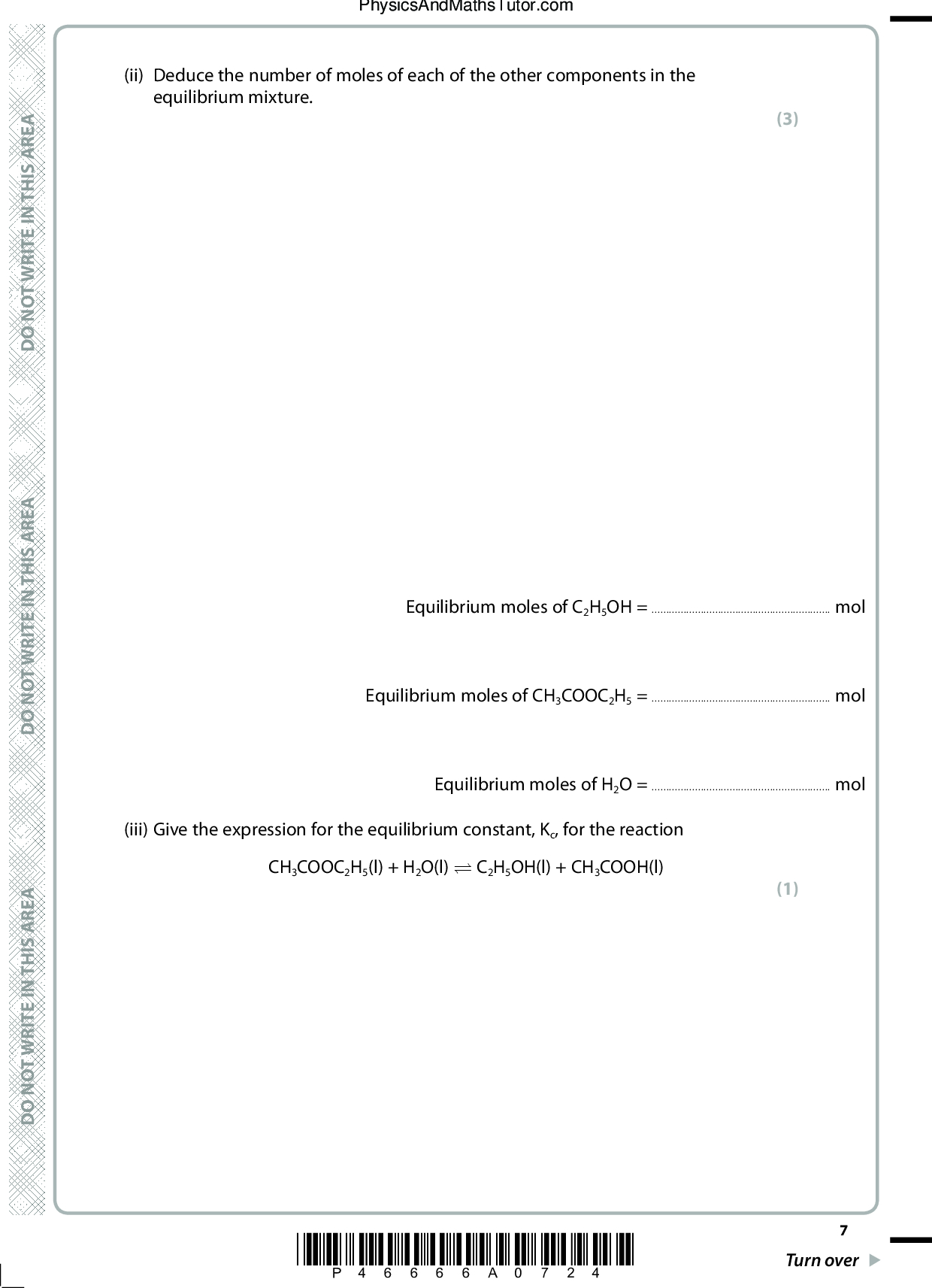
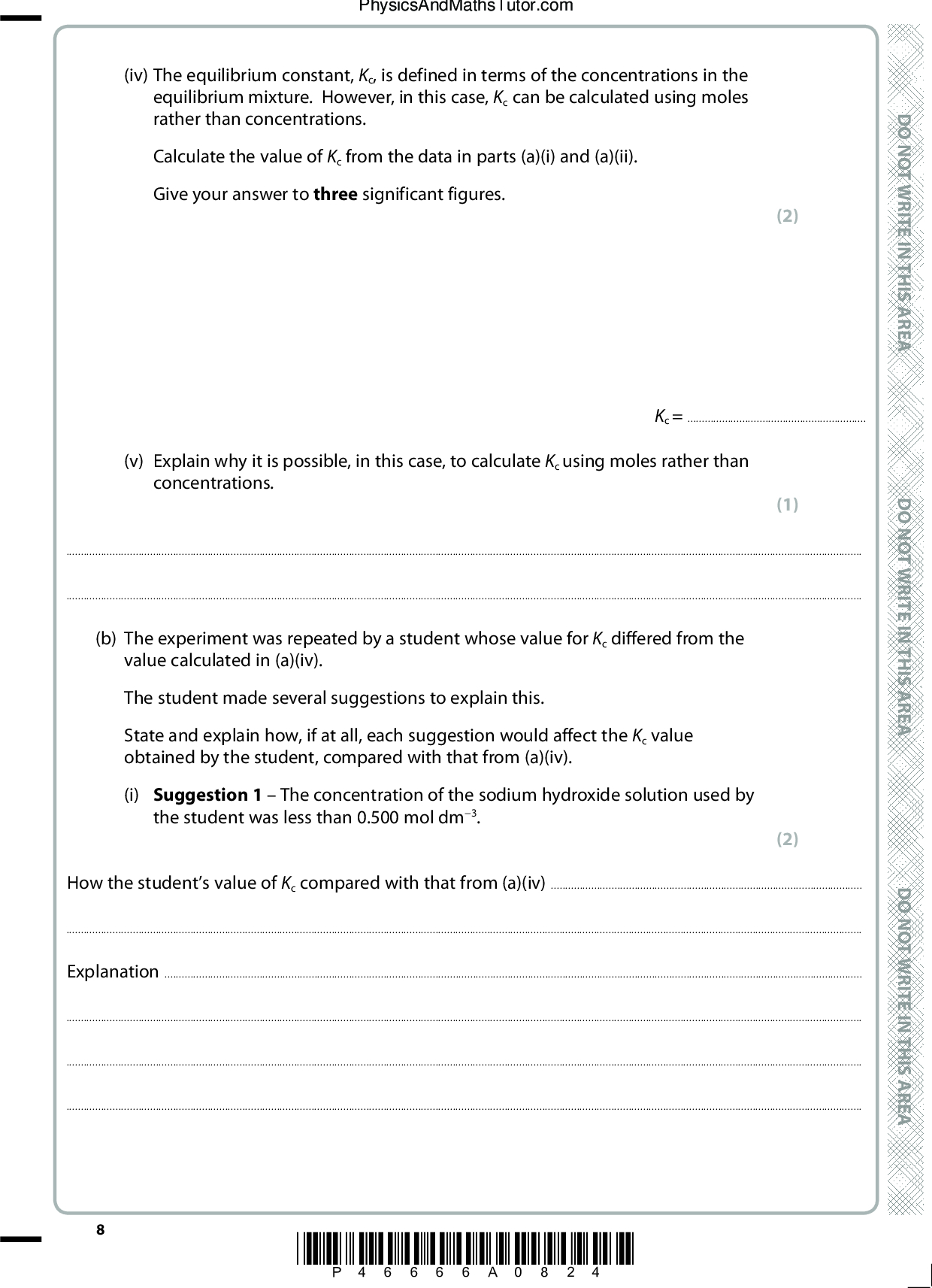
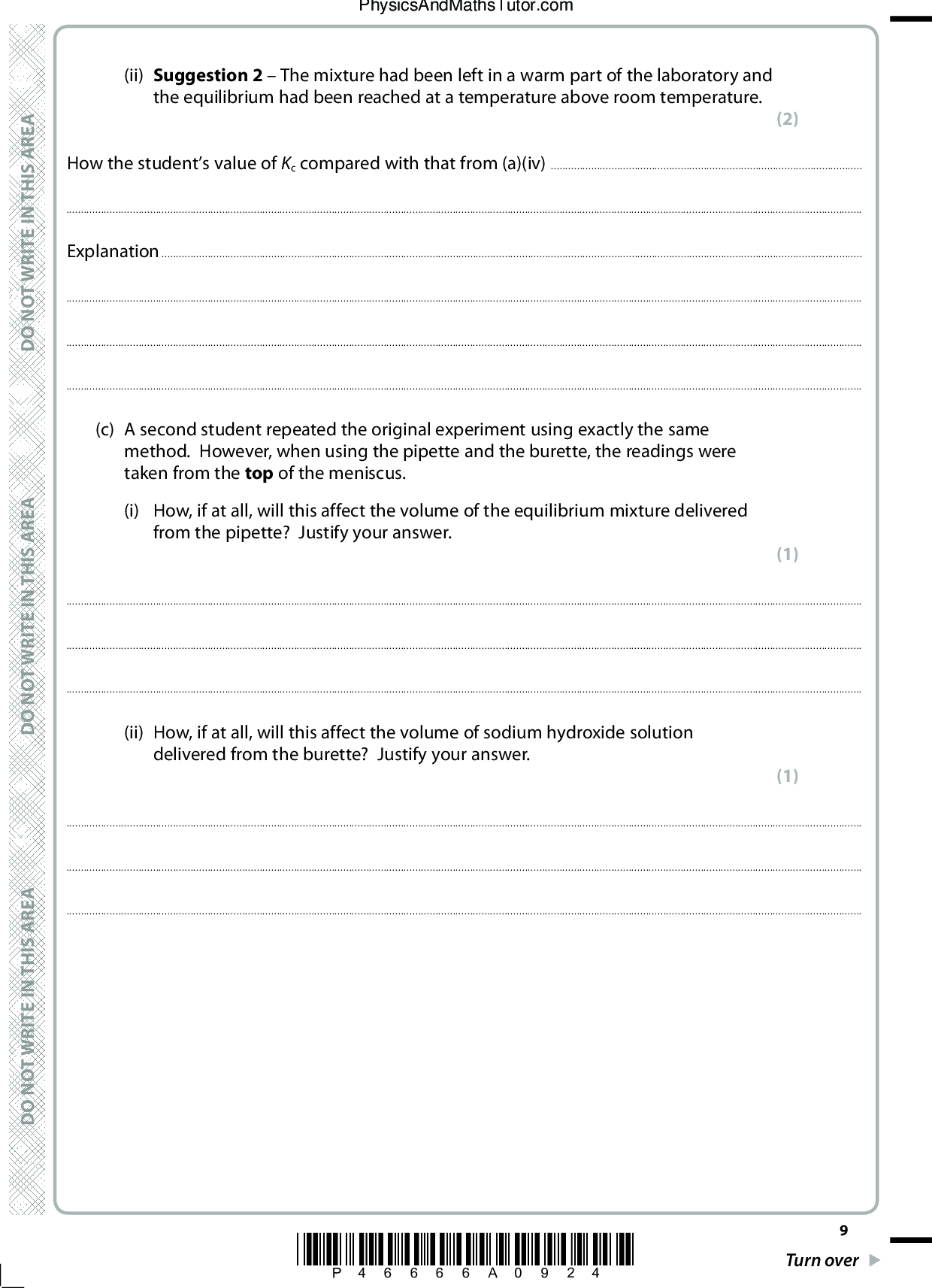

![Reject Mark (3) Question Number 2(a)(i) Correct Answer EXPECTED ANSWER 1st mark: Calculates moles of NaOH to neutralise 5 cm3 of equilibrium mixture = 0.500 x 42.4 = 0.0212 (mol) (1) 1000 2nd mark: Calculates moles of NaOH to neutralize 25 cm3 of equilibrium mixture = 5 x 0.0212 = 0.106 (mol) (1) 3rd mark: Calculates moles of CH3COOH in 25 cm3 of equilibrium mixture = 0.1060.0100 (= 0.0960) (1) Mark TE for 2nd and 3rd mark on moles of NaOH calculated ESSENTIALLY First mark: Calculates moles of NaOH Second mark: Scaling x 5 Third mark: Subtraction of moles of HCl<br />
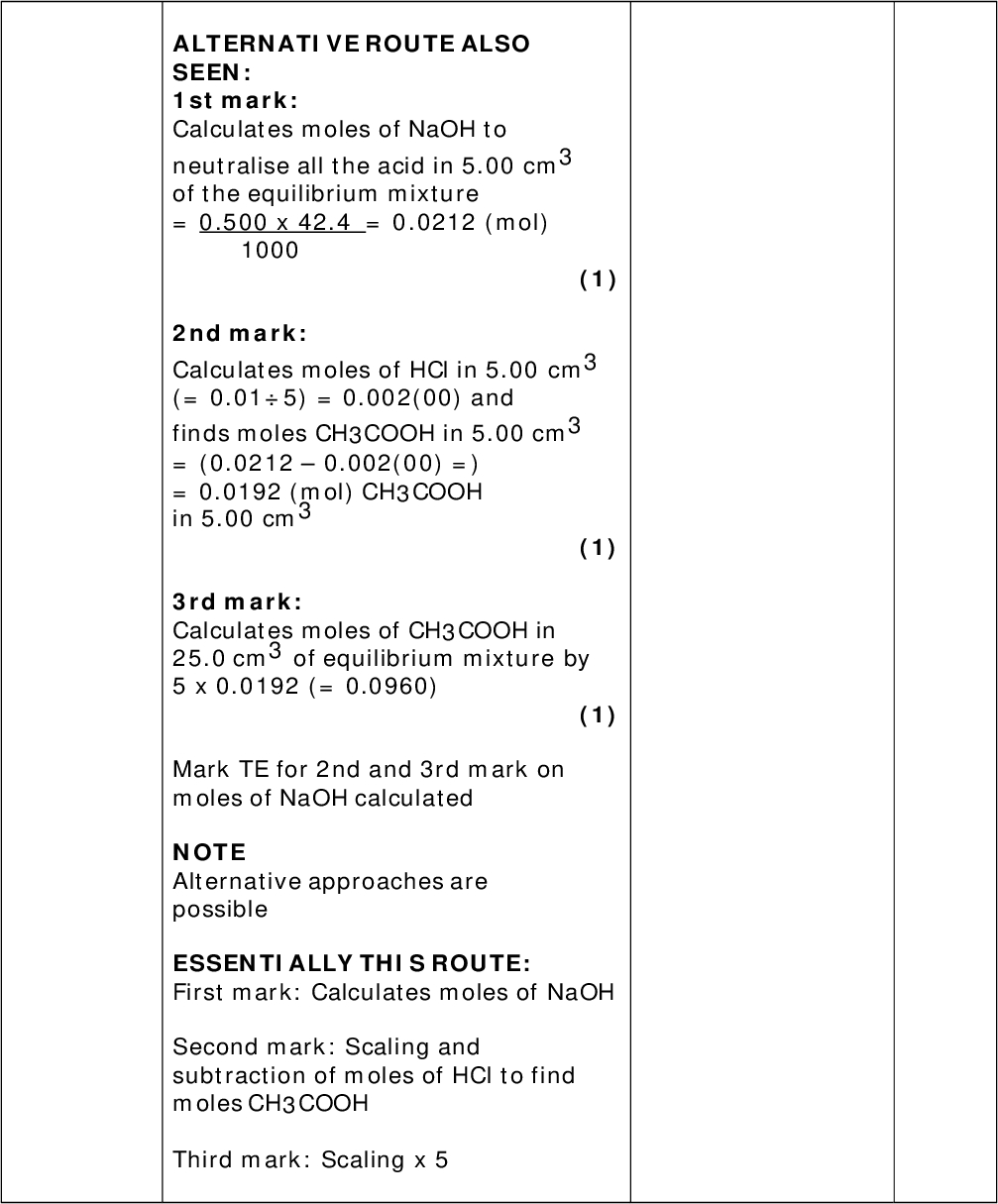
ALTERNATIVE ROUTE ALSO SEEN: 1st mark: Calculates moles of NaOH to neutralise all the acid in 5.00 cm3 of the equilibrium mixture = 0.500 x 42.4 = 0.0212 (mol) 1000 (1) 2nd mark: Calculates moles of HCl in 5.00 cm3 (= 0.015) = 0.002(00) and finds moles CH3COOH in 5.00 cm3 = (0.02120.002(00) =) = 0.0192 (mol) CH3COOH in 5.00 cm3 (1) 3rd mark: Calculates moles of CH3COOH in 25.0 cm3 of equilibrium mixture by 5 x 0.0192 (= 0.0960) (1) Mark TE for 2nd and 3rd mark on moles of NaOH calculated NOTE Alternative approaches are possible ESSENTIALLY THIS ROUTE: First mark: Calculates moles of NaOH Second mark: Scaling and subtraction of moles of HCl to find moles CH3COOH Third mark: Scaling x 5<br />
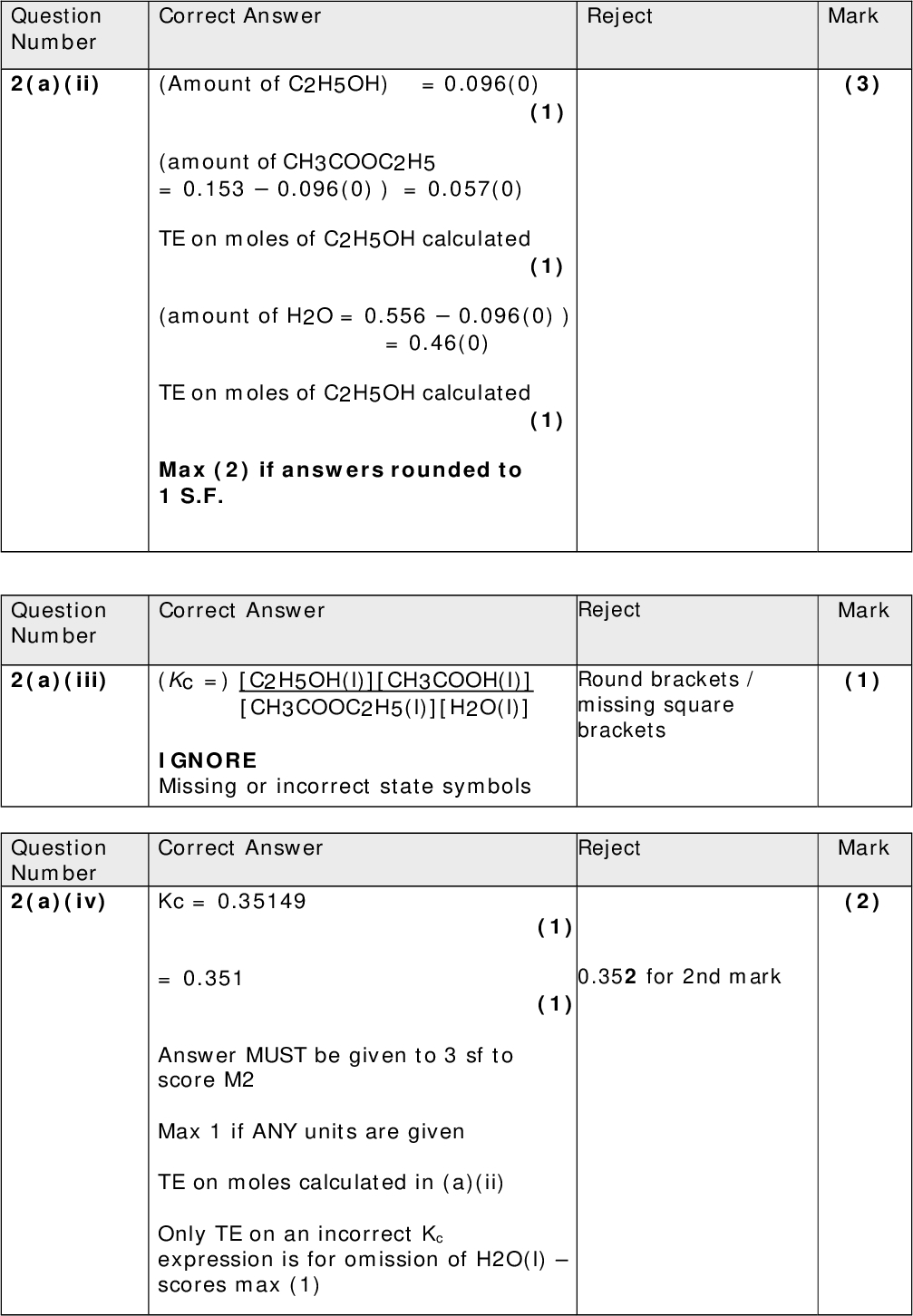
Question Number 2(a)(ii) Question Number 2(a)(iii) Question Number 2(a)(iv) Correct Answer (Amount of C2H5OH) = 0.096(0) (1) (amount of CH3COOC2H5 = 0.1530.096(0) ) = 0.057(0) Reject Mark (3) TE on moles of C2H5OH calculated (1) (amount of H2O = 0.5560.096(0) ) = 0.46(0) TE on moles of C2H5OH calculated (1) Max (2) if answers rounded to 1 S.F. Correct Answer Reject (Kc =) [C2H5OH(l)][CH3COOH(l)] [CH3COOC2H5(l)][H2O(l)] IGNORE Missing or incorrect state symbols Round brackets / missing square brackets Correct Answer Kc = 0.35149 = 0.351 Reject 0.352 for 2nd mark (1) (1) Answer MUST be given to 3 sf to score M2 Max 1 if ANY units are given TE on moles calculated in (a)(ii) Only TE on an incorrect Kc expression is for omission of H2O(l)scores max (1) Mark (1) Mark (2)<br />
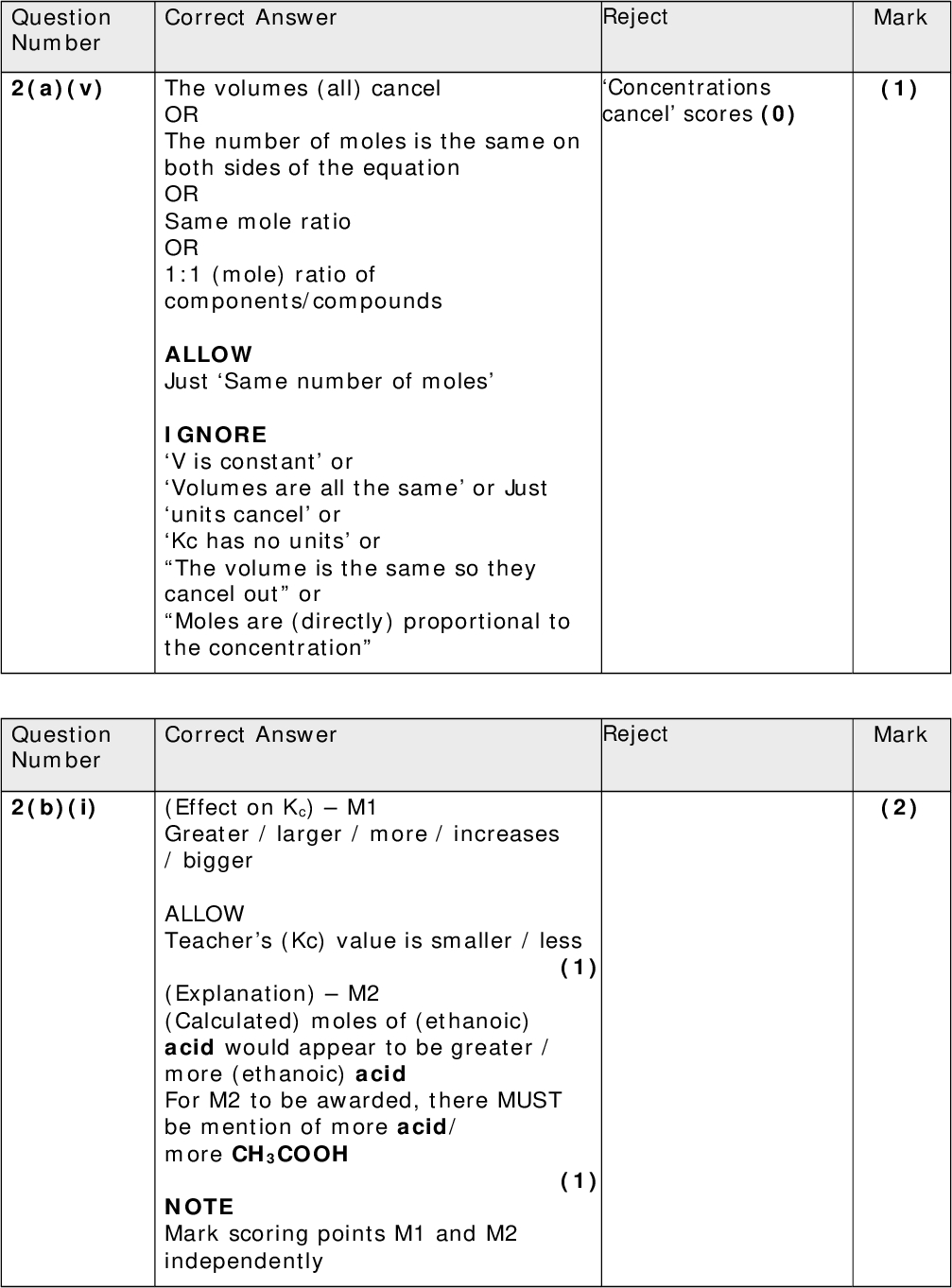
Question Number 2(a)(v) Question Number 2(b)(i) The volumes (all) cancel OR The number of moles is the same on both sides of the equation OR Same mole ratio OR 1:1 (mole) ratio of components/compounds ALLOW Just Same number of moles IGNORE V is constant or Volumes are all the same or Just units cancel or Kc has no units or The volume is the same so they cancel out or Moles are (directly) proportional to the concentration Correct Answer (Effect on Kc)M1 Greater / larger / more / increases / bigger ALLOW Teachers (Kc) value is smaller / less (1) (Explanation)M2 (Calculated) moles of (ethanoic) acid would appear to be greater / more (ethanoic) acid For M2 to be awarded, there MUST be mention of more acid/ more CH3COOH (1) Correct Answer Reject Mark (1) Concentrations cancel scores (0) Reject Mark (2) NOTE Mark scoring points M1 and M2 independently<br />
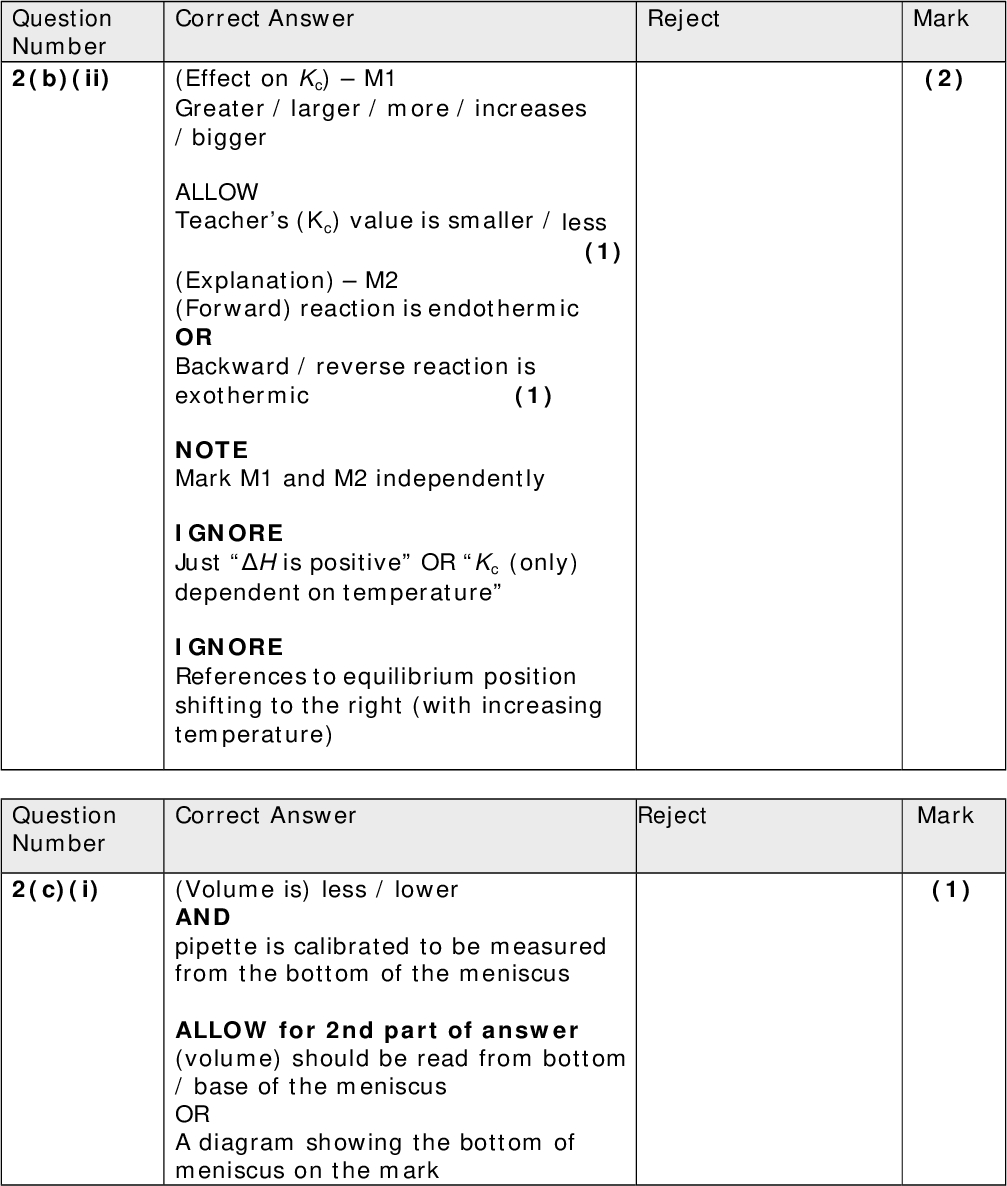
Question Number 2(b)(ii) Question Number 2(c)(i) Correct Answer Reject (Effect on Kc)M1 Greater / larger / more / increases / bigger Mark (2) ALLOW Teachers (Kc) value is smaller / less (1) (Explanation)M2 (Forward) reaction is endothermic OR Backward / reverse reaction is exothermic (1) NOTE Mark M1 and M2 independently IGNORE Just H is positive OR Kc (only) dependent on temperature IGNORE References to equilibrium position shifting to the right (with increasing temperature) Correct Answer Reject (Volume is) less / lower AND pipette is calibrated to be measured from the bottom of the meniscus ALLOW for 2nd part of answer (volume) should be read from bottom / base of the meniscus OR A diagram showing the bottom of meniscus on the mark Mark (1)<br />
Mark (1) Mark Question Number 2(c)(ii) Question Number 2(c)(iii) Reject Correct Answer (Volume is) same / not changed AND (volume from burette) is (difference between) two readings / is measured by difference ALLOW Any idea that the error cancels out Reject ()0.24 /()0.234 scores (0) Correct Answer 2 x 0.05 x 100% = () 0.23474 (%) 42.60 IGNORE S.F. but answer must be rounded correctly NOTE 0.2/ 0.23 / 0.235 / 0.2347 / 0.23474 all score the available mark IGNORE Any signs or the omission ofin front of the final answer (Total for Question 2 = 17 marks)<br />](https://learnah.org/wp-content/uploads/2018/08/June_2016_IAL_MS_-_Unit_6_Edexcel_Chemistry_2-0.jpg)