Edexcel Jun 2016 (IAL) Paper 3 Q

Answers available below

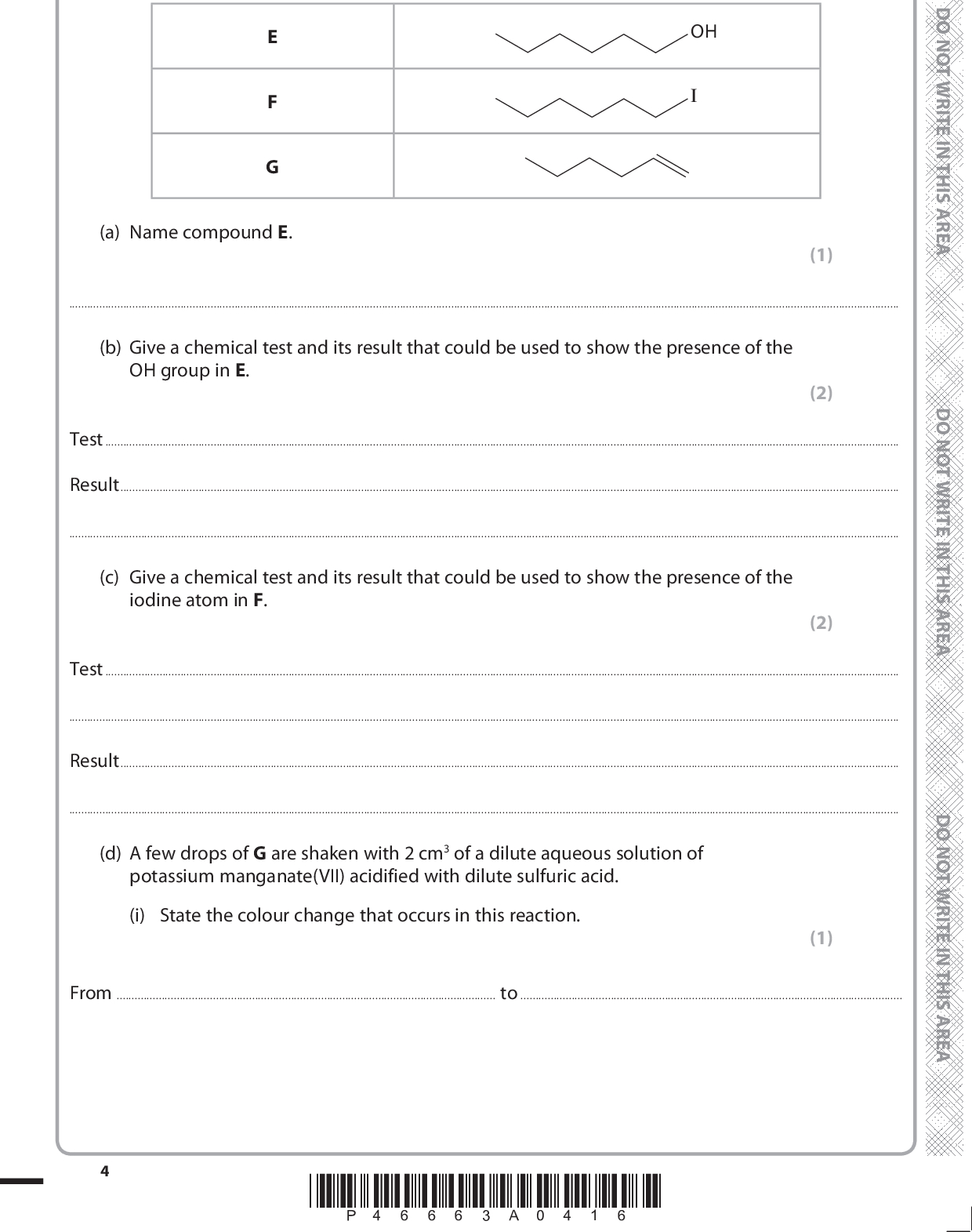
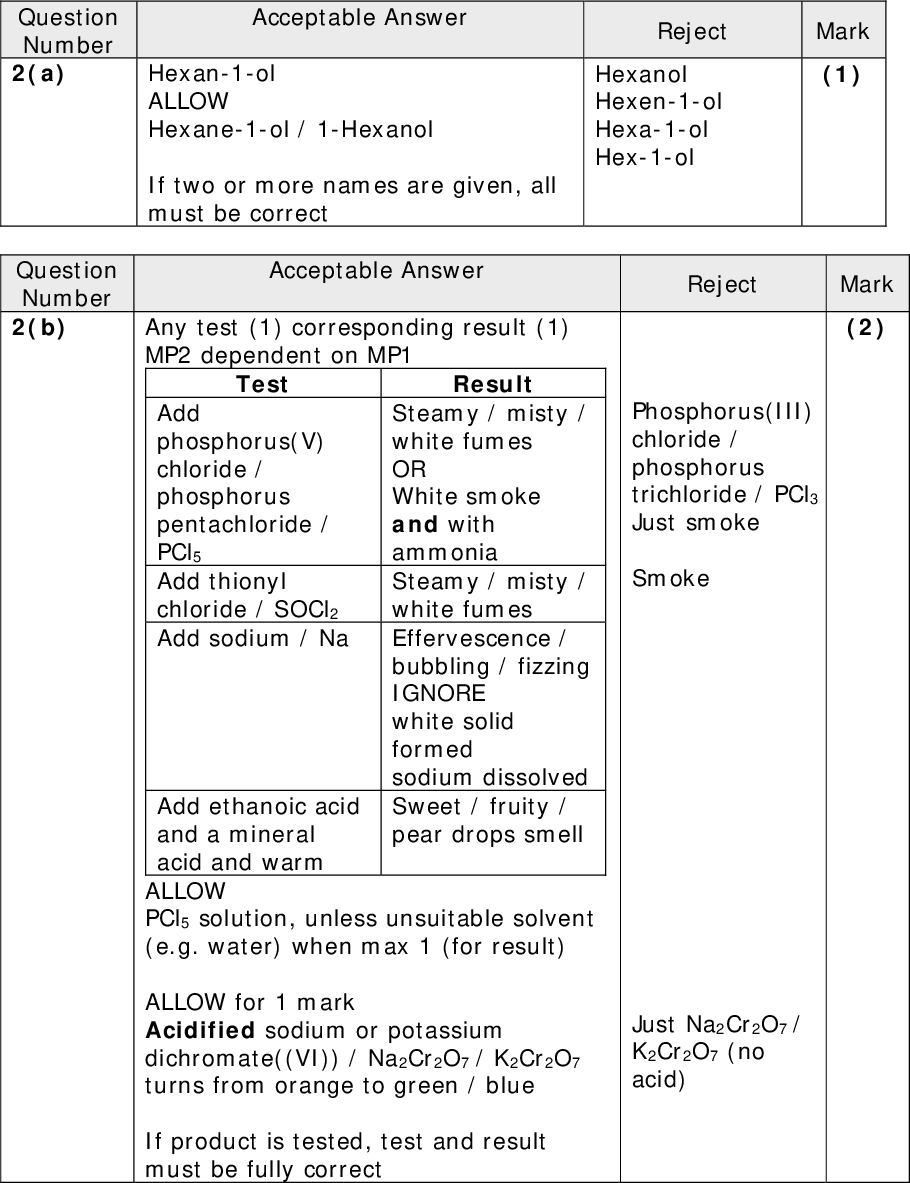
2 The skeletal formulae of three organic compounds, E, F and G, are shown in the table. OH (a) Name compound E. (1)(b) Give a chemical test and its result that could be used to show the presence of the OH group in E. (2) TestResult(c) Give a chemical test and its result that could be used to show the presence of the iodine atom in F. (2) TestResult(d) A few drops of G are shaken with 2 cm3 of a dilute aqueous solution of potassium manganate(VII) acidified with dilute sulfuric acid. (i) State the colour change that occurs in this reaction. (1) Fromto*P46663A0416*<br />
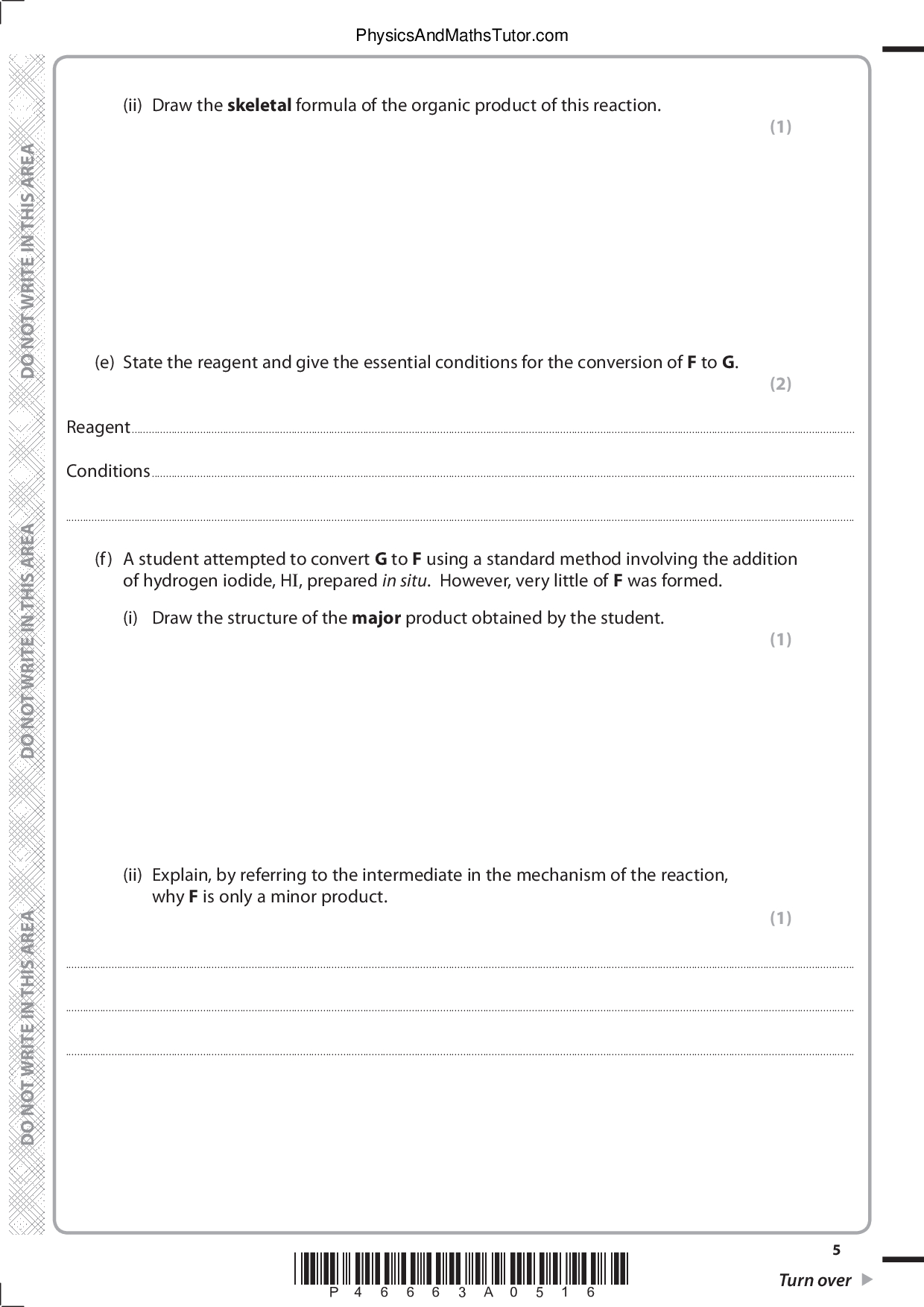
 (ii) Draw the skeletal formula of the organic product of this reaction. (e) State the reagent and give the essential conditions for the conversion of F to G. (1) (2) ReagentConditions(f) A student attempted to convert G to F using a standard method involving the addition of hydrogen iodide, HI, prepared in situ. However, very little of F was formed. (i) Draw the structure of the major product obtained by the student. (1) (1) (ii) Explain, by referring to the intermediate in the mechanism of the reaction, why F is only a minor product.*P46663A0516* Turn over<br />
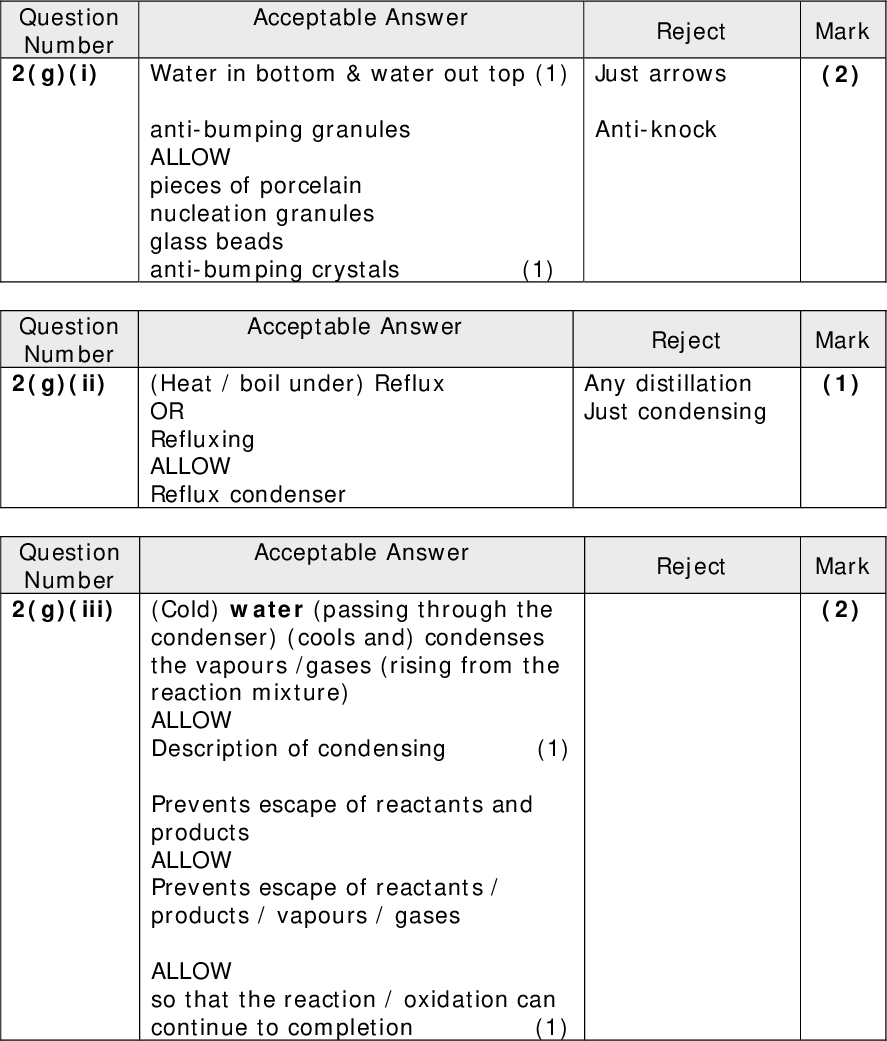
 (g) Compound E may be oxidized with potassium dichromate(VI) acidified with sulfuric acid, using the apparatus shown below. For clarity, clamps, stands and rubber tubing have been omitted from the diagram.Liebig condenserreaction mixture round bottom flask(i) Complete the labelling of this diagram. heat (ii) Name the technique that is carried out using this apparatus. (2) (1)(iii) Explain how the Liebig condenser works and its purpose in the apparatus shown. (2)*P46663A0616*<br />
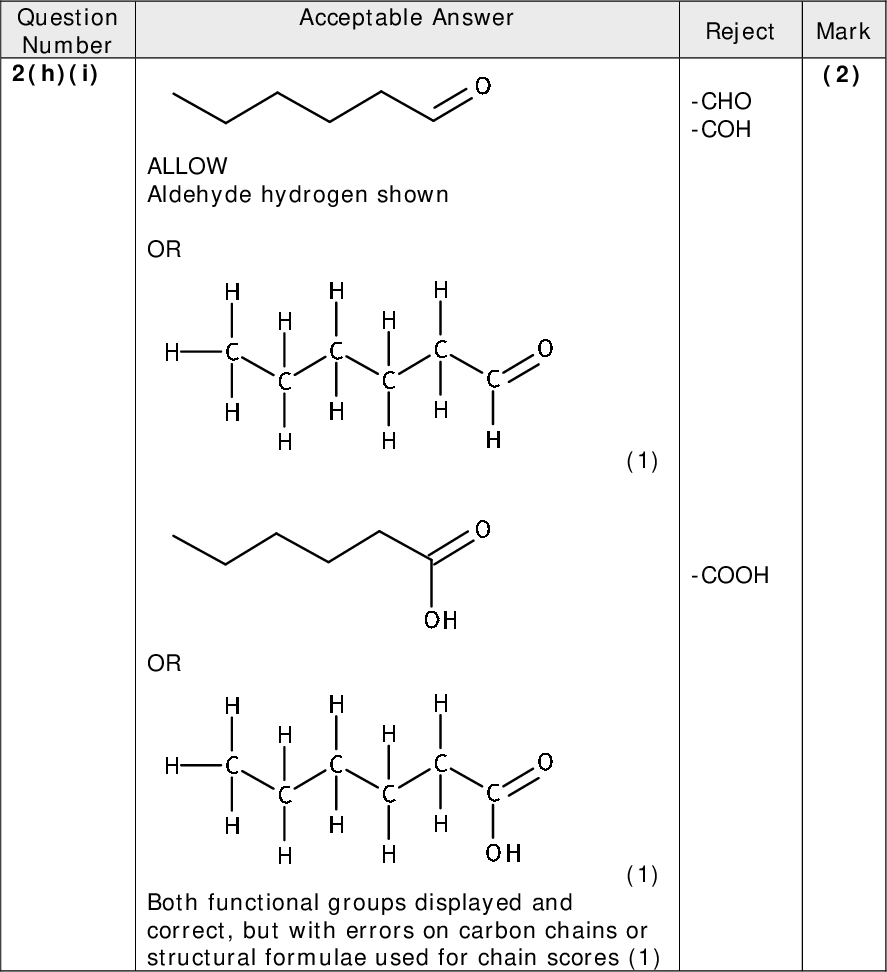
 (h) Oxidation of E can result in the formation of an aldehyde or a carboxylic acid. OH (i) Give the skeletal or displayed formulae of these products. Aldehyde Carboxylic acid (ii) By considering the bonds in these two products, explain how infrared spectroscopy can be used to distinguish between them. You are not expected to give specific wavenumbers. (2) (1)*P46663A0716* Turn over<br />
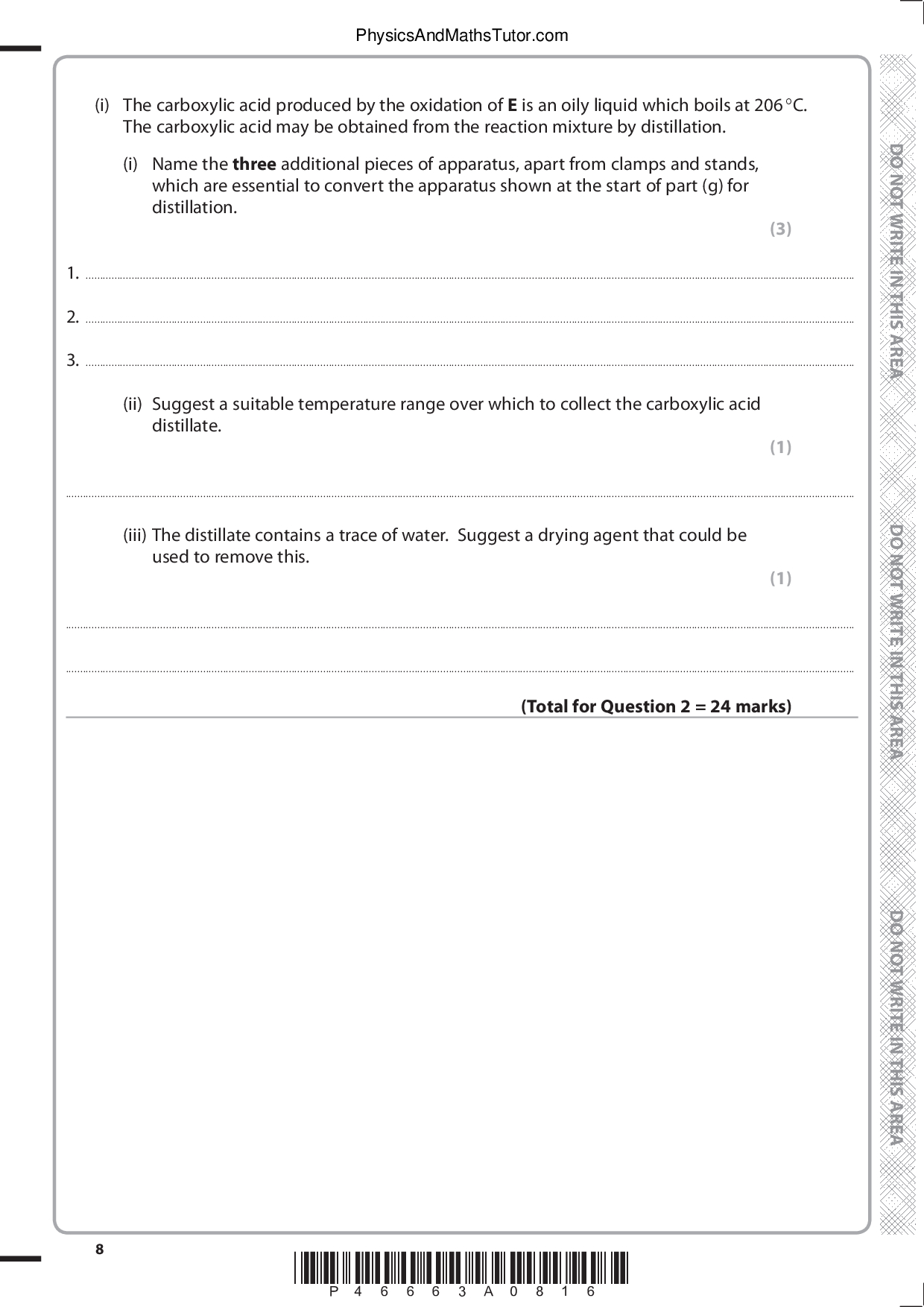
 (i) The carboxylic acid produced by the oxidation of E is an oily liquid which boils at 206C. The carboxylic acid may be obtained from the reaction mixture by distillation. (i) Name the three additional pieces of apparatus, apart from clamps and stands, which are essential to convert the apparatus shown at the start of part (g) for distillation. (3) 1.2.3.(ii) Suggest a suitable temperature range over which to collect the carboxylic acid distillate. (1)(iii) The distillate contains a trace of water. Suggest a drying agent that could be used to remove this. (1)(Total for Question 2 = 24 marks) *P46663A0816*<br />
 BLANK PAGE *P46663A0916* Turn over<br />

Show answer