Edexcel Jun 2015 (IAL) Paper 3 Q4

Answers available below

4 Cyclohexene, C6H10, can be prepared by dehydrating cyclohexanol, C6H11OH, with phosphoric acid. H3PO4 C6H11OH C6H10 + H2O Procedure Step 1 12.0 cm3 of cyclohexanol was put into a small flask. 5 cm3 of concentrated phosphoric acid, an excess, was added slowly to the cyclohexanol using a dropping pipette. Some anti-bumping granules were added to the mixture and the flask was set up for distillation. Step 2 The portion of the distillate collected between 80(cid:113)C and 90(cid:113)C contained only cyclohexene and water. Step 3 The distillate of cyclohexene and water was transferred to a separating funnel and a saturated solution of sodium chloride was added. Most of the water which was in the distillate went into the saturated sodium chloride layer. Step 4 The crude cyclohexene was run out of the separating funnel and dried with anhydrous calcium chloride. Step 5 The calcium chloride was removed by filtration through glass wool, and the liquid was redistilled to collect pure cyclohexene. Cyclohexene has an unpleasant smell and irritates the eyes, so the entire experiment was carried out in a fume cupboard. In Step 1, tubing was connected to carry any uncondensed cyclohexene to a drain. (a) The chemicals involved in this reaction are all hazardous if they make contact with the eyes, or if swallowed or inhaled. Other than their effect on the eyes or their toxicity, state two different hazards of the chemicals involved in this reaction. Name the chemical associated with each hazard. (2) Chemical Hazard *P44883A01116* 11 Turn over<br />
 (b) Calculate the number of moles of cyclohexanol used in this experiment. The density of cyclohexanol is 0.962 g cm3. (c) Draw a labelled diagram showing how to distil the reaction mixture in Step 1 and collect the distillate boiling between 80(cid:113)C and 90(cid:113)C. (2) (4) 12 *P44883A01216*<br />
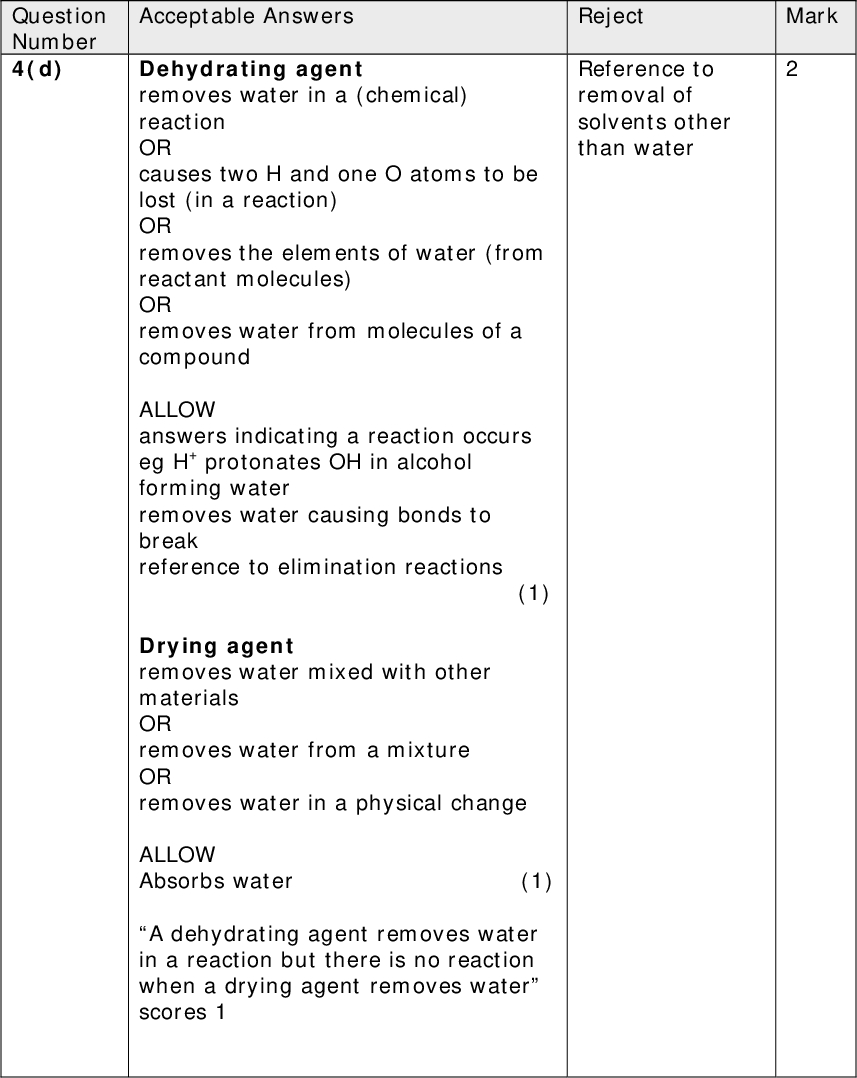
 (d) Explain the difference between a dehydrating agent, such as the phosphoric acid used in Step 1, and a drying agent, such as the anhydrous calcium chloride used in Step 4. (2)(e) Suggest one advantage of using glass wool, rather than filter paper, when removing the calcium chloride in Step 5. (1)(f) Calculate the mass of cyclohexanol needed to obtain 10.0 g cyclohexene if the yield is 75%. (3) *P44883A01316* 13 Turn over<br />
 (g) The cyclohexene was tested by mixing it with bromine dissolved in an organic solvent. (i) What colour change would be observed? (1)(ii) Give the displayed formula for the organic product of this reaction. (1) (Total for Question 4 = 16 marks) TOTAL FOR PAPER = 50 MARKS 14 *P44883A01416*<br />

Show answer