Edexcel Jun 2015 (IAL) Paper 1 Q23

Answers available below

23 This question is about alkenes. (a) Give the general formula for the homologous series of alkenes. (1)(b) Give the structural formula of the organic product formed when ethene, CH2=CH2, reacts with (i) hydrogen (ii) chlorine (iii) acidified aqueous potassium manganate(VII) (iv) bromine water (1) (1) (1) (1) 20 *P44880A02028*<br />
 (c) When propene, CH3CH=CH2, reacts with hydrogen chloride, there are two possible products, a major product and a minor product. (i) Draw the displayed formulae of these products. Major product Minor product (ii) Give the mechanism for the reaction of propene with hydrogen chloride which forms the major product. (2) (3) *P44880A02128* 21 Turn over<br />
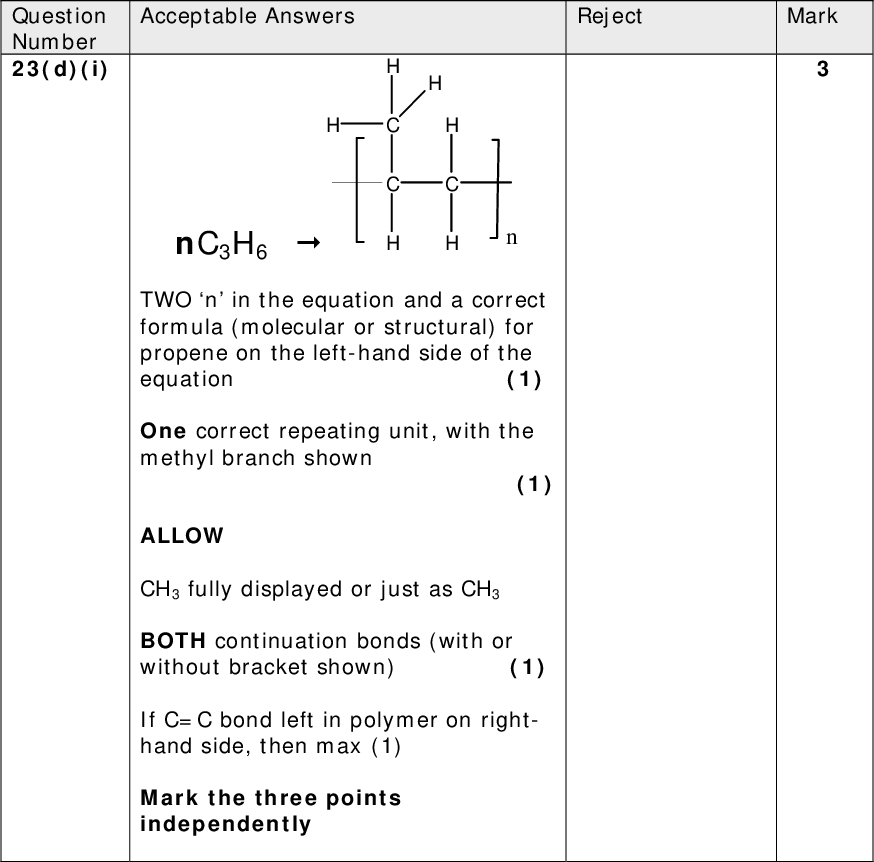
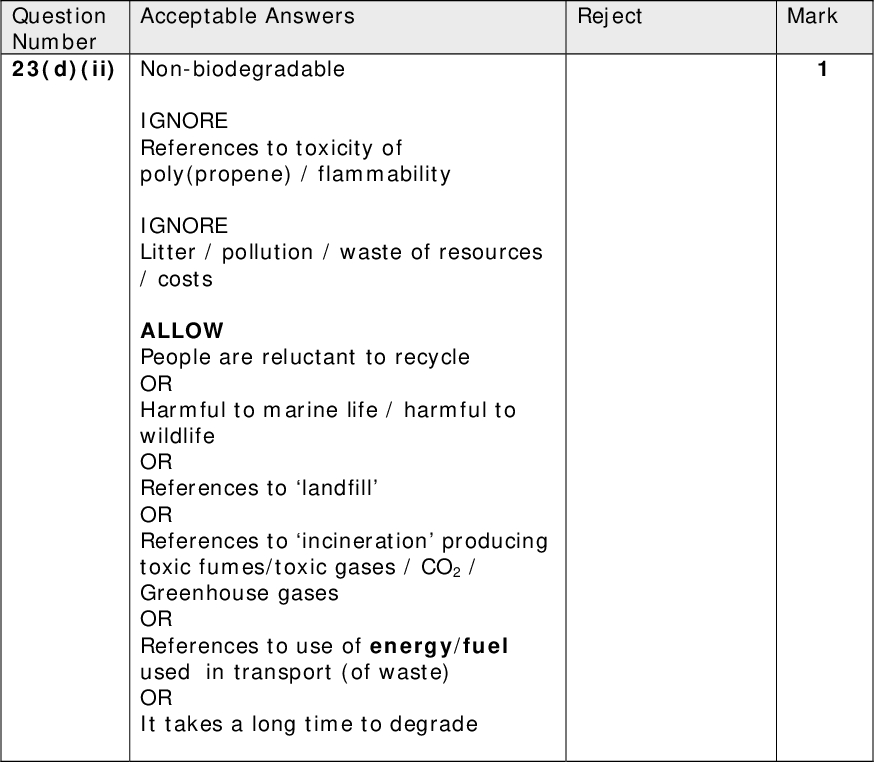
 (d) Propene can be polymerized. (i) Write a balanced equation for the polymerization of propene to form poly(propene), drawing the displayed formula of the repeat unit of poly(propene). (ii) State a problem associated with the disposal of waste poly(propene). (3) (1)22 *P44880A02228*<br />
 (e) Standard enthalpy changes of combustion can be used to calculate the standard enthalpy change of formation of propene. 3C(s) + 3H2(g) C3H6(g) Values for some standard enthalpy changes of combustion, (cid:507)H (cid:57) table below. c , are shown in the Substance (cid:507)H (cid:57) c / kJ mol1 C(s) H2(g) C3H6(g) 394 286 2058 (i) Complete the Hess cycle below to enable you to calculate (cid:507)H f (cid:57) from combustion data. 3C(s) + 3H2(g) (cid:57) (cid:507)H f C3H6(g) (ii) Calculate (cid:507)H f (cid:57), in kJ mol1. (1) (2) standard enthalpy change of formation of propene =kJ mol1 (Total for Question 23 = 17 marks) *P44880A02328* 23 Turn over<br />

Show answer