Edexcel Jun 2012 Paper 2 Q17

Answers available below

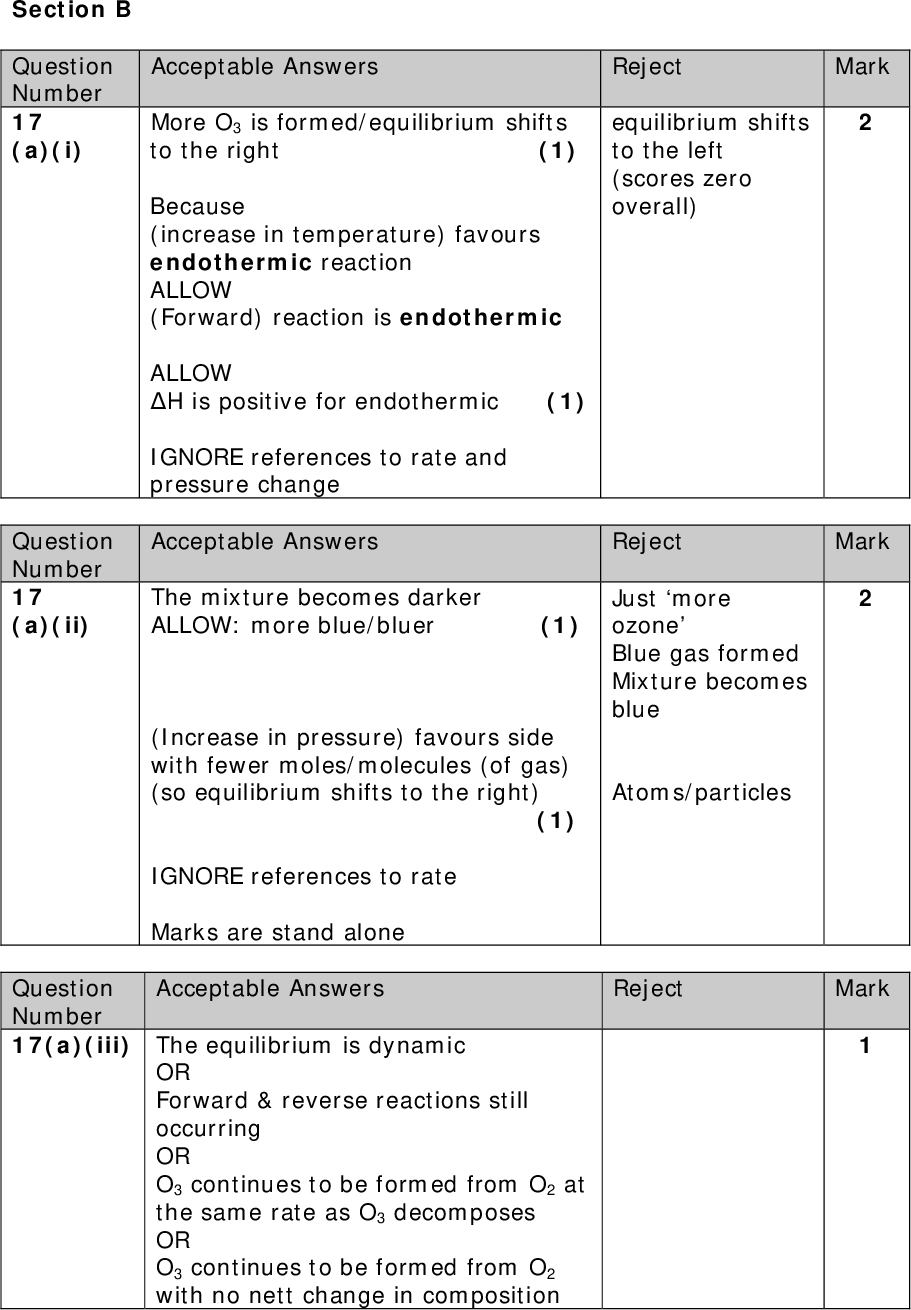
SECTION B Answer ALL the questions. Write your answers in the spaces provided. 17 (a) Ozone, O3, is formed when oxygen is exposed to ultraviolet (UV) radiation or to an electric discharge. Ozone is a blue gas whereas oxygen is colourless. When the two gases are mixed, an equilibrium is established as shown in the following equation. 3O2(g) U 2O3 J H = +143 kJ mol1 (i) When the temperature of the pale blue equilibrium mixture is increased at constant volume, the colour darkens. Explain this observation in terms of the changes to the equilibrium. (2)(ii) State and explain what you would see if the pressure of the system at equilibrium were increased. (2)(iii) A small amount of oxygen gas containing the isotope 18O is added to the equilibrium mixture. After a few hours, ozone containing 18O is detected. Given that the equilibrium position is not affected, explain this observation. (1)*P39307A0820*<br />
 (b) The concentration of ozone in the atmosphere may be determined by bubbling air through a solution of acidified potassium iodide. Iodine is formed in solution, the concentration of which may be determined by titration with a solution of sodium thiosulfate of known concentration. The equations for the reactions are O3 + 2I + 2H+ o O2 + H2O + I2 Equation 1 Equation 2 2 o 2I + S4O6 2 I2 + 2S2O3 In an experiment to determine the concentration of ozone in a sample of air, 100 m3 of air was bubbled through 100 cm3 of a solution containing an excess of acidified potassium iodide. The resulting solution was titrated against a solution of sodium thiosulfate of concentration 0.0155 mol dm3. The volume of sodium thiosulfate solution required for complete reaction was 25.50 cm3. (i) Calculate the number of moles of sodium thiosulfate that react. (ii) Calculate the number of moles of iodine that reacted with the sodium thiosulfate. (iii) Use equation 1 to deduce the number of moles of ozone that reacted with the acidified potassium iodide. (1) (2) (1) *P39307A0920* Turn over<br />
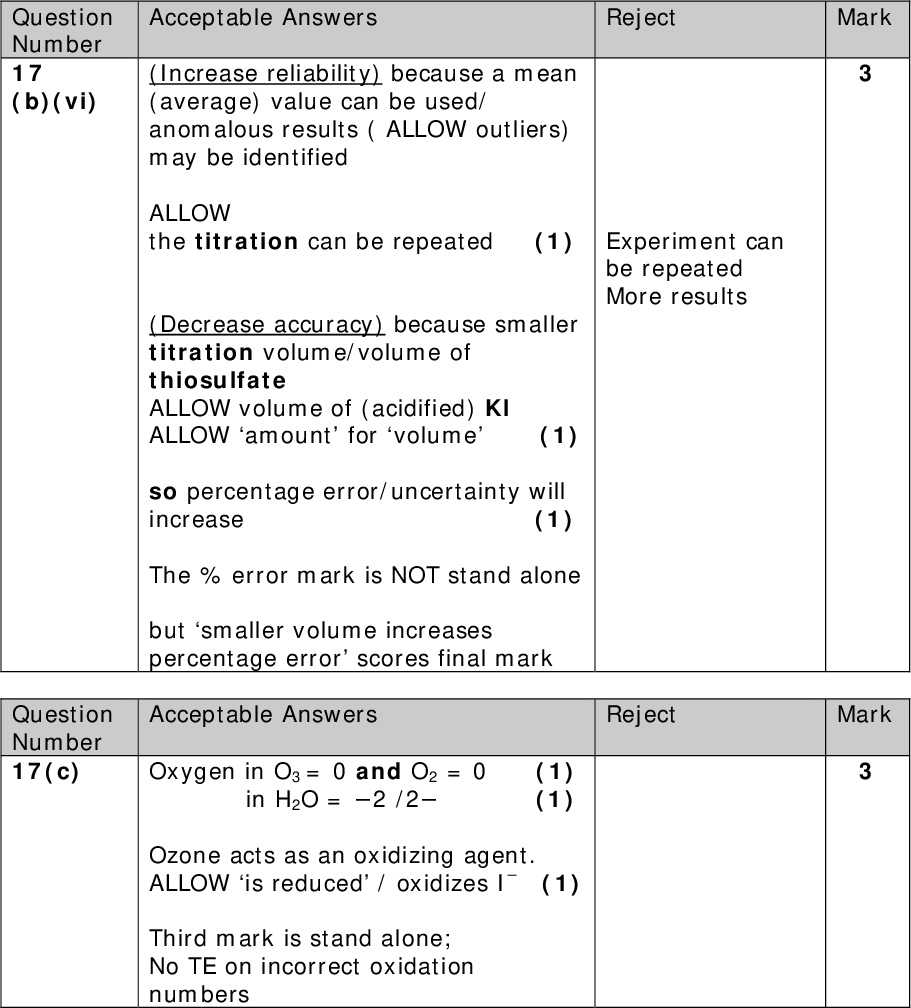
 (iv) Calculate the volume of ozone, measured in m3, present in the original sample of air. Assume that all gas volumes were measured at room temperature and pressure and that the molar volume of any gas under these conditions is 0.024 m3 mol1. (v) Calculate the concentration of ozone in the sample of air in units of parts per million (ppm) by volume. (vi) A student suggested that the 100 cm3 of acidified potassium iodide should be divided into four portions before the titration. Explain how this change increases the reliability and decreases the accuracy of the experiment. (1) (1) (3) Increases reliabilityDecreases accuracy10 *P39307A01020*<br />
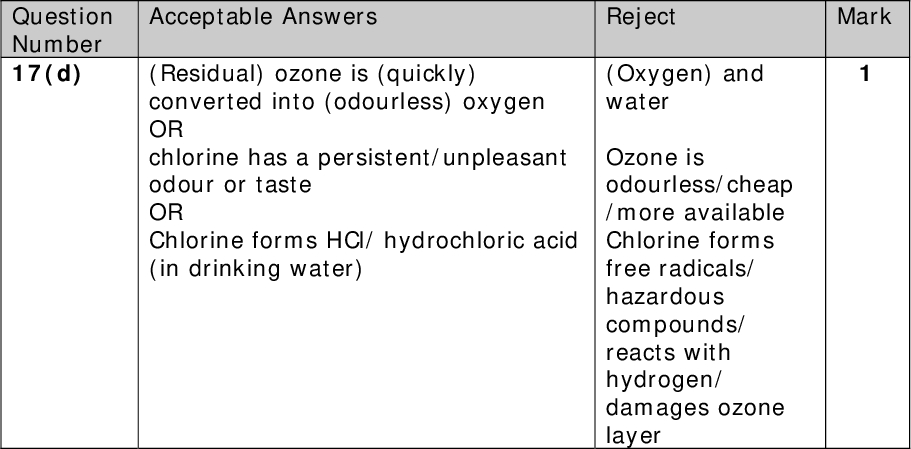
 (c) Give the oxidation numbers of oxygen in equation 1, shown below. Hence state the role of ozone in this reaction. (3) O3 + 2I + 2H+ o O2 + H2O + I2 Oxidation number of ORole of ozone(d) Ozone is used as an alternative to chlorine to disinfect flood damaged buildings, to remove residual smoke odours from fires and in the treatment of drinking water. Suggest one advantage of using ozone rather than chlorine, given that chlorine and ozone are both toxic. (1)(Total for Question 17 = 18 marks) *P39307A01120* 11 Turn over<br />

Show answer