Edexcel Jan 2013 Paper 3 Q1

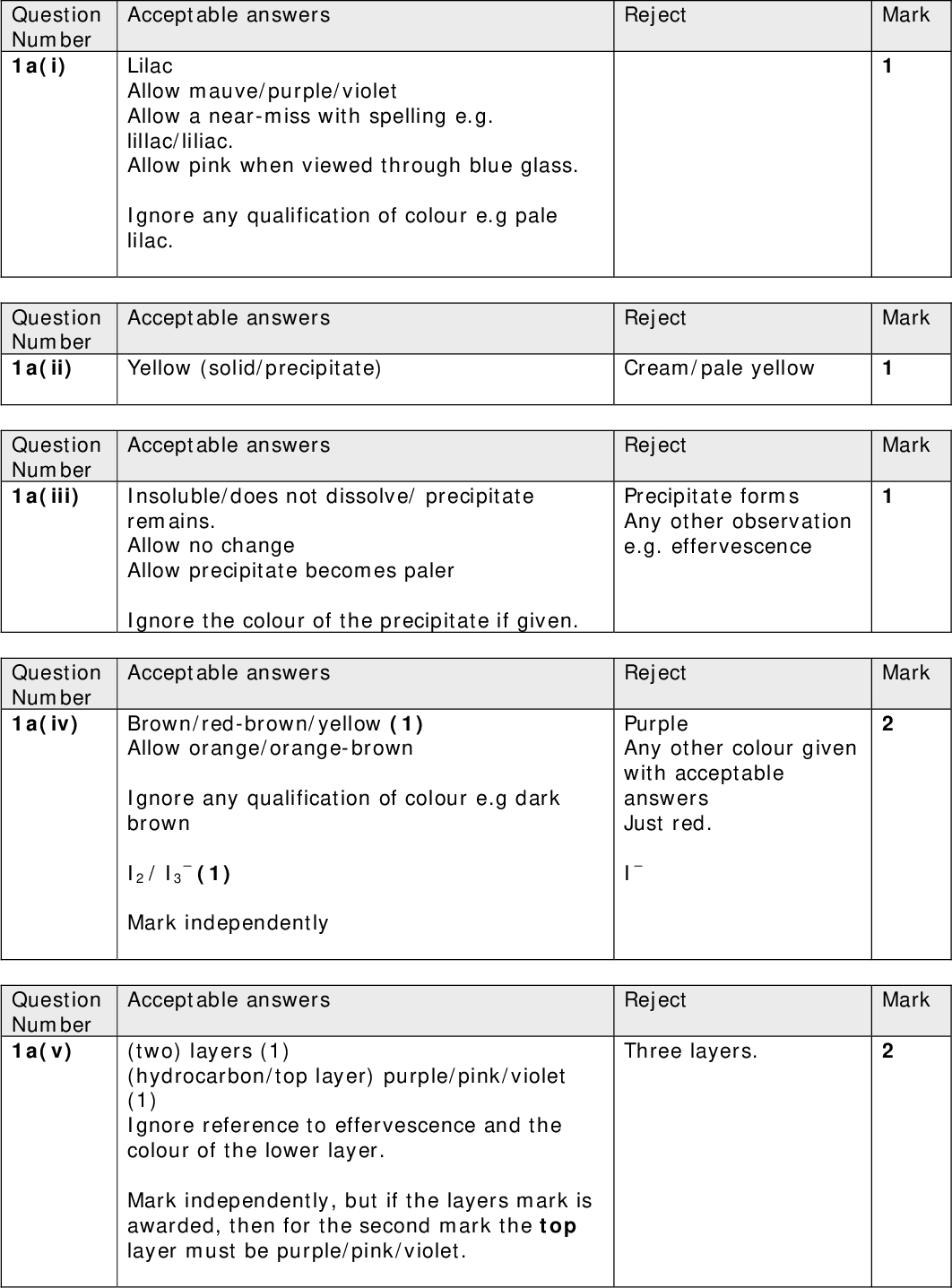
Answers available below

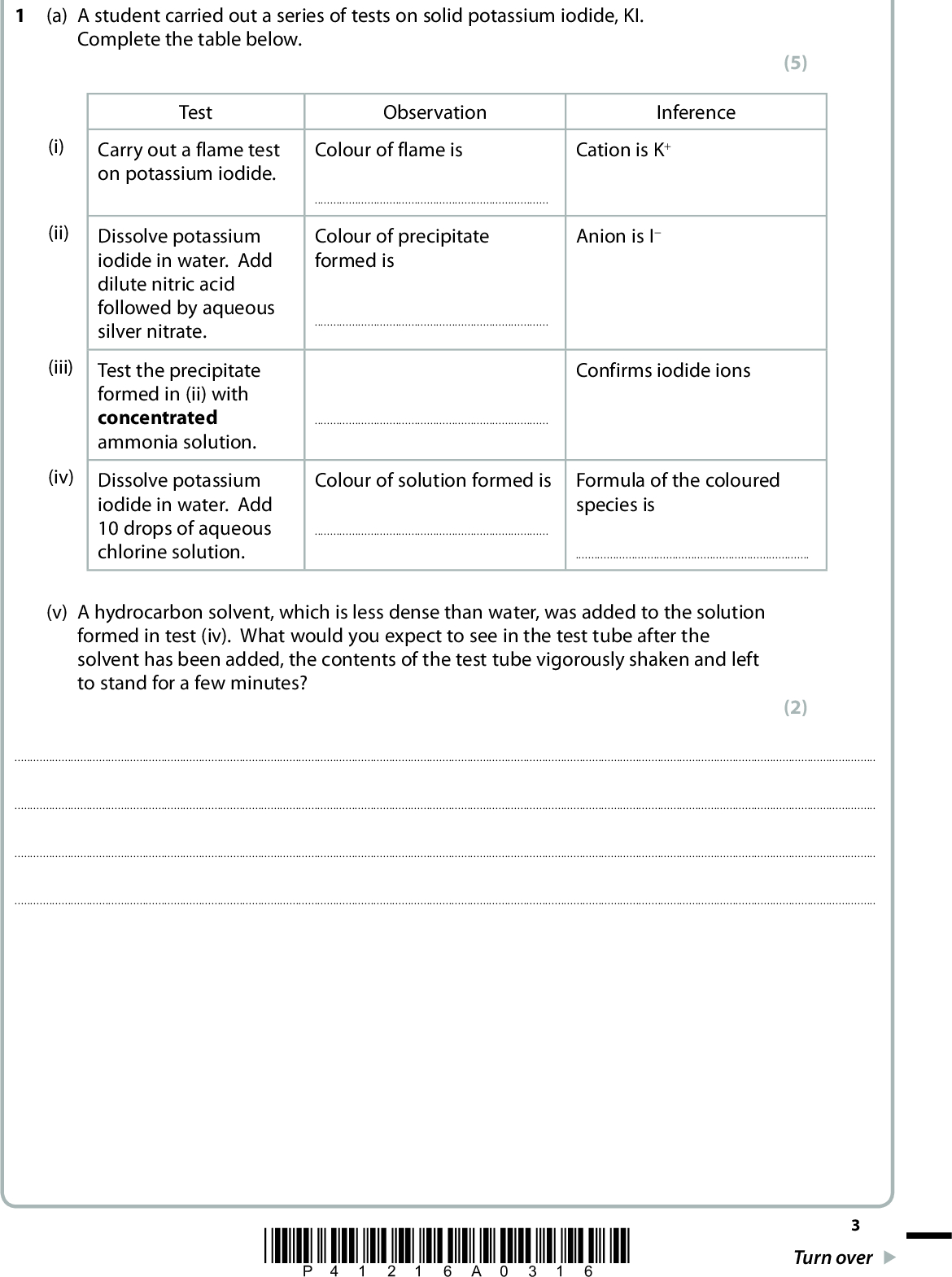
Answer ALL the questions. Write your answers in the spaces provided. (a) A student carried out a series of tests on solid potassium iodide, KI. Complete the table below. (5) Test Observation Inference (i) (ii) Carry out a flame test on potassium iodide. Dissolve potassium iodide in water. Add dilute nitric acid followed by aqueous silver nitrate. (iii) Test the precipitate formed in (ii) with concentrated ammonia solution. (iv) Dissolve potassium iodide in water. Add 10 drops of aqueous chlorine solution. Colour of flame is Cation is K+Colour of precipitate formed is Anion is IConfirms iodide ionsColour of solution formed is Formula of the coloured species is(v) A hydrocarbon solvent, which is less dense than water, was added to the solution formed in test (iv). What would you expect to see in the test tube after the solvent has been added, the contents of the test tube vigorously shaken and left to stand for a few minutes? (2)*P41216A0316* Turn over<br />
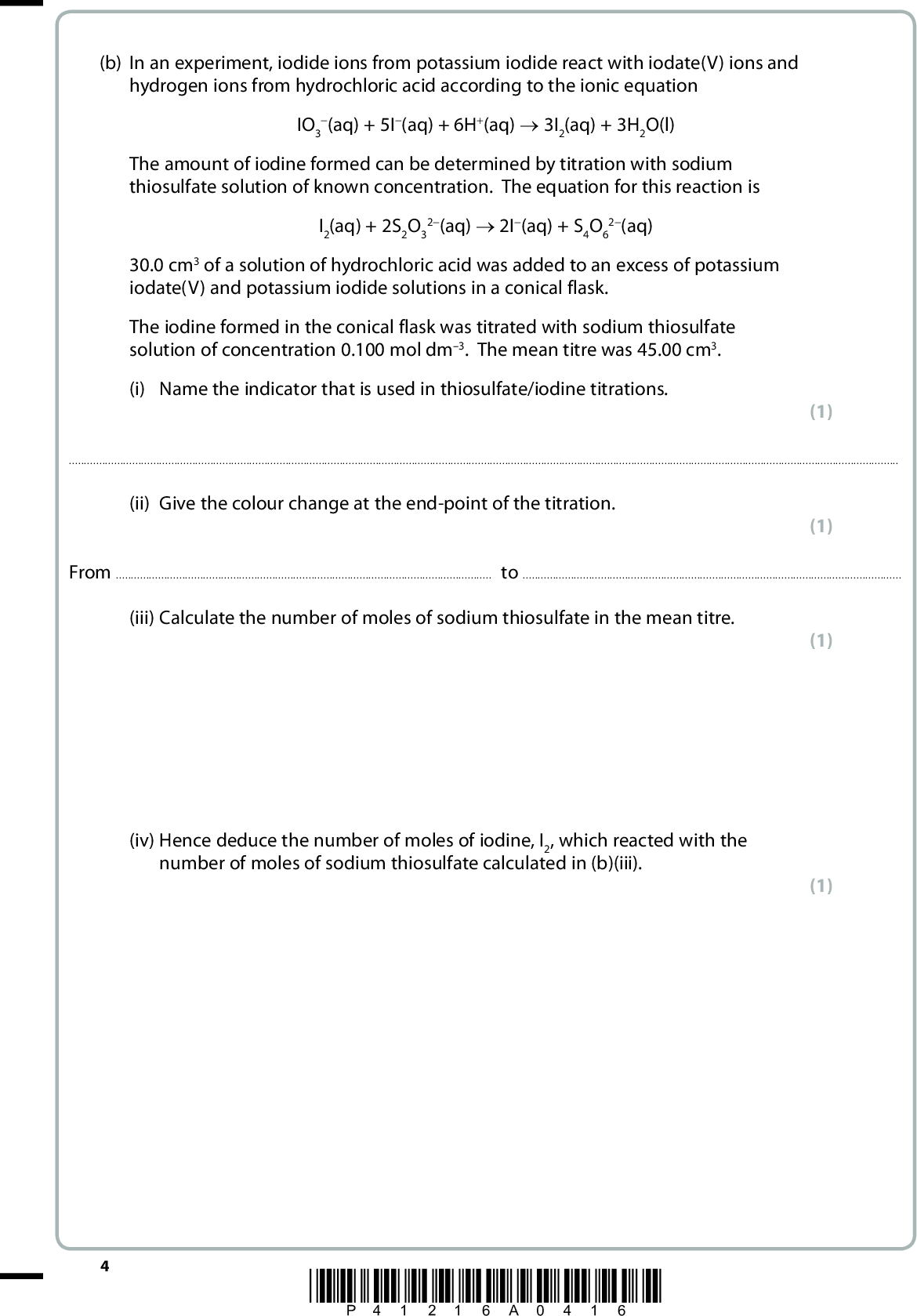
 (b) In an experiment, iodide ions from potassium iodide react with iodate(V) ions and hydrogen ions from hydrochloric acid according to the ionic equation IO3 (aq) + 5I(aq) + 6H+(aq) o 3I2(aq) + 3H2O(l) The amount of iodine formed can be determined by titration with sodium thiosulfate solution of known concentration. The equation for this reaction is I2(aq) + 2S2O3 2(aq) o 2I(aq) + S4O6 2(aq) 30.0 cm3 of a solution of hydrochloric acid was added to an excess of potassium iodate(V) and potassium iodide solutions in a conical flask. The iodine formed in the conical flask was titrated with sodium thiosulfate solution of concentration 0.100 mol dm3. The mean titre was 45.00 cm3. (i) Name the indicator that is used in thiosulfate/iodine titrations. (1)(ii) Give the colour change at the end-point of the titration. (1) Fromto(iii) Calculate the number of moles of sodium thiosulfate in the mean titre. (iv) Hence deduce the number of moles of iodine, I2, which reacted with the number of moles of sodium thiosulfate calculated in (b)(iii). (1) (1) *P41216A0416*<br />
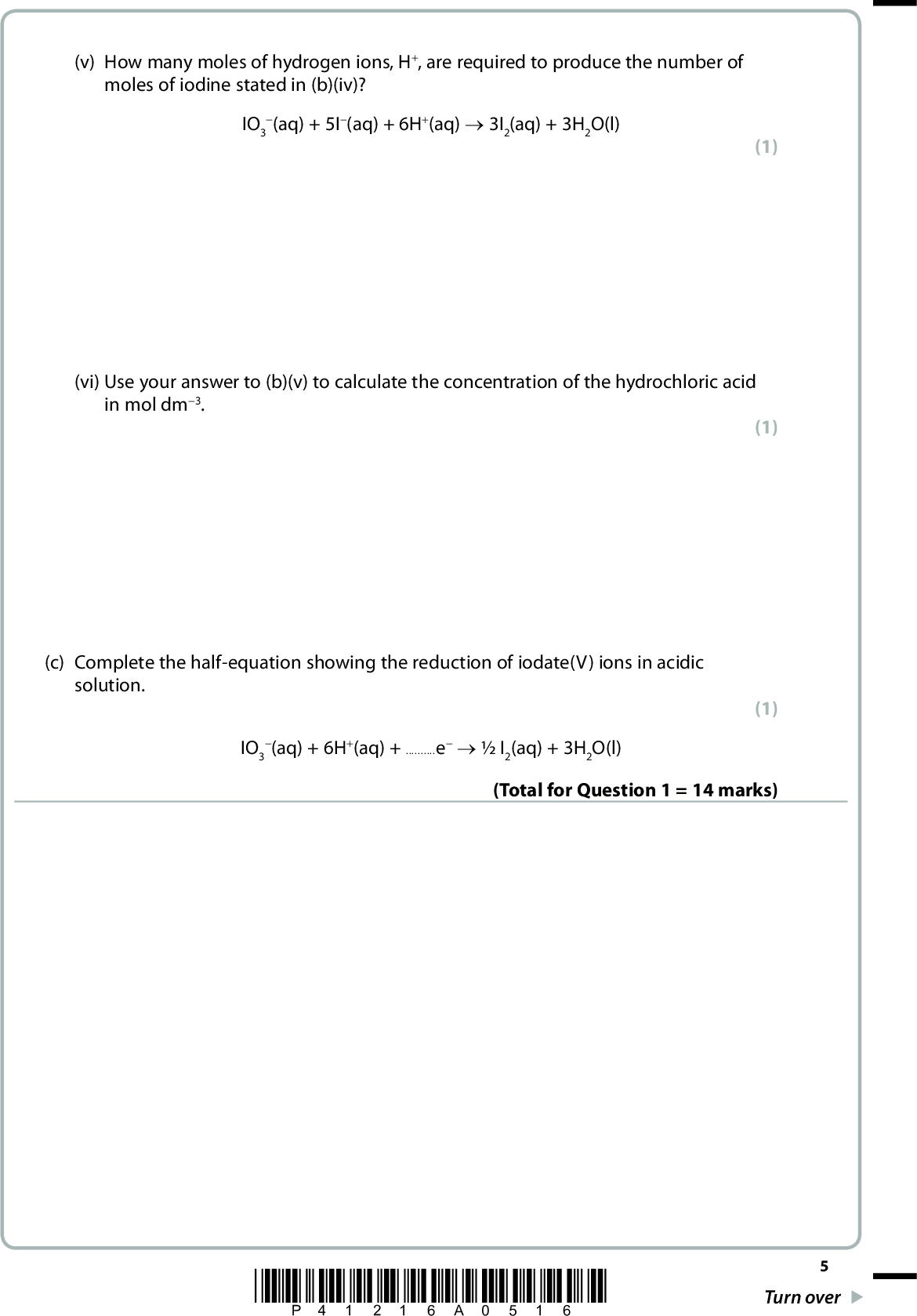
 (v) How many moles of hydrogen ions, H+, are required to produce the number of moles of iodine stated in (b)(iv)? IO3 (aq) + 5I(aq) + 6H+(aq) o 3I2(aq) + 3H2O(l) (1) (vi) Use your answer to (b)(v) to calculate the concentration of the hydrochloric acid in mol dm3. (1) (1) (c) Complete the half-equation showing the reduction of iodate(V) ions in acidic solution. IO3 (aq) + 6H+(aq) + e oI2(aq) + 3H2O(l) (Total for Question 1 = 14 marks) *P41216A0516* Turn over<br />

Show answer