Skip to content
Edexcel Jan 2013 Paper 1 Q19
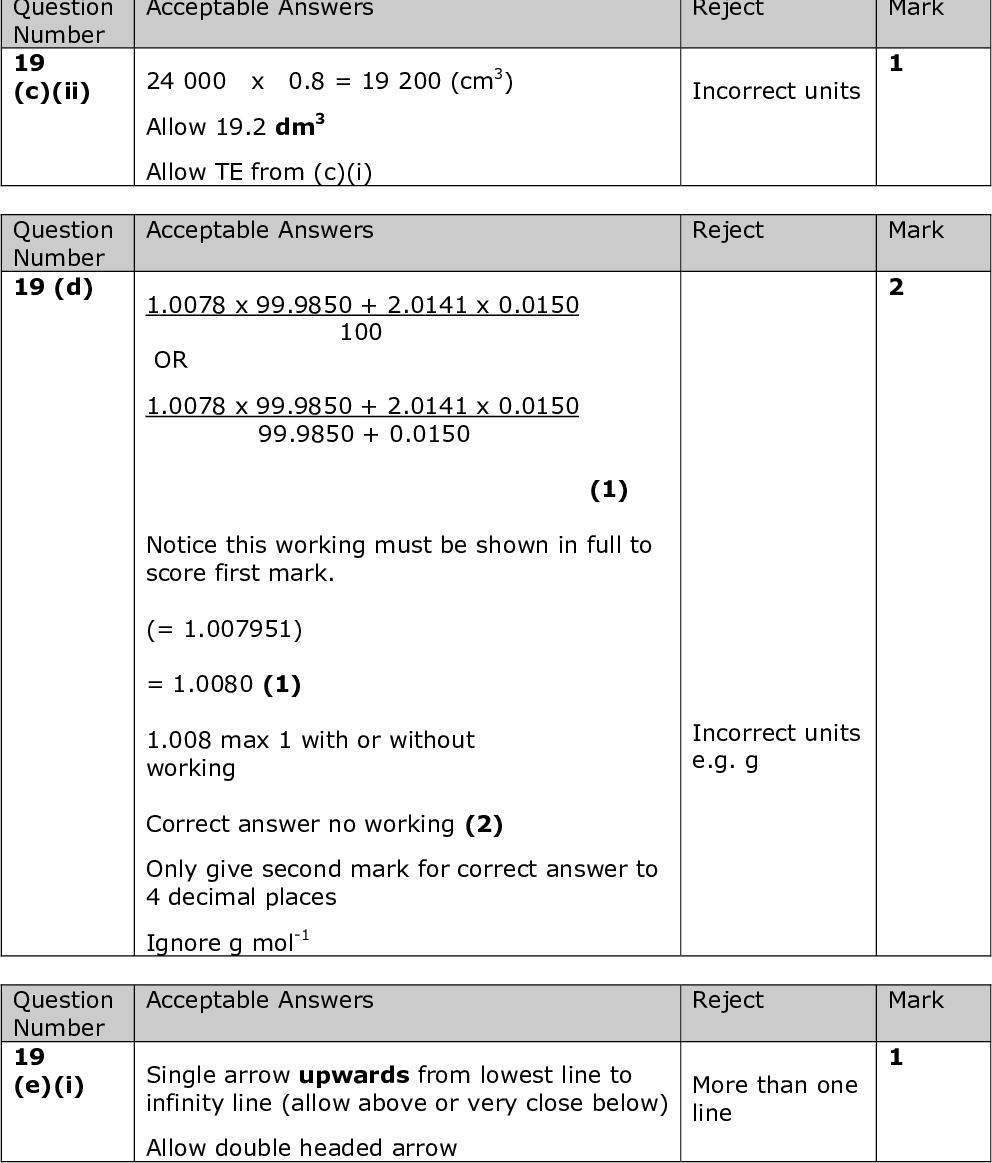
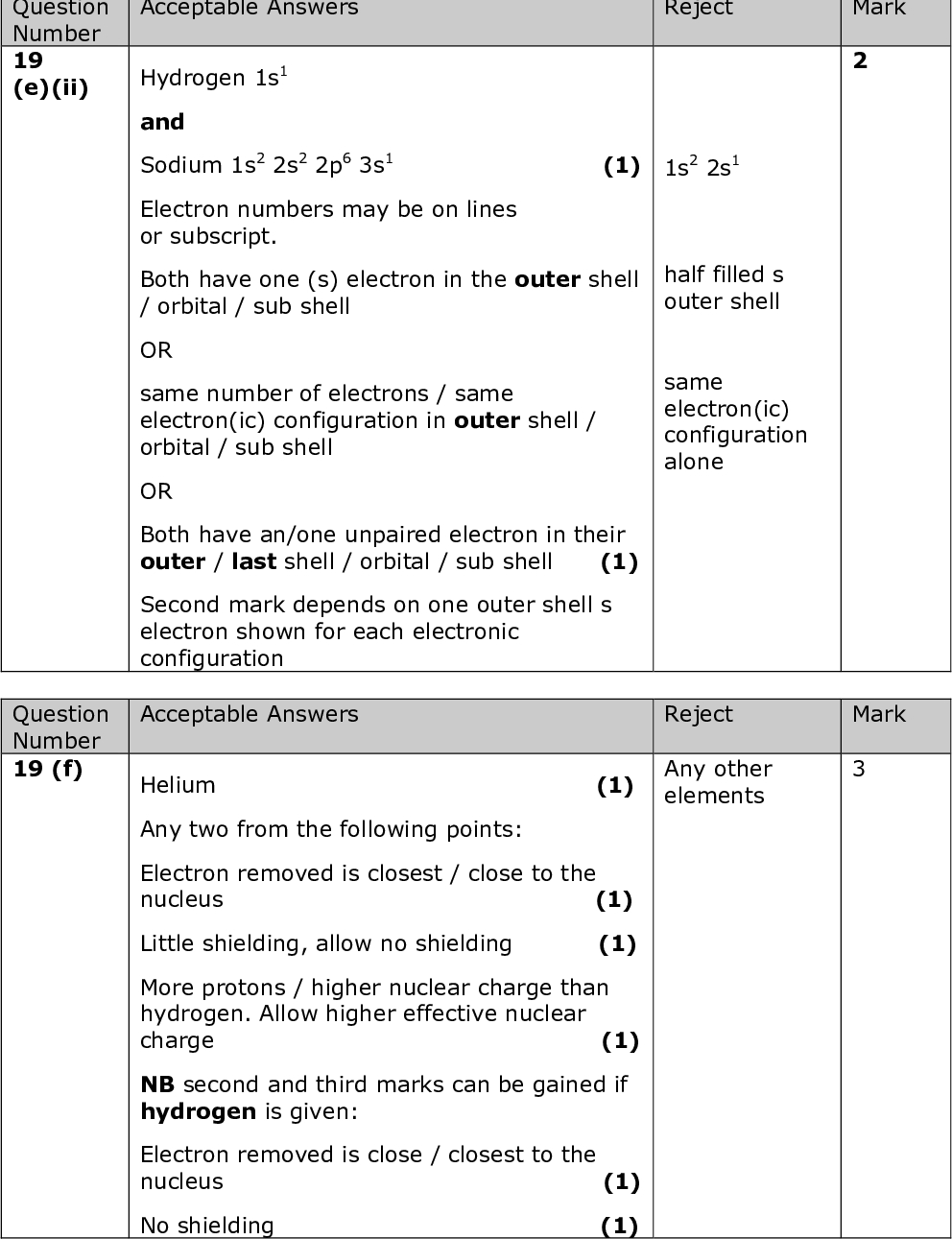
Answers available below
Show answer
Question
17
18
19
20

![19 Hydrogen has three isotopes, 1H, known as protium, 2H, deuterium, and 3H, tritium. (a) In terms of sub-atomic particles, give the similarities and differences between atoms of these three isotopes of hydrogen. (3)(1) (2) (1) (b) When a nitrogen atom collides with a high energy neutron, one atom of tritium and one atom of another element are formed. Complete the equation below. 14 7N + 1 0n o 3 1H +(c) Tritium-deuterium gas, consisting of molecules each containing one deuterium atom and one tritium atom, is used in some nuclear warheads. Typically, each warhead has about 4.0 g of the gas added. (i) Calculate the number of moles of tritium-deuterium in 4.0 g. 16 (ii) Calculate the volume, in cm3, of 4.0 g of tritium-deuterium gas. [Molar volume of a gas under these conditions = 24 000 cm3 mol1] *P41212A01624*<br />
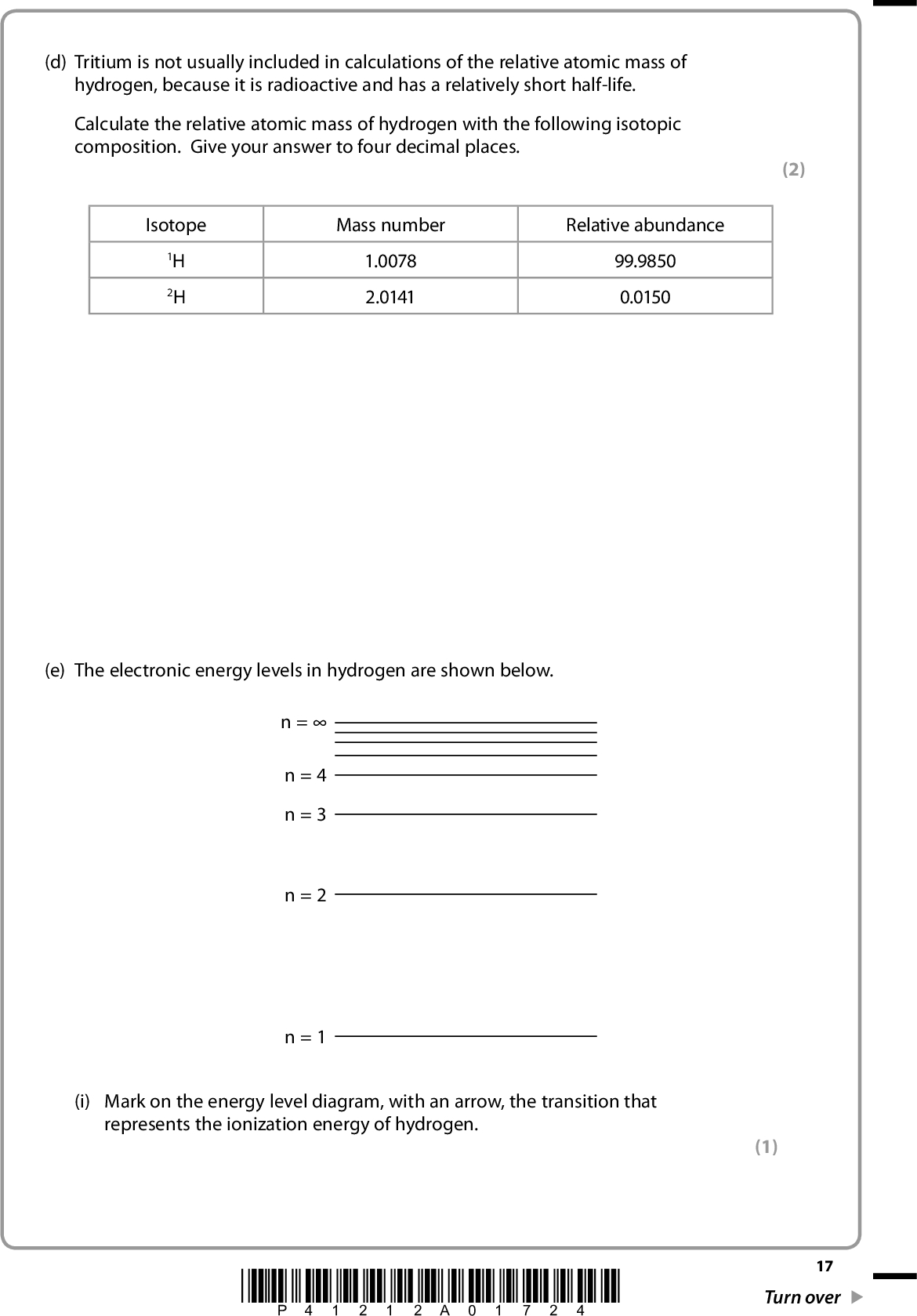
(d) Tritium is not usually included in calculations of the relative atomic mass of hydrogen, because it is radioactive and has a relatively short half-life. Calculate the relative atomic mass of hydrogen with the following isotopic composition. Give your answer to four decimal places. (2) Isotope Mass number Relative abundance 1H 2H 1.0078 2.0141 99.9850 0.0150 (e) The electronic energy levels in hydrogen are shown below. n =n = 4 n = 3 n = 2 n = 1 (i) Mark on the energy level diagram, with an arrow, the transition that represents the ionization energy of hydrogen. (1) *P41212A01724* 17 Turn over<br />
(ii) In some versions of the Periodic Table, hydrogen is placed in the same group as sodium. Give the electronic configurations for both a hydrogen atom and a sodium atom, using the s and p notation. Use these electronic configurations to suggest why this is a reasonable grouping. (2) HNa*(f) Which element in the Periodic Table has the highest first ionization energy? Justify your answer. (3)(Total for Question 19 = 15 marks) 18 *P41212A01824*<br />](https://learnah.org/wp-content/uploads/2018/08/l_smalljpgJanuary_2013_QP_-_Unit_1_Edexcel_Chemistry_A-level_19-0.jpg)