Skip to content
Edexcel Jan 2012 Paper 6 Q1
Answers available below
Show answer
Question
1
2
3
4


![Question Number 1 (a)(i) Question Number 1 (a)(ii) Acceptable Answers A H HCH C O C H H H C H H H C H C O H (1) (1) ALLOW non-displayed alkyl groups, CH3, C2H5 . ALLOW skeletal formulae. A & B wrong way roundscores (1) Acceptable Answers Reject Mark Reject Mark (1) Either B because three (sets of)peaks/ three (proton) environments OR B because of 5:3:3 splitting pattern OR Only the aldehyde has a peak greater than 9 ppm Either A would have only one peak/ one (proton) environment OR A would have singlet ALLOW ECF on carbonyls only (1) 6CH0801 1201<br />
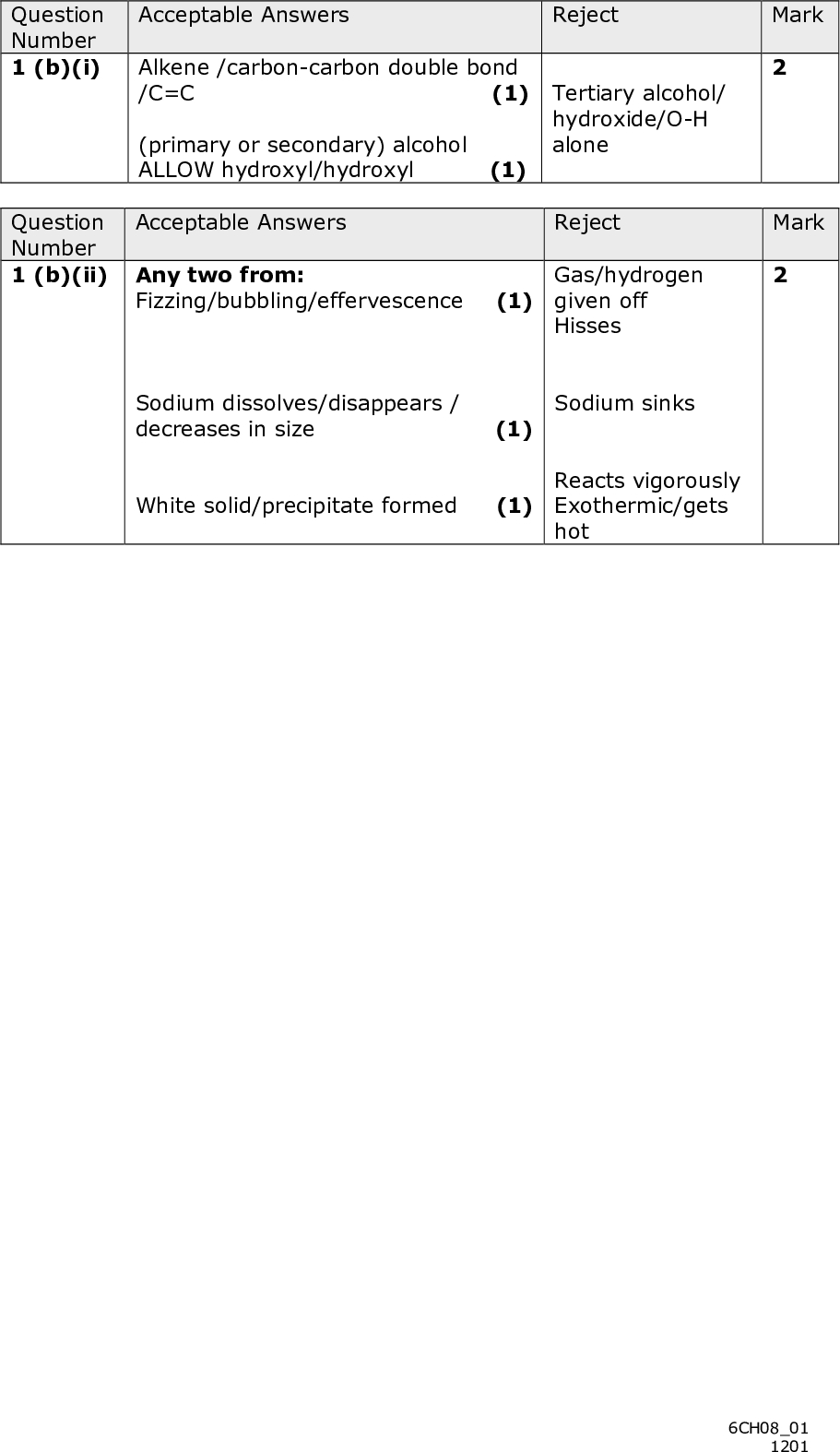
Question Number 1 (b)(i) Acceptable Answers Reject Alkene /carbon-carbon double bond /C=C (primary or secondary) alcohol ALLOW hydroxyl/hydroxyl (1) Tertiary alcohol/ hydroxide/O-H alone (1) Mark Acceptable Answers Question Number 1 (b)(ii) Any two from: Fizzing/bubbling/effervescence (1) Sodium dissolves/disappears / decreases in size White solid/precipitate formed (1) (1) Mark Reject Gas/hydrogen given off Hisses Sodium sinks Reacts vigorously Exothermic/gets hot 6CH0801 1201<br />
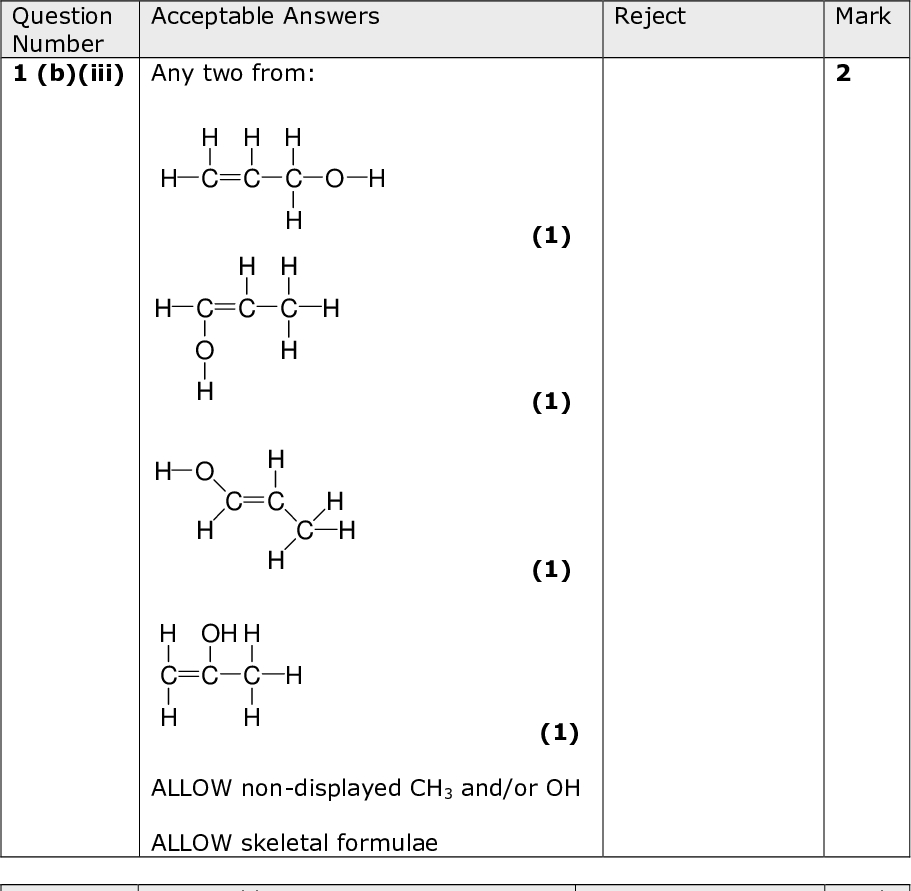
Question Number 1 (b)(iii) Acceptable Answers Any two from: H H H H C C C O H H (1) Reject Mark H H CCC O H H (1) OH H C H HC (1) HOH H C C C H H (1) ALLOW non-displayed CH3 and/or OH ALLOW skeletal formulae Question Number 2 (a) Question Number 2 (b) Question Number 2 (c) Acceptable Answers Reject Mark Iron(II) hydroxide/Fe(OH)2 / Fe(H2O)4(OH)2 / [Fe(H2O)4(OH)2] /Fe(OH)2 (H2O)4 / [Fe(OH)2 (H2O)4] /Fe(OH)2xH2O [Fe(H2O)4(OH)2]2+ [Fe(H2O)6(OH)2] Acceptable Answers Reject Mark Ammonia (gas)/NH3 / NH3(g) Ammonium (gas) NH4 (+) Acceptable Answers Reject Barium sulfate/Barium sulphate / BaSO4 Mark 6CH0801 1201<br />](https://learnah.org/wp-content/uploads/2018/08/January_2012_MS_-_Unit_6_Edexcel_Chemistry_A-level_1-0.jpg)